


Table of Contents
- Why Soft Close Trash Cans for Small Kitchens Are Different
- What to Look for in the Best Trash Cans for Small Spaces
- Small Kitchen Trash Can Size: How to Measure Before You Buy
- Under-Sink Trash Can Options: Fit, Clearance, and Workflow
- What Makes a Soft-Close Kitchen Trash Can Actually Quiet
- Common Mistakes to Avoid When Buying a Small Kitchen Trash Can
- Long-Term Care, Bag Fit, and Keeping Your Soft Close Trash Can Working
- Conclusion
- Frequently Asked Questions
Last Updated: October 14, 2026
Why Soft Close Trash Cans for Small Kitchens Are Different
Soft close trash cans solve a problem that only shows up in tight quarters: the slammed lid.
A soft close trash can is a waste bin fitted with a hydraulic or spring-damped hinge that lowers the lid slowly and quietly instead of letting it drop. The mechanism is simple, but the payoff in a small space is outsized.
Small kitchens force trade-offs between capacity, footprint, and lid mechanics: a wider bin holds more but eats floor space, a taller bin may not clear the counter overhang, and a quiet hinge adds cost.
What to Look for in the Best Trash Cans for Small Spaces
The best trash cans for small spaces prioritize footprint and lid control over raw capacity. Five features decide whether a bin works in a compact kitchen.
- Foot pedal or sensor lid. Hands-free operation keeps your hands off the lid while you're cooking.
- Soft-close hinge. The core feature: a damped hinge lowers the lid without a bang.
- Removable inner bucket. A lift-out liner makes emptying and washing far easier than a fixed tub.
Small Kitchen Trash Can Size: How to Measure Before You Buy
Small kitchen trash can size comes down to three measurements: width, depth, and the height of the opening arc. Measure all three before you buy, capacity in gallons tells you almost nothing about fit.
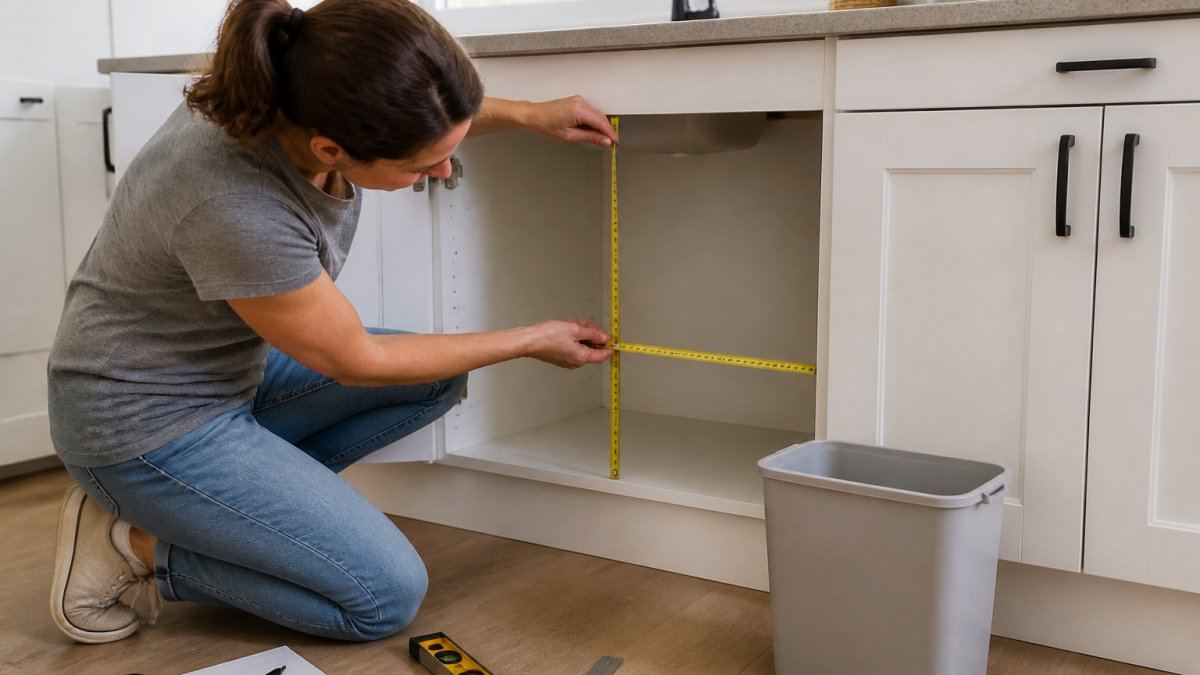
Here's the order we recommend:
- Measure the floor footprint. Width and depth of the spot where the bin will live, with at least an inch of clearance on each side for the pedal and lid swing.
- Measure the height to any obstruction. If the bin goes under a counter, measure from floor to the underside of the countertop.
- Add the lid arc. A soft-close lid still needs room to rise, so add the open-lid height to your clearance check.
- Match capacity to household size. A one- or two-person household rarely needs more than a compact bin; larger households may need to empty more often, the real trade-off of a small footprint.
| Space Available | Recommended Capacity | Best Placement |
|---|---|---|
| Under 12 inches wide | 1.5-3 gallons | Under sink or beside cabinet |
| 12-16 inches wide | 3-5 gallons | End of counter run |
| 16-20 inches wide | 5-8 gallons | Corner or beside fridge |
Under-Sink Trash Can Options: Fit, Clearance, and Workflow
An under-sink trash can works only when the plumbing leaves room for it. The area under most sinks is crowded with a P-trap, a garbage disposal, and supply lines, and those obstacles decide what fits.
A common mistake is buying by capacity and hoping it slides under the sink.
Workflow matters too. A bin that forces you to step away from the counter gets ignored, and scraps pile up instead.
What Makes a Soft-Close Kitchen Trash Can Actually Quiet
A soft-close kitchen trash can stays quiet because a damped hinge controls the lid's descent, not because the lid is heavy.
Two hinge types dominate. Hydraulic hinges use fluid resistance to slow the lid; spring-damped hinges use a spring and a small piston.
The pedal matters as much as the hinge. A stiff pedal makes you stomp, which defeats the purpose.
How to Test Soft-Close Performance Before You Commit
Most reviews describe the lid as "smooth" or "quiet" and stop there. That tells you nothing. Here is a repeatable test you can run in the store, or in the first five minutes after delivery while the return window is still open:
- Full-open drop test. Open the lid all the way and release it. A well-damped lid takes roughly two to four seconds to settle; anything under about one second is barely damped and will bang on an empty bin.
- Half-open drop test. Open the lid to roughly 45 degrees and release. A good hinge still catches it and lowers it gently; a weak hinge lets it fall from that angle.
- Empty-bin test. Run both tests with the bin empty, there's no weight to cushion the fall and no trash to muffle the sound.
- Bounce check. The lid should settle once, not bounce two or three times. Bounce means the damping is undersized for the lid weight.
- Noise check. Listen, don't just watch. A properly damped lid produces a soft tap at most; a hollow clack means the rim is absorbing the impact.
- Repeat test. Open and close the lid ten times. If the closing speed changes noticeably by the tenth cycle, the damping is inconsistent and will degrade faster.
What the Numbers Actually Tell You
A few seconds of closing time is the difference between a bin you forget about and one you notice every meal.
Reliability matters as much as speed. A hinge that closes gently from full-open but drops from half-open is only half-damped, and half-damped is what you'll experience most of the time, because you rarely open the lid all the way just to scrape a plate.
Why Small Kitchens Amplify the Difference
In a large kitchen, the bin sits at the end of a run and the lid sound dissipates across the room. In a small kitchen, the bin is close to the counter, the table, and often a sleeping pet or a home office desk on the other side of a wall. The same hinge that feels fine in a showroom becomes the loudest thing in the room at 6 a.m., so the closing-time and bounce tests matter more here.
Common Mistakes to Avoid When Buying a Small Kitchen Trash Can
The most common mistakes in small-kitchen bin shopping all trace back to buying on looks or capacity alone. Avoid these and you'll skip the returns.
- Ignoring the lid arc. A bin that can't open fully is a daily annoyance.
- Overbuying capacity. A bigger bin in a small kitchen crowds the space you were trying to protect.
- Skipping bag fit. A bin that only takes a specific liner size locks you into ongoing cost and hassle.
Long-Term Care, Bag Fit, and Keeping Your Soft Close Trash Can Working
Maintenance keeps a soft-close hinge working for years. The mechanism is durable but not maintenance-free, and small habits extend its life. The bigger ownership story, though, is what the bin costs you every month after you buy it, and whether you can repair it instead of replacing it.
Bag Fit: The Quiet Recurring Cost
Bag fit is the cost nobody mentions in the spec sheet. A bin that takes standard kitchen liners keeps your ongoing cost low and your sourcing easy. A bin that demands a proprietary liner locks you into a specific brand, size, and price for as long as you own it.
Standard tall kitchen liners are sold in bulk boxes at grocery and warehouse stores. Proprietary liners usually come in smaller counts, often only from the manufacturer or a single retailer.
Before you buy, confirm three things:
- Does the bin take a standard liner size, or a proprietary one? If proprietary, check how many bags come per pack and where they're sold.
- Does the liner stay put? A bag that's too small slips off the rim; one that's too big bunches at the rim and can block the lid from closing fully, which strains the hinge.
- Is there a liner-retaining ring or groove? A retaining ring holds the bag in place so it doesn't slip when you load it, which matters more in a small bin you fill quickly.
Repairability: What Wears Out and What You Can Replace
A soft-close bin has three wear points: the pedal, the pedal linkage, and the hinge. Everything else, the bucket, the body, the lid, usually outlasts them. The question is whether the wear parts are replaceable or whether the whole bin becomes disposable when the pedal gets mushy.
- Pedal and linkage. The pedal spring and the rod connecting the pedal to the lid take the most abuse. If the pedal feels mushy or the lid stops opening fully, the spring or linkage is usually the cause. On bins with replaceable pedal assemblies, this is a cheap fix; on sealed units, it's the end of the bin's useful life.
- Hinge damping. Hydraulic units tend to hold their feel longer; spring units can loosen and drop faster. If the hinge is serviceable, replacing it restores the soft-close feel; if it's sealed into the lid, it isn't.
- Lid and rim. The rim takes the impact every time the lid closes. A cracked or warped rim won't seal, which hurts odor control as well as the closing feel.
Before buying, check whether the manufacturer sells replacement pedals, hinges, or lid assemblies, and whether the warranty covers the mechanism or only the body.
Cleaning and Odor Control That Actually Works
A removable inner bucket is the single biggest maintenance advantage in a small kitchen: you can carry it to the sink and wash it instead of wiping the inside of a fixed tub.
- Wipe the hinge area. Crumbs and grease can gum up the damping action; a damp cloth once a week is enough.
- Rinse the inner bucket. A quick rinse with dish soap, or a wipe with diluted vinegar, handles most everyday odors.
- Don't overload the lid. Forcing a full bag down strains the hinge and can bend the linkage. If the bag won't fit, empty it, don't press it.
Conclusion
Small kitchens punish bad bin choices faster than large ones, because every square inch and every decibel is amplified.
SinkElle builds minimalist, Scandinavian-inspired organization systems for tight sink areas, with waterproof materials and tool-free installation that suit renters and design-minded homeowners alike. If you're ready to make your sink zone work harder, explore the SinkElle collection and organize your kitchen in minutes.
Frequently Asked Questions
What are the best trash cans for small spaces?
The best trash cans for small spaces are slim, rectangular bins that fit tight gaps and hold 8 to 13 gallons. Look for a soft-close lid, a sturdy foot pedal, and a removable inner bucket for easy bag changes. Measure your cabinet opening and floor space before buying, since a bin that is even an inch too wide will not fit under a counter or beside a stove.
What is a good size trash can for a small kitchen?
For most small kitchens, a 10 to 13 gallon bin works well for a one or two person household. If you cook often or have limited floor space, an 8 gallon model can be enough. A small kitchen trash can size that is too large wastes space and leads to odor buildup, while one that is too small means frequent bag changes and more trips outside.
How do I measure a space for a kitchen trash can?
Measure the width, depth, and height of the spot where the bin will sit, then subtract at least one inch from each number for lid clearance and airflow. For under-sink placement, measure around the plumbing and garbage disposal. Write down the opening height for the lid, since a soft-close lid needs room to swing up without hitting the counter or cabinet frame.
Are soft-close trash cans worth it for a small kitchen?
In a small kitchen, a soft-close lid reduces noise and prevents the loud slam that echoes in tight spaces. The hinge also protects the lid from cracking over time. If you cook early in the morning or late at night, a soft-close kitchen trash can is worth the extra cost for the quieter operation alone.