


Last Updated: October 25, 2026
Quick Summary
Workstation sinks home chefs rely on consolidate washing, rinsing, straining, and drying into one compact zone with integrated ledges and accessories, cutting unnecessary movement and keeping your countertop clear. They deliver the most value for frequent cooks who prep multiple ingredients at once, especially in kitchens with limited counter space.
- Workstation sinks cost more than standard sinks due to ledges and included accessories, with replacement pieces sold separately ranging from $17.99 to $61.99.
- A workstation sink is less valuable if you hand-wash dishes constantly, have very small sink footprints, or prefer a completely open basin.
- The Sinkelle ExtendDry Retractable Sink Rack ($24.99) and HookNest Kitchen Sponge Holder ($29.99) are foundational accessories for most setups.
- Measure your sink basin width, depth, faucet clearance, and drain placement before buying to ensure accessories will fit and function properly.
- Start with one or two core accessories and expand based on your cooking needs, since most SinkElle products install without tools.
Table of Contents
- What Makes a Workstation Sink Different from a Regular Sink
- How Workstation Sinks Transform Your Food Preparation Workflow
- Essential Workstation Sink Accessories and What They Do
- Workstation Sink Pros and Cons: The Complete Picture
- How to Choose a Workstation Sink That Fits Your Space and Cooking Style
- Sanitation and Maintenance in a Workstation Setup
- Building Your Workstation Sink System with the Right Tools
- Frequently Asked Questions
What Makes a Workstation Sink Different from a Regular Sink
A workstation sink is a specialized kitchen sink with integrated ledges and accessories that turn the basin into a functional prep station, keeping food preparation, cleaning, and organization in one efficient zone.
The key difference is the ledge system: a flat rim above the basin creates a platform for cutting boards, colanders, and drying racks, keeping prep work over the sink where water and debris drain away.
At SinkElle, we've designed accessories to maximize this ledge concept. The Sinkelle ExtendDry Retractable Sink Rack extends across your basin, creating a drying surface over the drain; water flows through the ventilated structure instead of pooling.

The ergonomic advantage matters too: with everything within arm's reach, you cut unnecessary movement, prep time, and countertop mess.
How Workstation Sinks Transform Your Food Preparation Workflow
A workstation sink consolidates washing, rinsing, straining, and drying into one compact zone, so you stay in one place instead of moving between sink, cutting board, and countertop. Learn how to set up a simple meal prep station in a small kitchen with practical layout tips and equipment guidance.
Washing and Rinsing Produce
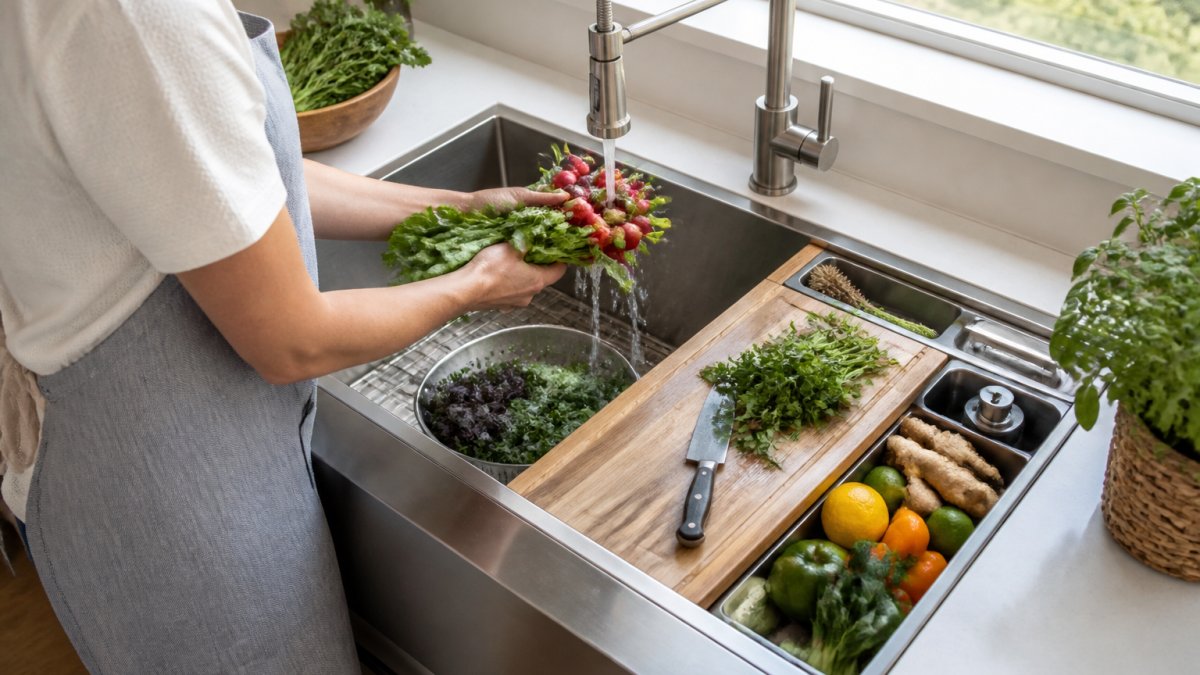
The ledge provides a stable surface for a colander or strainer, so you can rinse produce directly over the basin without splashing your countertop, and the ventilated design drains water immediately.
A dedicated rinsing zone reduces back-and-forth movement: wash, rinse, and drain in one motion, then move straight to cutting or cooking.
Organizing Cookware and Dirty Dishes
A workstation sink keeps mixing bowls, sheet pans, and dirty dishes contained while you work, and the ledge accommodates larger cookware that doesn't fit in a standard basin.
Keeping dirty dishes visible and contained over the sink stops them piling up on the countertop, so your prep area stays cleaner throughout your cooking session.
Essential Workstation Sink Accessories and What They Do
Building a workstation sink system means choosing accessories that match your workflow, turning a basic washing station into a fully integrated prep center.
Learn how to choose the right kitchen sink storage accessories. You can also explore luxury kitchen sink organization systems to see how high-end setups maximize both function and aesthetics.
The most useful accessories fall into a few categories: drying racks, cutting boards, colanders, and organizers for cleaning supplies. A drying rack like the Sinkelle ExtendDry Retractable Sink Rack ($24.99) handles multiple tasks, and its retractable design adjusts to different sink sizes and retracts for full basin access.
For organizing cleaning essentials, the Sinkelle HookNest Kitchen Sponge Holder ($29.99) keeps sponges, scrubbers, and dish cloths in one spot, preventing clutter around the faucet and keeping cleanup tools easy to grab during food prep.

| Accessory | Primary Function | Best For | Price |
|---|---|---|---|
| Retractable Sink Rack | Dish drying, produce rinsing | Multi-purpose prep | $24.99 |
| Sponge Holder | Cleaning supply organization | Keeping essentials accessible | $29.99 |
| FlowRack Pro Caddy | Drainage + storage | Drying sponges without odor | $39.99 |
| DryFlow Splash Mat | Water containment | Protecting countertops | $19.99 |
Workstation Sink Pros and Cons: The Complete Picture
Workstation sinks home chefs rely on offer real benefits, but they are not right for every kitchen, it comes down to how you cook, how much counter space you have, and how much dishwashing you do.
When a Workstation Sink Makes Sense
A workstation sink delivers the most value if you cook frequently and prep multiple ingredients at once.
Home chefs who prepare meals several times a week find the efficiency gain justifies the investment: one prep zone means no constant wiping down countertops or relocating bowls and utensils.
The sanitation benefit matters too: containing food prep and dirty dishes in one area reduces cross-contamination risks, and water and debris stay over the sink instead of spreading across your counter.
Specific cooking styles benefit in different ways:
- Batch cooking and meal prep: A large basin with a colander and cutting board on the ledge lets you wash, chop, and portion several ingredients without resetting your workspace between each one.
- Baking: A workstation sink gives you a contained spot to scrape bowls, rinse dough-covered utensils, and dry sheet pans without coating your counter in flour and water.
- Cooking for a crowd: The ledge holds mixing bowls and sheet pans that will not fit in a standard basin, keeping them off the counter while you work.
When It Might Not Be the Right Fit
A workstation sink is less valuable if you have ample counter space or rarely cook at home; if you use your countertop as your primary prep zone, the ledge system may feel unnecessary.
The initial setup requires choosing accessories and learning a new workflow; if you cook occasionally or prefer a minimalist kitchen, the organizational overhead might not pay off.
Specific limitations to weigh before buying:
Sinkelle ExtendDry Retractable Sink Rack →
- Small kitchens: A workstation sink needs enough clearance for accessories to sit on the ledge and still let you reach the basin. In a very tight footprint, the ledges can reduce usable basin width and make large pots harder to maneuver.
- Frequent dishwashing: If you wash dishes by hand several times a day, the ledge accessories can get in the way of a clear basin. You will find yourself removing the cutting board or rack to fit stockpots and baking sheets.
- Limited accessory storage: Accessories that are not in use still need a home. If you lack cabinet or drawer space, the cutting boards, colanders, and racks can become counter clutter.
The Cost Side of the Equation
Workstation sinks usually cost more than a comparable standard sink because the ledges and included accessories add material and complexity. Replacement accessories are sold separately and vary widely in price, so factor in what you will actually use rather than buying a full set upfront. Maintenance is low for stainless steel and silicone, but expect to replace worn cutting boards and racks over time; if you would buy a drying rack and cutting board anyway, the bundled setup can be cost-effective.
A Quick Decision Checklist
Use these questions to decide whether a workstation sink fits your household:
- Do you prep multiple ingredients at once at least a few times a week?
- Is your counter space limited enough that moving prep over the sink would help?
- Do you have a place to store accessories when they are not on the ledge?
- Is your sink wide enough that accessories will not block access to the basin?
- Are you comfortable removing accessories when you need to wash large cookware?
If you answered yes to most of these, a workstation sink is likely a good fit. If several answers are no, a standard sink with a few freestanding accessories may serve you better.
How to Choose a Workstation Sink That Fits Your Space and Cooking Style
Start by measuring your sink basin and the space around it, width, depth, and distance from the faucet to the back wall, since these dimensions determine which accessories will actually fit.
Compatibility and Measurement Checklist
Before you buy, work through these checks. They are the difference between a workstation sink that feels integrated and one that fights your kitchen every day.
- Cabinet width: Measure the interior width of the base cabinet where the sink will sit. The sink's outer rim must fit with clearance for the cabinet walls and any mounting hardware. A sink that is too wide for the cabinet will not install without modifying the cabinet.
- Sink dimensions: Record the exterior length, width, and depth, plus the interior basin dimensions. Accessories sit on the ledge, so the interior width determines how much usable prep surface you actually get.
- Faucet clearance: Check the height and reach of your faucet relative to the sink ledge and any accessories. A tall cutting board or drying rack can block a low faucet spout, and a short faucet may not reach the back of a deep basin.
Match the Sink to Your Cooking Style
Consider your cooking frequency and meal prep style. If you batch-cook or prepare elaborate meals, prioritize volume-handling accessories, larger drying racks and multiple organizational zones.
If counter space is tight, focus on vertical organization and accessories that use the sink ledge efficiently. The Sinkelle FlowRack Pro Caddy ($39.99) is designed for compact spaces; it sits on the counter next to your sink with suction-cup feet that require no drilling, making it ideal for renters or temporary setups.

Material compatibility matters as well. Stainless steel accessories resist corrosion and integrate seamlessly with most modern kitchens. If your sink is stainless steel, matching materials creates a cohesive, intentional look rather than a cluttered appearance.
Plan for Accessory Storage
Before committing to a full accessory set, decide where the pieces will live when not on the ledge. If storage is tight, choose a smaller core set, a retractable rack and a sponge holder, and add pieces only as you need them.
Factor In Total Cost of Ownership
The purchase price is only part of the cost. Add up the sink itself, installation (which may require cabinet modification or new plumbing), and any accessories you will buy separately. Check that replacements are available and reasonably priced; the best value comes from a sink whose included accessories you will actually use every week, not from the largest accessory bundle.
Sanitation and Maintenance in a Workstation Setup
Keeping a workstation sink clean requires a straightforward routine. The Daily Kitchen Sink Sanitizing Routine provides step-by-step guidance for maintaining a hygienic prep zone.
The key is managing water flow and drainage.
Cleaning the accessories themselves is simple: most stainless steel racks and organizers wipe clean with a damp cloth, and the waterproof silicone of the Sinkelle DryFlow Splash Mat ($19.99) is flexible and easy to rinse.
Building Your Workstation Sink System with the Right Tools
Start with one or two core accessories and expand based on your needs. Most workstation sinks home chefs use benefit from a drying rack and a cleaning supply organizer as foundational pieces.
The Sinkelle DryFlow Dish Rack ($61.99) offers a comprehensive solution for a dedicated drying station: its adjustable design accommodates different dish volumes, and the auto-draining system prevents water from pooling.
Layer in secondary accessories as your workflow develops. The Sinkelle AquaShield Faucet Guard ($17.99) prevents splashes and keeps your countertop dry, a small addition that makes a noticeable difference. Building your workstation with the right tools helps you complete your setup with professional-grade organization.
The beauty of a modular system is flexibility: start minimal and add accessories as your cooking routine evolves.
Workstation sinks aren't essential for every kitchen, but they solve real problems for home chefs who cook frequently and value efficiency. Get started with the Sinkelle ExtendDry Retractable Sink Rack and transform your food preparation workflow today.
Frequently Asked Questions
What is a workstation sink, and how is it different from a regular kitchen sink?
A workstation sink is a large, single-basin sink with an integrated ledge or rim around the perimeter. Unlike a regular sink, the ledge holds accessories like cutting boards, colanders, and drying racks directly over the basin. This design creates a dedicated prep zone where you can wash, chop, strain, and dry food without moving between countertops. The open design prevents water from pooling around your work area.
Are workstation sinks worth the investment for home chefs?
Workstation sinks are worth it if you cook frequently and have limited counter space. They consolidate multiple tasks into one compact zone, reduce clutter, and keep your workflow efficient. However, they require more counter clearance than standard sinks and aren't essential for casual cooks or kitchens with ample prep space. Consider your cooking frequency, kitchen layout, and budget before deciding.
What workstation sink accessories are most useful?
The most practical accessories are retractable drying racks, cutting boards, and colanders. A drying rack like the Sinkelle ExtendDry ($24.99) lets you drain dishes directly over the sink, saving counter space. Cutting boards fit the ledge for prep work, and colanders strain pasta or vegetables without needing a separate bowl. Sponge holders and splash guards keep the area organized and hygienic.
How do I know if a workstation sink will fit my kitchen?
Measure your sink's width, depth, and the clearance between the sink rim and your faucet or backsplash. Workstation sinks typically need 24-36 inches of width and at least 8-10 inches of clearance above the basin for accessories. Check whether your plumbing allows for a larger basin, and confirm your countertop can support the weight. If you have a garbage disposal or complex plumbing angles, verify the sink's design accommodates those before purchasing.
