


Table of Contents
- Under Sink Storage vs Cabinet Organizers: Which Solves Your Plumbing Problem
- How to Measure Under Sink Space Before You Buy
- Plumbing Obstructions That Block Storage
- Pull-Out Organizers vs Stationary Shelving for Tight Plumbing
- Common Under Sink Storage Mistakes to Avoid
- Minimalist Kitchen Sink Organization Ideas That Actually Work
- Weight Capacity and Load-Bearing for Under-Sink Organizers
- DIY vs Pre-Made Organizers: Cost and Installation Trade-Offs
- Frequently Asked Questions
Last Updated: September 1, 2026
Under Sink Storage vs Cabinet Organizers: Which Solves Your Plumbing Problem
Your kitchen sink area is prime real estate, but it's also where plumbing complications often render storage impossible. The difference between under sink storage and cabinet organizers isn't just about aesthetics or price, it's about whether a solution actually fits your plumbing layout. Many homeowners discover this the hard way after purchasing an organizer that won't accommodate their drain pipes, P-traps, or shutoff valves.
Under sink storage refers to organizers specifically designed to work around plumbing obstructions, while cabinet organizers are general-purpose shelving that assumes open space. The distinction matters because plumbing-aware designs account for clearance, weight distribution, and moisture exposure in ways generic organizers simply don't.
At SinkElle, we understand the challenges of organizing around plumbing. Our approach focuses on providing solutions that integrate seamlessly with your kitchen's existing layout. The reality is that most storage failures happen because people buy first and measure plumbing second, the opposite of what actually works.
Below, we'll show you exactly how to assess your under sink space, identify which storage type matches your plumbing reality, and avoid the common mistakes that waste money and create clutter instead of solving it.
How to Measure Under Sink Space Before You Buy
Measuring under sink space correctly requires accounting for more than just width and depth. You need to map where your plumbing actually sits, not just the empty spaces around it.
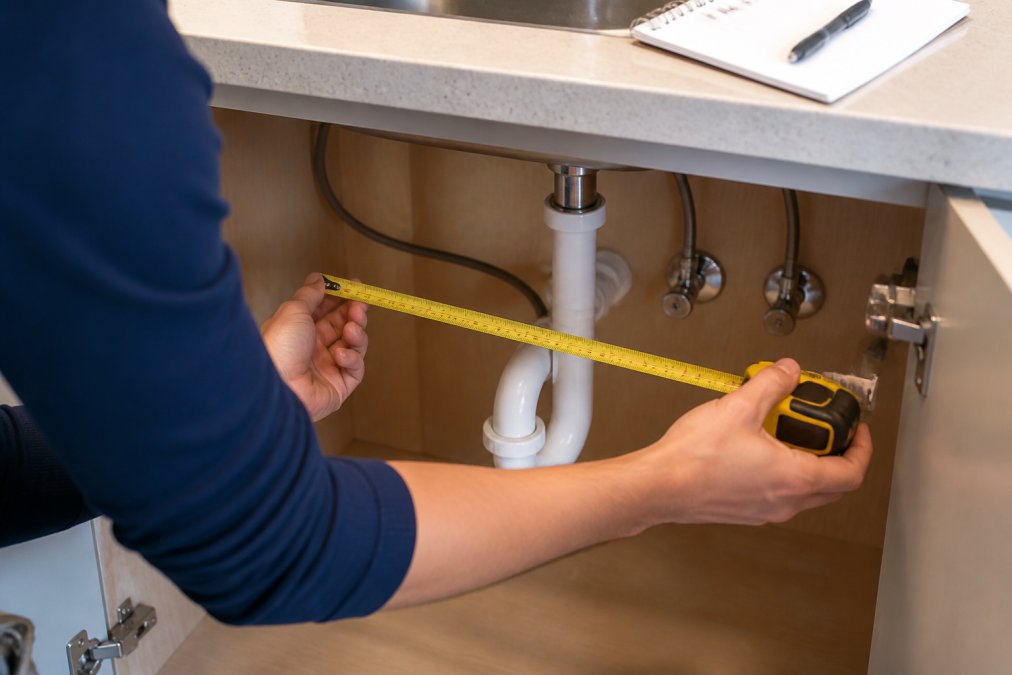
Start by measuring the cabinet's interior dimensions: width, depth, and height from the bottom of the cabinet to the underside of the countertop. Write these down. But here's where most people stop, and where mistakes begin. The actual usable space is significantly smaller once plumbing enters the equation.
Account for Drain Pipes and P-Traps
The drain pipe is your primary obstacle. It runs from your sink basin down through the cabinet floor, and the P-trap (the U-shaped section) takes up considerable space directly below the drain opening. Measure from the center of the drain opening down to where the P-trap bends, then measure the horizontal distance the trap extends into the cabinet. Most P-traps occupy a footprint roughly 4-6 inches wide and 8-10 inches deep (peer-reviewed research).
Place your organizer away from this zone entirely. A pull-out drawer that slides over a P-trap will catch on the plumbing every time you try to access it. Stationary shelving above the P-trap works better because gravity keeps items in place, but you'll lose that shelf space for anything taller than 6-8 inches.
Check Shutoff Valves and Water Lines
Under your sink, you'll find shutoff valves, one for hot water, one for cold. These are typically located on the wall or cabinet back, 12-18 inches above the cabinet floor (the CDC). Measure their exact position. An organizer that blocks access to shutoff valves creates a genuine emergency problem if you ever need to cut water supply quickly.
Water lines run from these valves to your faucet. They're flexible but they do take up space, and they can leak. Never place a rigid shelf directly against water lines. Leave at least 1-2 inches of clearance around them. If you're using a pull-out organizer, make sure the drawer slides smoothly without bending or pinching any lines.
Plumbing Obstructions That Block Storage
Beyond the standard drain and P-trap, some kitchens have additional complications that dramatically reduce usable storage space.
Garbage disposals add significant bulk directly under the drain opening. The disposal unit itself occupies 6-10 inches of vertical space and extends 4-6 inches into the cabinet. This eliminates most of the prime real estate directly below the sink. Your storage solution must work around the disposal entirely, either positioned to the side or elevated above it.
Angled or corner cabinets present another common challenge. If your sink sits in a corner cabinet, the plumbing often angles awkwardly, and the cabinet's interior shape doesn't match standard rectangular organizers. Corner cabinets typically require custom-fit solutions or rolling carts that can be positioned flexibly.
Double-bowl sinks have two drain lines, which means two P-traps taking up space. This cuts your usable footprint nearly in half compared to single-bowl setups. If your kitchen has a double-bowl sink, expect to use only the outer edges of the cabinet for storage.
Dishwashers installed adjacent to the sink sometimes share plumbing infrastructure. Check whether your dishwasher drain line runs through the under-sink cabinet. If it does, that space is off-limits for storage.
Pull-Out Organizers vs Stationary Shelving for Tight Plumbing
Pull-out organizers (also called sliding drawers or pull-out shelves) and stationary shelving each solve different plumbing problems.
Pull-out organizers work best when your plumbing is confined to one specific zone, typically directly under the drain. By positioning the drawer to the side, you gain easy access to items without having to reach around pipes. The sliding mechanism lets you extract the entire drawer, so you can grab items from the back without disturbing everything in front. For kitchens with standard, centered plumbing, pull-out organizers are often the better choice.
The Sinkelle 2 SlideNest Organizer exemplifies this approach. Its dual pull-out tiers slide smoothly, allowing you to access cleaning supplies or cabinet essentials without contorting your arm around plumbing. The metal frame is durable enough to hold weight without sagging, and the smooth drawer glides handle repeated use without jamming.

Stationary shelving works better when plumbing is scattered or when you have limited horizontal space. A fixed shelf positioned above the P-trap gives you vertical storage without the mechanical complexity of sliding drawers. Stationary shelves are also simpler to install and less likely to malfunction. The trade-off is reduced accessibility, you're reaching into a static space, which can be awkward if items end up toward the back.
The real difference emerges with awkward plumbing. If your P-trap extends far into the cabinet or your shutoff valves are positioned centrally, a pull-out system might not fit at all. In those cases, stacked stationary shelving or a rolling cart becomes your only viable option.
Common Under Sink Storage Mistakes to Avoid
The most frequent error is buying an organizer before measuring plumbing. People see a product online, assume it will fit, purchase it, and then discover it won't slide because of a P-trap or sits too low because of a disposal. By then, the return window is closing.
Overloading shelves is another common mistake. Under-sink cabinets are damp environments. Water condensation from pipes, minor leaks, and humidity create moisture that weakens structural integrity over time. A shelf rated for 30 pounds might sag or collapse if you load it with 50 pounds of cleaning products. Check weight capacity before filling your organizer.
Storing hazardous materials directly on shelving without containment is dangerous. Cleaning chemicals, bleach, and drain cleaners can leak or spill. If you're storing these items under the sink, use sealed containers and place them on a tray that catches spills. This protects both your cabinet and the plumbing below.
Ignoring moisture is perhaps the most costly mistake. Many organizers marketed as "waterproof" are actually just water-resistant. They'll survive occasional splashes but not sustained moisture. Over months, water resistance degrades. Materials warp, rust forms, and mold grows. SinkElle's products use genuinely waterproof materials because the under-sink environment demands it. Cheaper organizers often fail within a year in this exact setting.
Minimalist Kitchen Sink Organization Ideas That Actually Work
Minimalist organization under the sink means using vertical space efficiently while keeping the visual footprint small. This approach reduces clutter while maintaining accessibility.
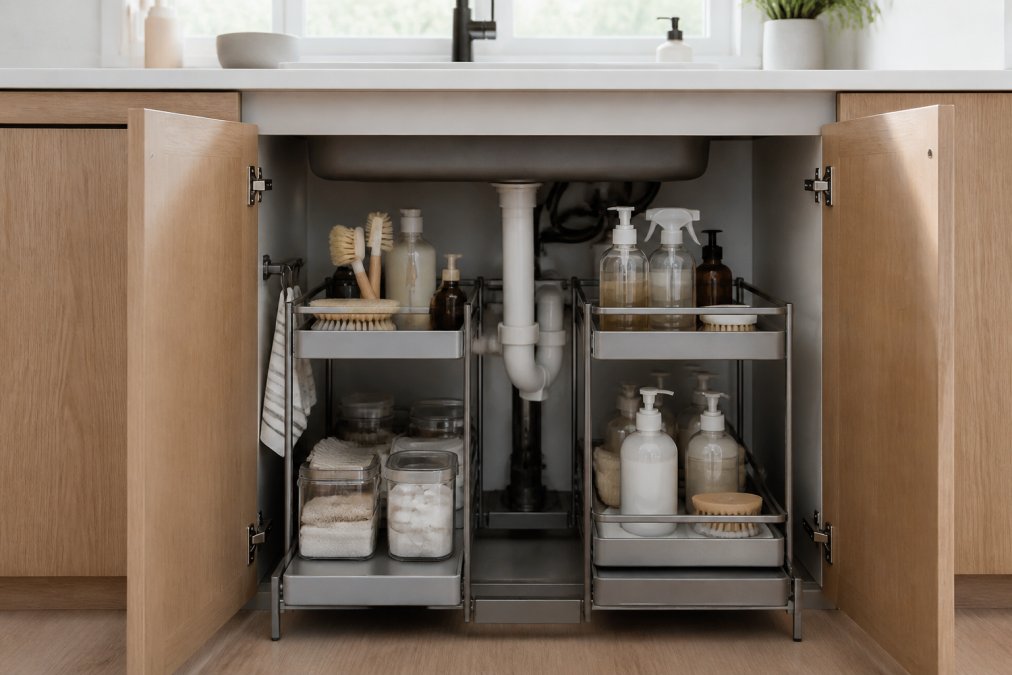
Start by categorizing what actually belongs under the sink. Cleaning supplies, yes. Dish soap and sponges, yes. But paper towels, trash bags, and miscellaneous items? Those should live elsewhere. Under-sink space is expensive because it's damp and difficult to access. Reserve it for items you use frequently and items that genuinely belong near water.
Use clear, stackable containers for cleaning products. This serves two purposes: it maximizes vertical space, and it lets you see what you have without removing everything. Label containers clearly. A minimalist aesthetic doesn't mean unmarked mystery boxes, it means organized, visible systems.
Tension rods are underrated. Stretched horizontally across the cabinet, they let you hang spray bottles or cloths, freeing shelf space below. This vertical approach keeps the cabinet from feeling packed.
The Sinkelle CabinetFlow Hanging Organizer applies this principle by using the space beneath the cabinet itself. By hanging storage under the cabinet rather than inside it, you free up the under-sink area entirely for items that must be there. Paper towels, cleaning cloths, and cutting boards hang out of the way, visible but not cluttering the cabinet.

Moisture management is part of minimalist organization. Place a thin waterproof mat on the cabinet bottom. This protects the cabinet from minor leaks and condensation while creating a clean visual base. Wipe down the interior monthly to prevent mold buildup.
Weight Capacity and Load-Bearing for Under-Sink Organizers
Weight capacity is often overlooked until a shelf collapses mid-use. Understanding load-bearing limits prevents damage to your cabinet, plumbing, and the organizer itself.
Most under-sink cabinets have a structural limit of 50-75 pounds total, distributed across all shelves (peer-reviewed research). This sounds like plenty until you consider what you're actually storing. A gallon of cleaning solution weighs 8 pounds. Five gallons of various cleaners, plus bottles of drain cleaner and degreasers, quickly reaches 40-50 pounds.
Metal-frame organizers like the Sinkelle 2 SlideNest handle this better than plastic alternatives because metal distributes weight more evenly and resists sagging. The frame sits directly on the cabinet floor, transferring weight down rather than concentrating it on shelf supports.
Check your organizer's weight capacity rating before purchasing. If it claims 25 pounds per shelf but you need to store 40 pounds, it will fail. Real-world testing shows that some organizers may sag or collapse well below stated limits.
Distribution matters as much as total weight. A shelf rated for 30 pounds performs better if that weight is spread across the entire surface rather than concentrated on one side. When loading your organizer, place heavier items toward the center and distribute weight evenly front to back.
Consider the cabinet floor itself. Older cabinets sometimes have particle board bottoms that don't support weight well. If your cabinet floor feels soft or flexes, place a sturdy base board under your organizer to distribute weight across a larger area.
DIY vs Pre-Made Organizers: Cost and Installation Trade-Offs
The DIY approach, building custom shelving from wood or metal, offers flexibility but demands time, skill, and tools. Pre-made organizers are faster but limit customization.
DIY shelving costs between $30-80 in materials if you already own basic tools. You can cut shelves to exact dimensions, position them around your specific plumbing, and build to your exact weight requirements. The drawback is installation. If you've never worked with plumbing-adjacent spaces, you risk damaging water lines or drain pipes. Professional installation adds to the cost, which can erase the savings advantage.
DIY solutions also require ongoing maintenance. Wood absorbs moisture and eventually warps or rots. Metal rusts without proper coating. Many DIYers discover their custom shelving deteriorates within 18-24 months in the high-moisture under-sink environment.
Pre-made organizers like SinkElle's offerings eliminate these risks. The Sinkelle 2 SlideNest Organizer costs $55.99 and installs in minutes without tools. It's engineered for moisture resistance and plumbing compatibility. You sacrifice some customization, but you gain reliability and durability.
For renters, pre-made organizers are the only viable option. Most rental agreements prohibit permanent modifications to cabinets. Pre-made systems are temporary, removable, and leave no damage. SinkElle's tool-free installation philosophy directly addresses this constraint, you can organize your space without risking your security deposit.
The real cost comparison isn't just purchase price. It's purchase price plus installation time plus replacement frequency. A $30 DIY shelf that fails in two years and requires rebuilding costs more over time than a $55 pre-made organizer that lasts five years without maintenance.
For small apartments with limited counter space, the efficiency gain from a pre-made system justifies the cost. You're not just buying storage; you're reclaiming functional kitchen real estate that would otherwise sit empty or cluttered.
Organizing your under-sink area starts with understanding your plumbing, not with buying the first organizer you find. Most storage failures happen because people skip the measurement step and discover their purchase doesn't fit. SinkElle's minimalist, waterproof organizers are engineered specifically for this environment, with tool-free installation that works in rental apartments and permanent homes alike. Measure your plumbing first, choose a solution designed for your specific layout, and you'll transform wasted space into functional storage that actually stays organized.
Frequently Asked Questions
What are the most common under sink storage mistakes to avoid?
The biggest mistakes are ignoring plumbing obstructions, overloading shelves beyond weight capacity, and choosing rigid organizers that don't fit around drain pipes and P-traps. Moisture-sensitive materials warp quickly in under-sink environments. Avoid stacking items directly on cabinet floors where water can pool. Instead, use elevated organizers with drainage gaps, like the Sinkelle 2 SlideNest, and keep cleaning supplies in waterproof containers to prevent spills and mold.
How do I measure under sink space accurately for an organizer?
Measure the cabinet width, depth, and height with the cabinet doors closed. Account for the drain pipe and P-trap by measuring from the back wall to where pipes begin. Check shutoff valve locations and water line routes. Measure the floor space available after accounting for the sink basin. Document any angled corners or irregular shapes. Bring these measurements when selecting organizers to ensure proper fit and avoid purchasing solutions that won't accommodate your plumbing layout.
Are pull-out organizers better than stationary shelves for plumbing-heavy cabinets?
Pull-out organizers like the Sinkelle 2 SlideNest work well in tight plumbing situations because they provide accessibility without requiring you to reach behind pipes. Sliding drawers let you access items at the front without disturbing plumbing behind. Stationary shelving takes up less space but requires more careful item placement around obstructions. For cabinets with complex plumbing, pull-out systems can reduce the risk of hitting pipes and offer better space optimization.
What weight can under-sink organizers safely hold?
Most quality under-sink organizers support 15-25 pounds per shelf, depending on construction material. Metal organizers typically handle more weight than plastic. Never exceed manufacturer specifications, as overloading can damage the cabinet or organizer structure. Distribute weight evenly across shelves and avoid concentrating heavy items in one area. Store heavier cleaning supplies on lower shelves and lighter items above. Check product documentation for specific weight limits before loading.
This article was written using GrandRanker