


Table of Contents
- Why Sink Organizer Size Matters More Than You Think
- Step 1: Measure Your Under Sink Storage Dimensions
- Step 2: Match Organizer Size to Sink Basin and Cabinet Type
- How to Organize Under Kitchen Sink with Plumbing: A Size Guide
- Step 3: Evaluate Weight Capacity and Material Durability
- Best Kitchen Sink Organizers 2026: A Quick Comparison
- Common Sizing Mistakes and How to Avoid Them
- Conclusion: Your Fit Checklist Before You Buy
- Frequently Asked Questions
Last Updated: September 5, 2026
Why Sink Organizer Size Matters More Than You Think
Choosing the right kitchen sink organizer size is the single biggest factor between a cabinet that stays tidy and one that becomes a black hole of sponges, bottles, and tangled scrub brushes. Most people buy a visually appealing organizer first and then discover it doesn't fit, leaving them with wasted money and the same clutter. The real challenge isn't finding a bin; it's understanding the physical constraints of the space beneath your sink before you spend a cent.
Cabinet dimensions vary wildly. A universal "one size fits all" product rarely works because plumbing configurations and basin depths create unique obstacles. Getting the sink organizer size right requires a simple measurement process that takes about ten minutes and prevents a frustrating return cycle. Below, we'll walk you through the exact steps to measure, map your plumbing, and match an organizer to your basin type, ensuring your purchase fits the first time.
Step 1: Measure Your Under Sink Storage Dimensions
The most accurate way to determine the correct sink organizer size is to measure the cabinet's interior dimensions, which are often several inches smaller than the exterior cabinet width. Standard base cabinet width is typically 36 inches, but the interior opening can be closer to 33 or 34 inches due to the thickness of the cabinet walls and the door frame (homedepot.com). You need the interior height, depth, and width to ensure the organizer fits without blocking the door hinges or interfering with the sink basin that drops down into the space.
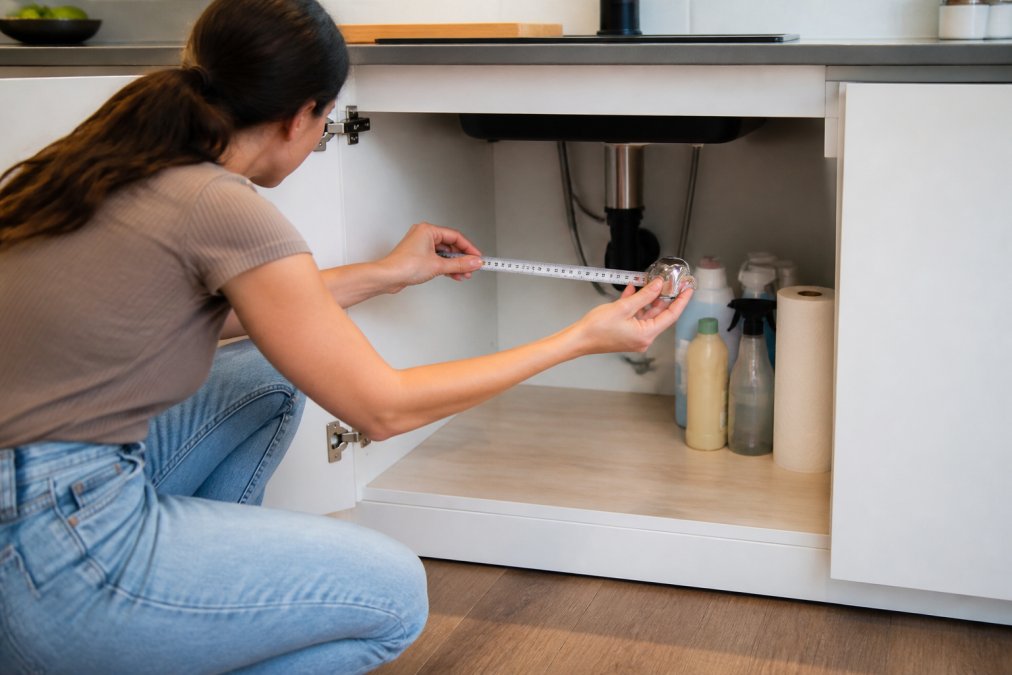
Cabinet Width, Depth, and Interior Height
Start by measuring the interior width from the inside edge of one cabinet wall to the other. Next, measure the depth from the front frame to the back wall, noting that the P-trap and drain pipes will reduce the usable depth in the center. Finally, measure the interior height from the cabinet floor to the underside of the sink basin, as the basin often protrudes downward and takes up critical vertical space.
Subtract a few inches from each measurement to create a buffer. This clearance is essential for sliding the organizer in and out without scraping the cabinet walls or catching on the plumbing. For example, if your interior width is 33 inches, look for a unit that is 30 inches or less to leave room for the cabinet door hinges and any slight misalignment.
Mapping Plumbing Obstructions
A critical step in choosing the right kitchen sink organizer size is mapping the plumbing obstructions that consume the center of the cabinet. The drain pipe and P-trap typically occupy a vertical zone that you cannot use, turning the usable space into an L-shape or two separate side zones. Trace the path of the drain pipe from the sink basin down to the wall, and note the highest point of the P-trap, as this determines the maximum height of any organizer that slides underneath it.
Measure the clearance from the cabinet floor to the bottom of the P-trap. This measurement tells you whether a low-profile sliding tray will fit beneath the plumbing or if you need organizers that sit on either side of the central obstruction. In many cases, the best sink organizer size is actually two smaller units placed on the left and right sides of the P-trap, rather than one large unit that tries to straddle it.
Step 2: Match Organizer Size to Sink Basin and Cabinet Type
Once you have the cabinet dimensions and plumbing map, you can match the organizer size to your specific sink basin and cabinet type. Deep, double-basin sinks often have a large central drain assembly that consumes more under-sink space, while shallow single-basin sinks may allow for taller organizers. The key is to differentiate between the sink basin depth and the available cabinet depth, as the basin depth only affects the vertical space from the top.
For standard base cabinet depth, which is usually around 24 inches, you have a choice between organizers that pull out toward you or fixed shelves that stay in place (lowes.com). Pull-out organizers with sliding track systems are ideal for deep cabinets because they let you access items at the back without removing everything in the front. If your cabinet is shallower or has a lot of plumbing, fixed tiered units that fit on the side zones are often a more practical choice.
How to Organize Under Kitchen Sink with Plumbing: A Size Guide
Knowing how to organize under kitchen sink with plumbing is a matter of working with the obstruction, not against it. The most effective approach is to divide your storage into zones: one for cleaning supplies, one for sponges and brushes, and one for larger items like trash bags or extra dish soap. Each zone gets an organizer sized to fit its specific location, with the P-trap zone reserved for either short items or nothing at all.
A common approach is to use a tiered unit on one side of the P-trap for tall bottles and a smaller caddy on the other side for scrub brushes and cloths. This prevents you from stacking items on top of the drain pipe, which can cause leaks to go unnoticed and damage the cabinet floor. Adding a waterproof lining to the cabinet floor protects against drips and makes cleaning spills much easier.
Working Around Disposals and P-Traps
Garbage disposals create a bulky horizontal obstruction that makes the under-sink footprint even more complex. When a disposal is present, the usable vertical space is often reduced to just a few inches below the unit, limiting you to shallow trays or baskets that can slide underneath. Measure the clearance from the cabinet floor to the lowest point of the disposal unit to know exactly how tall your organizer can be.
For setups with disposals, consider organizers with adjustable shelf heights or modular storage that you can reconfigure around the specific plumbing configuration. A pull-out organizer with a cutout for the disposal pipe is a premium solution, but it requires precise measurements. If you prefer a simpler fix, use stackable bins that fit around the disposal and reserve the side spaces for items you need to access frequently.
Choosing Between Tiered and Single-Level Units
Tiered units maximize vertical space by using the often-wasted air above low items, making them ideal for tall spray bottles and cleaning solutions. Single-level units, by contrast, are better for cabinets with very low clearance under the P-trap or for storing bulky, heavy items that are easier to slide out on a flat surface. Your choice between the two should be driven by the interior height measurement you took in Step 1.
If you have more than 12 inches of clearance under the lowest plumbing point, a tiered unit will give you significantly more storage (thespruce.com). If your clearance is under 8 inches, a single-level sliding tray is often the only option that fits. Measure the height of your tallest bottle to ensure it fits on the top tier without preventing the cabinet door from closing.
Step 3: Evaluate Weight Capacity and Material Durability
The correct sink organizer size is meaningless if the unit cannot hold the weight of your cleaning supplies or withstand the humid, wet environment under a sink. Corrosion-resistant materials like coated steel, aluminum, or high-quality plastics are essential, as cheaper materials can warp or rust when exposed to moisture. Check the load-bearing capacity of any sliding track system, as cheap drawer slides often fail under the weight of multiple full spray bottles.
Waterproof materials are not just a nice-to-have; they are a necessity for longevity. The area under a sink is prone to condensation and accidental spills, so look for organizers made from materials that will not swell, mold, or degrade. Many users find that a combination of a corrosion-resistant frame and a waterproof, removable liner provides the best protection for both the organizer and the cabinet itself.
Best Kitchen Sink Organizers 2026: A Quick Comparison
For most modern kitchens, the best kitchen sink organizers combine space optimization with easy installation and a clean aesthetic. When comparing options, focus on how the organizer's footprint matches your measured dimensions and how its material holds up to moisture. The table below summarizes the key types to help you narrow down your choice based on your specific plumbing and cabinet constraints.
| Organizer Type | Best For | Key Feature | Installation |
|---|---|---|---|
| Pull-out sliding tray | Deep cabinets with high P-trap clearance | Full access to back items | Requires track mounting |
| Tiered side unit | Narrow spaces beside the P-trap | Maximizes vertical space | Sit-on-floor, no tools |
| Over-door caddy | Cabinets with one usable door | Uses door interior space | Hooks over door panel |
| Countertop caddy | Small under-sink footprint | Keeps essentials at hand | No installation needed |
For a sophisticated, minimalist solution that complements this approach, the SinkElle FlowRack Pro is designed to keep sponges and brushes dry on the countertop, reducing the moisture load that reaches your under-sink organizers. Its angled drain tray sends water back into the sink, and the compact footprint fits tight corners without permanent installation. If you are looking to protect the countertop itself, the SinkElle DryFlow Splash Mat channels water away from the faucet base, preventing puddles and stains around the sink area.

Common Sizing Mistakes and How to Avoid Them
The most frequent sizing mistake is purchasing an organizer based on the exterior cabinet width without accounting for the interior frame and door hinges. This often results in a unit that is too wide to fit through the door opening or that blocks the hinges from closing. Always use the interior dimensions and subtract at least an inch on each side for clearance.
Another common error is forgetting to account for the sink basin depth when measuring interior height. The basin often drops several inches into the cabinet, and an organizer that is too tall will hit the bottom of the sink, preventing the drawer or shelf from sliding out. A third mistake is ignoring the vertical space consumed by the P-trap, leading to a purchase that cannot slide under the plumbing at all.
Conclusion: Your Fit Checklist Before You Buy
Choosing the right kitchen sink organizer size comes down to a few precise measurements and an honest assessment of your plumbing layout. Before you add anything to your cart, confirm the interior width, depth, and height of your cabinet, and map the exact location of the P-trap and any disposal unit. Verify that the organizer's weight capacity is sufficient for your heaviest bottles and that its materials can withstand a wet environment.
If you are looking for a tool-free, waterproof system that maximizes your sink area without permanent installation, SinkElle offers a range of organizers designed to fit modern plumbing configurations. From the FlowRack Pro for countertop sponge storage to the AquaShield Faucet Guard for preventing splashes, each piece is built to reduce clutter and elevate the look of your kitchen. Get started with SinkElle and give your sink area the organized, functional upgrade it deserves.
Frequently Asked Questions
What size kitchen sink organizer fits a standard 30-inch cabinet?
A standard 30-inch base cabinet has an interior width of roughly 27 to 28 inches. For a sink organizer to fit, it must be narrower than that, typically around 24 to 26 inches wide. Depth is also critical, standard cabinets are about 23 inches deep, but the sink basin and plumbing reduce usable space. Always measure the interior dimensions and the clearance around the P-trap before choosing a sink organizer size.
How do I account for garbage disposals when choosing an organizer size?
A garbage disposal unit takes up significant space and creates an obstruction that blocks access to the back of the cabinet. Measure the distance from the front of the disposal to the cabinet door and the height from the cabinet floor to the bottom of the disposal unit. Choose a tiered or single-level organizer that is shallow enough to slide around the unit, or one with adjustable shelves to fit the available space.
Should I choose a tiered or single-level sink organizer?
Your choice depends on your plumbing configuration. A tiered organizer works best when you have vertical clearance to stack items, but it can block access to the back of the cabinet if the P-trap is in the way. A single-level organizer, often with a sliding track system, is better for cabinets with complex plumbing because it pulls out for full access. For most setups, a single-level pull-out organizer is the more versatile choice.
How much clearance do I need for under-sink plumbing?
You need at least 3 to 4 inches of clearance between the highest point of the plumbing, usually the P-trap, and the top of your organizer. This gap ensures you can slide the organizer in and out without hitting the drain pipe. Before purchasing, measure the height from the cabinet floor to the bottom of the P-trap and subtract the height of your organizer to confirm it fits.