


Table of Contents
- Quick Comparison: Top Cleaning Supplies for Small Kitchens
- How to Organize Cleaning Supplies Under the Sink
- Space-Saving Kitchen Cleaning Tools That Earn Their Spot
- Refillable and Concentrated Systems: Less Packaging, More Room
- Essential Cleaning Supplies for Small Kitchens: What to Buy
- Frequently Asked Questions
Last Updated: September 14, 2026
Quick Comparison: Top Cleaning Supplies for Small Kitchens
The best cleaning supplies for small kitchens are the ones that do two jobs at once and store in space you already have. In compact kitchens, every item competes for the same few centimeters of counter and cabinet space, so multi-purpose tools and vertical storage beat single-use bottles every time. This guide from SinkElle covers what to buy, where to put it, and which refillable systems actually shrink your footprint.
Here's the core tension most buying guides ignore: a small kitchen doesn't need fewer cleaning products, it needs products that earn their square footage. A dedicated stainless-steel cleaner, a separate glass spray, and a floor solution each take up room and each get used once a week. One pH-neutral concentrate diluted three ways does the same work in a single bottle.
| Supply Type | Best For | Storage Footprint | Refillable |
|---|---|---|---|
| All-purpose concentrate | Counters, cabinets, appliances | One bottle, diluted as needed | Yes |
| Heavy-duty degreaser | Stovetop, range hood, backsplash | Small spray bottle | Often |
| Microfiber cloths | Streak-free wiping, dusting | Folded stack, drawer | Washable |
| Detail brush set | Grout, seams, faucet bases | One small caddy | No |
| Diatomite drying mat | Dishes, coffee station, sink area | Rolls or stacks flat | No |
| Under-sink caddy | Bottles, brushes, gloves | Vertical, one shelf | No |
The table above is the short version. The rest of this guide explains how to organize these under the sink, which tools replace three others, and where refillable systems save the most room.
How to Organize Cleaning Supplies Under the Sink
Organizing cleaning supplies under the sink starts with separating the cabinet into zones by height, not by product type. Tall spray bottles go to the back, short items to the front, and everything that hangs goes on the door. This keeps the deepest, darkest part of the cabinet for things you rarely touch.
The under-sink cabinet is usually the worst storage in a small kitchen. A garbage disposal and the sink trap eat the center, leaving two awkward side pockets. A common mistake is filling the center anyway and then knocking bottles over every time you reach for the disposal.
Start with a measurement, not a shopping trip:
- Measure the height from shelf to sink basin
- Measure the width on each side of the disposal
- Note where the pipes angle forward
Then sort your supplies into three groups: daily, weekly, and seasonal. Daily items go in the front zone, weekly items behind them, seasonal items in a bin you pull out twice a year. If you rent, this approach needs no drilling, which matters when your lease prohibits wall damage.
Vertical Storage Solutions for Tight Spaces
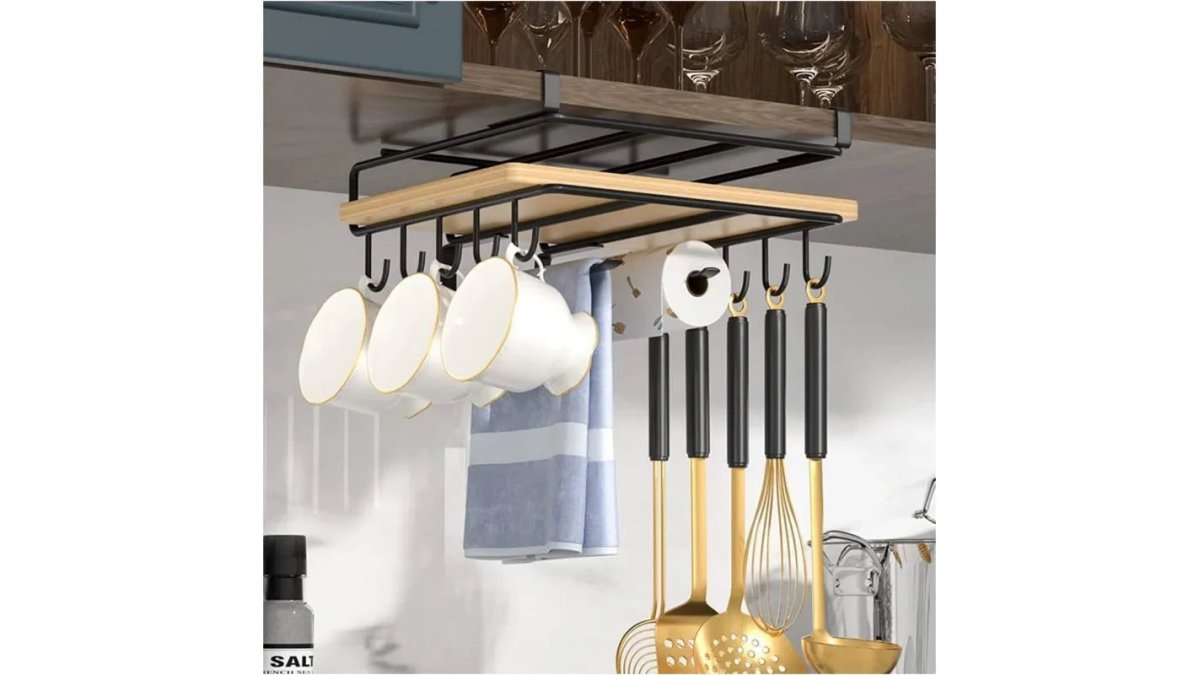
Vertical storage is the single highest-return change in a small kitchen, because it uses height that's already there. A hanging organizer under the cabinet holds paper towels, dishcloths, and cutting boards that would otherwise sit on the counter. The Sinkelle CabinetFlow Hanging Organizer ($44.99) is built for exactly this: durable metal construction that hangs beneath cabinets and shelves, holding paper towels, rags, cutting boards, and pot lids without consuming counter space.
Stacking upward works on the counter too. A two-tier shelf doubles the usable surface in the same footprint, and a three-tier rack does the same for spices and small bottles. The trade-off is real: tiered racks need a stable base and they collect dust on the upper level, so wipe them weekly.
Space-Saving Kitchen Cleaning Tools That Earn Their Spot
Space-saving kitchen cleaning tools are the ones that replace at least two single-purpose items. A brush with a scraper edge replaces a separate scraper. A microfiber cloth replaces paper towels and a sponge. The test is simple: if a tool only does one job and it isn't used daily, it doesn't get counter space.
Most guides list tools without asking what they displace. That's backwards. In a small kitchen, the question isn't "is this useful" but "what does this replace." Run every candidate tool through three filters before it earns a spot:
- Displacement count. Does it retire at least two items you currently store? A silicone spatula-scraper that also spreads and folds replaces three utensils.
- Storage shape. Does it hang, stack, or nest? Flat and stackable beats bulky and round every time in a shallow drawer.
- Failure mode. When it wears out, does it fail cheaply? A microfiber cloth that loses absorbency after 300 washes is a smaller loss than a spray head that clogs on day ten.
What actually earns a spot in a compact kitchen:
- A detail brush set for grout, faucet bases, and stovetop seams, replaces cotton swabs, a toothbrush, and a sponge corner
- Microfiber cloths, which clean glass streak-free and wash hundreds of times, replaces paper towels and a separate glass cloth
- A diatomite drying mat that absorbs water in seconds and protects the counter, replaces a dish towel and a drying rack liner
- One spray bottle per cleaning category, refilled from concentrate, replaces four ready-to-use bottles
Synthetic microfiber outperforms cotton for streak-free glass because the fine fibers lift residue instead of smearing it. That's a materials fact, not marketing, and it's why the same cloth handles dusting and mirror cleaning without a second product. The trade-off is that microfiber holds onto oils, so keep a separate cloth for greasy stovetop work or wash it hot with a degreasing detergent.
Multi-Functional Tools That Replace Three Others
A multi-functional tool is any item that handles three or more cleaning tasks without a separate purchase. The clearest example in a small kitchen is the sink area itself. Sponges left sitting in a puddle stay wet, smell, and leave rings on the counter, so a rack that lifts and drains them solves a cleaning problem and a storage problem at once.
The Sinkelle FlowRack Pro ($46.99) does this with an angled drain tray that sends water back into the sink rather than pooling underneath. It holds a sponge, scrubber, dish soap, brushes, and a hanging bar for a dishcloth in one compact footprint, and it's made from sturdy coated steel with no assembly required. For a renter or anyone avoiding drilling, that matters.

Pair it with the Sinkelle DryFlow Splash Mat ($19.99), a waterproof silicone mat with a sloped surface that channels water back into the sink instead of letting it spread across the counter. Together they replace a sponge holder, a drying tray, and a countertop protector.
Refillable and Concentrated Systems: Less Packaging, More Room
Refillable and concentrated systems cut storage volume because you store one bottle and dilute it, rather than storing four ready-to-use bottles. A single concentrate can make an all-purpose spray, a glass cleaner, and a light floor solution. The shelf space saved is often larger than the space the concentrate itself occupies.
This is the angle most cleaning guides skip entirely. They recommend buying the best version of every product category, which is fine if you have a pantry. In a small kitchen, buying fewer, stronger products is the whole strategy.
What to look for in a concentrate:
- A pH-neutral formula, which is surface-safe on sealed stone and laminate (the EPA)
- Dilution ratios printed clearly on the label
- A refillable bottle with a durable spray head, since cheap heads fail first
- Biodegradable or plant-based formulations if you want to avoid harsh solvents
A note on "non-toxic" and "eco-friendly" labels: these terms aren't standardized the way food labels are. The EPA Safer Choice program verifies products against a published ingredient standard, so a Safer Choice mark tells you more than the word "natural" on a bottle. For anything you're diluting yourself, follow the CDC guidance on safe household cleaning and disinfecting rather than guessing at ratios, especially for disinfectants, which need a specific dwell time on the surface to work.
Essential Cleaning Supplies for Small Kitchens: What to Buy
The essential cleaning supplies for a small kitchen fit in four categories: an all-purpose cleaner, a degreaser, a set of cloths and brushes, and a drying surface. Everything else is optional. Buy in that order and you cover the vast majority of kitchen cleaning tasks without filling a cabinet.
All-Purpose Cleaners and Degreasers
An all-purpose cleaner handles countertops, cabinet fronts, appliance exteriors, and light floor spills. A degreaser handles the stovetop, range hood, and backsplash, where cooking oil builds up and an all-purpose spray won't cut through it. Keeping both, in concentrate form, is the minimum viable kit.
For daily upkeep, a pH-neutral all-purpose spray is surface-safe on most sealed countertops and won't dull finishes over time. For heavy-duty work, a degreaser needs dwell time: spray it, wait, then wipe. Most people spray and immediately wipe, which is why they conclude the product doesn't work.
Match the cleaner to the surface before you buy, because the wrong pairing is what causes damage and wasted money:
| Surface | Safe Cleaner | Avoid |
|---|---|---|
| Sealed granite or quartz | pH-neutral all-purpose | Acidic sprays, vinegar |
| Laminate | pH-neutral all-purpose | Abrasive powders |
| Stainless steel | Dedicated stainless cleaner or mild dish soap | Chlorine bleach, abrasive pads |
| Glass cooktop | Ceramic-glass cleaner or a paste of baking soda | Abrasive scrubbers |
| Sealed wood cabinets | Damp microfiber with mild soap | Soaking, solvent sprays |
Stainless steel needs its own approach. Wipe with the grain, use a microfiber cloth rather than paper, and skip abrasive pads entirely. Abrasives scratch the surface and the scratches then trap grease.
For concentrates, dilution is the whole game. A typical all-purpose concentrate dilutes anywhere from 1:10 to 1:64 depending on the task, stronger for greasy buildup, weaker for daily wipe-downs. Follow the label ratio rather than eyeballing it, because over-concentrating leaves residue that attracts dirt faster.
Scrubbing Tools, Microfiber Cloths, and Drying Mats
Scrubbing tools should be chosen by surface, not by price. A stiff brush for grout and stovetop seams, a soft brush for delicate finishes, and a non-abrasive pad for cookware covers nearly everything. Abrasive pads have their place on burnt pans and nowhere near a glass cooktop.
Microfiber cloths are the workhorse. Buy a set of at least six in two colors so you can separate kitchen surfaces from bathroom or floor use. They clean glass streak-free, absorb several times their weight in water, and survive hundreds of washes. Wash them separately from lint-shedding fabrics and skip fabric softener, which coats the fibers and kills absorbency.
The drying surface is the piece people forget. A diatomite mat absorbs moisture in seconds and dries quickly, which prevents the water stains and soggy dish towels that make a clean kitchen look messy. The Sinkelle DryStone Quick-Dry Kitchen Mat ($14.99) uses a diatomite surface with a non-slip backing and comes in four sizes, so it fits a narrow counter strip as easily as a full dish-drying zone.

If you'd rather solve the whole sink area at once, the Sink Organization Bundle ($43.99) combines the sink rack, splash protection, and drying mat into one purchase. For a small kitchen where every item needs to justify its footprint, that's the version that replaces three separate purchases with one.
| If Your Priority Is | Choose | Why |
|---|---|---|
| Drying sponges and brushes | FlowRack Pro ($46.99) | Angled drain tray, sturdy coated steel |
| Stopping countertop puddles | DryFlow Splash Mat ($19.99) | Sloped silicone channels water to sink |
| Drying dishes and mugs | DryStone Mat ($14.99) | Diatomite absorbs in seconds |
| Solving the whole sink area | Sink Organization Bundle ($43.99) | Three essentials, one purchase |
| Under-cabinet storage | CabinetFlow Hanging Organizer ($44.99) | Hangs below cabinets, no counter used |
Frequently Asked Questions
How do you store cleaning supplies in a small kitchen?
Use vertical space first. A hanging organizer on the cabinet door holds brushes, cloths, and gloves without touching the shelf. A 2-tier shelf or caddy keeps bottles from toppling. Group by task (dishwashing, countertops, floors) so you grab one thing, not five. Stick to refillable concentrates to cut bottle count, and keep a small caddy for daily items so you are not digging through a crowded cabinet every time you wipe the counter.

What are the must-have cleaning tools for a compact kitchen?
A microfiber cloth or two, a compact scrub brush, a small squeegee, and a refillable all-purpose spray bottle cover most daily jobs. Add a degreaser for stovetops and a non-toxic disinfectant for sinks and cutting boards. A drying mat or splash mat keeps counters dry and reduces how often you wipe them down. Skip full-size mops and bulky buckets unless you have a closet to store them. Multi-surface products that handle glass, counters, and stainless save space and money.
What is the best all-purpose cleaner for a small kitchen?
A pH-neutral, non-toxic concentrate you dilute in a refillable bottle works best for small kitchens. It handles countertops, cabinet fronts, and appliance exteriors without damaging finishes. One concentrate replaces three or four ready-to-use bottles, which matters when cabinet space is tight. Look for biodegradable formulas that are surface-safe on stone, laminate, and stainless. Keep a separate degreaser for stovetops and range hoods, since all-purpose cleaners struggle with baked-on grease.
Is Dawn dish soap good for cleaning kitchen cabinets?
Dawn and similar grease-cutting dish soaps work on cabinet fronts when diluted in warm water, but they can leave residue or dull some finishes if used at full strength. Mix a few drops in a bowl of water, wipe with a microfiber cloth, then dry immediately. Test on a hidden spot first, especially on painted or wood cabinets. For daily upkeep, a pH-neutral all-purpose cleaner is gentler and leaves less film. Save the heavy degreaser for the stovetop and range hood filter.