


Last Updated: October 23, 2026
Quick Summary
Touchless kitchen faucets start and stop water with a motion sensor instead of a handle, so your hands never touch the spout between tasks. The main benefits are less cross-contamination during raw-meat prep, hands-free convenience, automatic shutoff that reduces waste, and easier use for people with limited mobility. They cost more up front and add electronic upkeep, so buy one for hygiene and convenience rather than water savings.
- A touchless faucet is a standard faucet plus a sensor, a solenoid valve, and a control board or battery pack.
- The solenoid valve cycles dozens of times a day and is the component most likely to fail first.
- Wipe the sensor window with a damp cloth every week or two to prevent missed waves and phantom activations.
- Budget an afternoon for installation and confirm power source, deck hole layout, and clearance behind the sink before buying.
- Confirm the warranty on the sensor and solenoid, the battery type and life, and power-outage behavior in writing.
Table of Contents
- Why Touchless Kitchen Faucets Are Gaining Ground in 2026
- Hygiene and Reduced Cross-Contamination at the Sink
- Convenience, Water Conservation, and Kitchen Cleanliness
- Touchless Kitchen Faucet Pros and Cons
- Touchless vs. Touch Kitchen Faucet: Which Activation Suits Your Kitchen?
- Touchless Kitchen Faucet Installation: What It Really Takes
- Are Touchless Kitchen Faucets Worth It for Your Household?
- Frequently Asked Questions
Why Touchless Kitchen Faucets Are Gaining Ground in 2026
A touchless kitchen faucet is a fixture that starts and stops water flow using a motion sensor instead of a handle, so your hands never have to touch the spout between tasks. Delta Faucet describes automatic shutoff as a water-saving feature of these fixtures, though the company does not publish a savings figure, Delta Faucet on touchless faucet benefits. Benjamin Plumbing markets the same fixtures for home kitchens, citing hygiene, water conservation, and hands-free convenience, Benjamin Plumbing on upgrading to a touchless kitchen faucet.
Hygiene and Reduced Cross-Contamination at the Sink
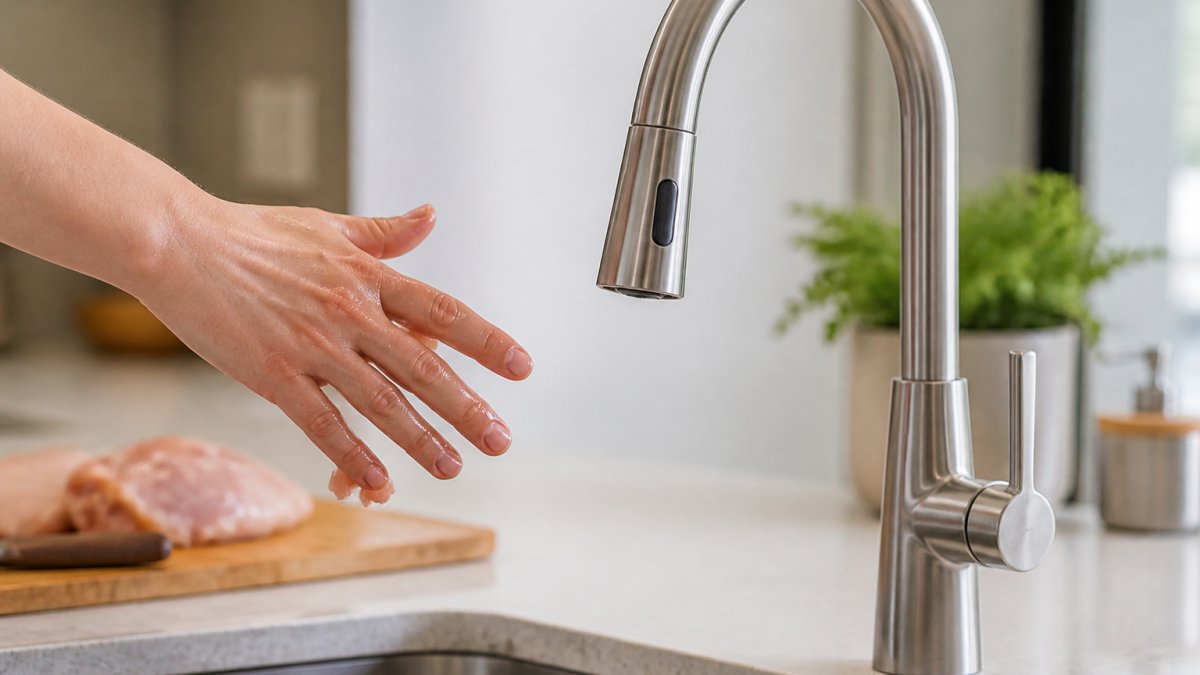
The hygiene argument is the headline reason people switch. When you handle raw chicken or ground beef, your hands carry bacteria to every surface they touch, and a faucet handle is one of the first stops. A motion sensor removes that step entirely: you wave, water runs, and the handle stays clean.
What the Bacteria Numbers Actually Mean
You will see dramatic figures quoted online. Continuum Services states that faucet handles can harbor up to 229,000 bacteria, Continuum Services on touchless faucets, but that article does not identify the underlying study or explain how the measurement was taken.
For readers who want to go further on sink hygiene, our guide on how to store wet sponges and brushes hygienically covers the tools that sit right beside the faucet.
Convenience, Water Conservation, and Kitchen Cleanliness
Convenience is the benefit that sells itself after a week of use. Filling a stockpot, rinsing vegetables, or washing flour off your hands mid-recipe all get easier when water starts with a gesture. There is also a cleanliness angle: fewer sticky fingerprints on the handle, and less water sprayed across the counter when you rinse a dish one-handed.
Automatic Shutoff and Water Savings
Automatic shutoff stops the flow when your hands leave the sensor zone, which addresses the classic waste case: a faucet left running while you answer the door. Neither Delta nor Roto-Rooter quantifies the savings in the material we reviewed, so treat water savings as a real but unmeasured perk. A splash mat that channels drips back into the basin pairs well with any new faucet; our DryFlow splash mat is built for exactly that counter zone.

Touchless Kitchen Faucet Pros and Cons
Here is the honest scorecard, drawn from manufacturer guidance and the maintenance concerns buyers raise in forums. The table is the summary; the notes below it are where the real decision lives.
| Factor | Pros | Cons |
|---|---|---|
| Hygiene | Less hand contact with the handle | Sensor window needs regular wiping |
| Water use | Automatic shutoff reduces waste | Savings vary by household |
| Convenience | Hands-free operation during prep | Sensor can misfire on steam or splashes |
| Installation | Fits most standard decks | Needs power, batteries, or an outlet |
| Cost | Long service life when maintained | Higher purchase price than a standard faucet |
| Upkeep | Fewer sticky handle cleanups | More complex parts to service |
What Actually Fails, and Why
A touchless faucet is a conventional faucet plus three electronic parts: the sensor, the solenoid valve that opens and closes the water path, and the control board or battery pack that ties them together. Most real-world complaints trace to one of those three, not to the brass body.
- Solenoid valve wear. The solenoid is the part that clicks every time the water starts and stops. In a busy kitchen it cycles dozens of times a day, and it is the component most likely to fail first. A failed solenoid usually shows up as water that will not shut off or will not start at all.
- Battery drain. Battery-powered models typically run on AA or lithium packs, and drain depends on how often the sensor fires. Cold under-sink air, cheap batteries, and a sensor that false-triggers on steam all shorten life. Keep a spare set on hand and note the date you install them.
- Sensor fouling. Hard-water film, grease spatter, and soap residue on the sensor window cause missed waves and phantom activations. A wipe with a damp cloth every week or two is the fix, but it is a chore a handle faucet never asks for.
The Pros That Hold Up
The hygiene and convenience benefits are real and repeatable. Fewer hand-to-handle contacts during raw-meat prep is a genuine cross-contamination reduction, and hands-free filling and rinsing genuinely speed up cooking.
Anmeifaucet lists higher maintenance and more complex installation among the cons, Anmeifaucet on touchless kitchen faucet types and benefits, and that matches what we hear from homeowners. The benefits are real, but they are not free.
Touchless vs. Touch Kitchen Faucet: Which Activation Suits Your Kitchen?
Touchless wins on hygiene and hands-free prep. A touch-activated faucet, where a tap on the spout starts the flow, wins on precision and reliability. If you cook with messy hands constantly, go touchless.
Sinkelle AquaShield Faucet Guard →
The sensor has limits worth knowing before you commit. Steam from a boiling pot can trigger it. So can a splash across the sensor window. Some models include a manual override for exactly these moments, and we would not buy one without it.
Touchless Kitchen Faucet Installation: What It Really Takes
Installation is more involved than swapping a standard faucet, but it is manageable for a confident DIYer. Budget an afternoon, not twenty minutes.
Power Source, Deck Holes, and Compatibility
Most touchless models run on batteries or plug into an outlet under the sink. Battery models avoid an electrician visit but need periodic changes; plug-in models need a nearby outlet. Check your deck holes too: a standard three-hole setup usually works, but some sensor models require a specific configuration. Because water exposure under the sink is a real risk during any install, our guide on how to prevent water damage under sink is worth reading first.
Are Touchless Kitchen Faucets Worth It for Your Household?
They are worth it if hygiene and hands-free convenience rank high for you and you accept the maintenance. They are not worth it if you want the simplest, most repairable fixture in the house. The useful question is not "are they good" but "is this household a fit", and that comes down to four things: who cooks, how often hands are messy, whether anyone has limited mobility, and how much electronic upkeep you will tolerate.
A Household Decision Framework
- Heavy raw-meat and baking households. Touchless earns its keep. Fewer handle contacts during prep and easier one-handed rinsing are daily wins.
- Households with children. Kids can start and stop water without climbing or stretching, but expect more false triggers from small hands waving near the sensor. A model with a manual override matters here.
- Households with limited mobility or arthritis. Hands-free operation is often genuinely easier than gripping and turning a handle, which tips the decision for many families. Check that the manual override is reachable from a seated position if that applies.
The Long-Term Ownership Picture
A touchless faucet costs more up front than a comparable handle model, and the ownership math does not stop at purchase. Budget for three recurring items: batteries (if the model is battery-powered), occasional solenoid or sensor replacement, and the time to wipe the sensor window.
Water savings are real but modest and household-dependent. Do not buy a touchless faucet expecting the water bill to repay the price premium; buy it for hygiene and convenience, and treat any savings as a bonus.
Power Outages and Manual Override
A plug-in model loses sensor function when the outlet loses power; most such models fall back to a manual handle or override, but confirm that before you buy. Battery models keep working through an outage until the batteries die.
For the counter around the faucet, our quick-dry kitchen sink mats guide explains how to keep that zone dry day to day, and our guide on how to prevent water damage under sink covers the moisture risk that matters more once electronics live under the cabinet.
Frequently Asked Questions
What are the main benefits of a touchless kitchen faucet?
The benefits of installing touchless kitchen faucets fall into four areas: less hand contact with the faucet handle during food preparation, convenience when your hands are full or messy, automatic shutoff that reduces water waste, and a cleaner-looking sink area. Accessibility is a fifth benefit for people with limited grip strength or mobility. The gains are real but modest, so treat a touchless kitchen faucet as a workflow upgrade rather than a medical device. It reduces one point of contact, not every point of contact in your kitchen.
Are touchless kitchen faucets worth the cost?
It depends on how often you cook and how much you dislike touching a handle with raw-meat hands. Touchless models cost more than conventional faucets and add a sensor, a power source, and a control module that can fail. Anmeifaucet lists higher maintenance and more complex installation among the drawbacks. If you cook daily, have limited mobility, or want automatic shutoff for water savings, the upgrade can justify itself. If you rarely use the sink, a standard faucet with a good spray head is the better value.
Do touchless faucets actually stay cleaner than traditional faucets?
They reduce one route of transfer, not all of them. A Continuum Services article states that faucet handles can harbor up to 229,000 bacteria, though the piece does not identify the study or the measurement method, so treat the number as directional rather than verified. What is certain is mechanical: if you never grip the handle with contaminated hands, you cannot deposit contamination there. The sensor window and spout still need wiping, and the sink basin remains the main reservoir. Pair the faucet with a splash guard such as the Sinkelle AquaShield Faucet Guard ($17.99) to keep drips off the counter.
Can a touchless kitchen faucet be installed in an existing sink?
Usually yes, with two checks. First, the deck hole count: most touchless models need the standard 1- or 3-hole setup, and a 3-hole configuration may require a deck plate. Second, the power source: battery models need clearance under the cabinet for the control box, while plug-in models need an outlet. Measure the space around your garbage disposal and shutoff valves before ordering. If the under-sink area is tight, a battery model is the simpler path. Installation itself is comparable to a standard faucet replacement.
The real challenge is not choosing a faucet; it is keeping the sink area clean and dry once the novelty wears off. SinkElle builds minimalist, waterproof sink accessories with tool-free installation, from splash guards that channel drips back into the basin to quick-dry mats that protect your countertops. Get started with SinkElle and turn a cleaner sink area into your kitchen's new normal.
