


Table of Contents
- Why Quick-Dry Sink Mats Earn Their Counter Space
- Scratch Protection and Less Wear on Your Sink Finish
- Moisture Control, Drainage, and Faster Drying
- The Diatomaceous Earth Sink Mat: How Stone Mats Absorb Water
- Silicone Sink Mats: Flexible Splash and Drainage Control
- Stone Faucet Mat Pros and Cons Before You Buy
- How to Clean a Sink Mat and Keep It Mold-Free
- Fit, Placement, and Choosing the Right Mat for Your Sink
- Frequently Asked Questions
Last Updated: October 18, 2026
Why Quick-Dry Sink Mats Earn Their Counter Space
A wet sponge on bare quartz leaves water stains, a dulled finish, and a dish towel that never quite dries, the benefits of quick-dry kitchen sink mats start right there.

A sink mat sits in or beside the basin to catch water and cushion dishes.
Below: what a quick-dry mat does, how materials differ, and how to keep one clean for years.
Scratch Protection and Less Wear on Your Sink Finish
The first job is physical protection. Dishes, cast iron, and metal utensils get set down hard near the sink, and repeated contact dulls finishes.
Ceramic and composite sinks chip and scuff at the edges; stainless steel sinks develop fine scratches that trap mineral deposits.
Cushioning matters for breakage too. A silicone sink mat or padded diatomite mat softens the clink of a mug meeting stone, reducing chips at the rim where most dish breakage begins.
Moisture Control, Drainage, and Faster Drying
Drainage is the mechanical half. The SinkElle DryFlow Splash Mat uses an upgraded sloped surface so water runs back into the sink rather than collecting in a ring around the faucet.

Fast-drying surface design is the material half. A mat that holds water stays damp for hours; one that releases it quickly is dry before the next load.
Airflow matters as much as absorption.
The Diatomaceous Earth Sink Mat: How Stone Mats Absorb Water
A diatomaceous earth sink mat is a rigid or semi-rigid pad made from diatomite, a porous mineral that pulls water off a surface and releases it into the air.
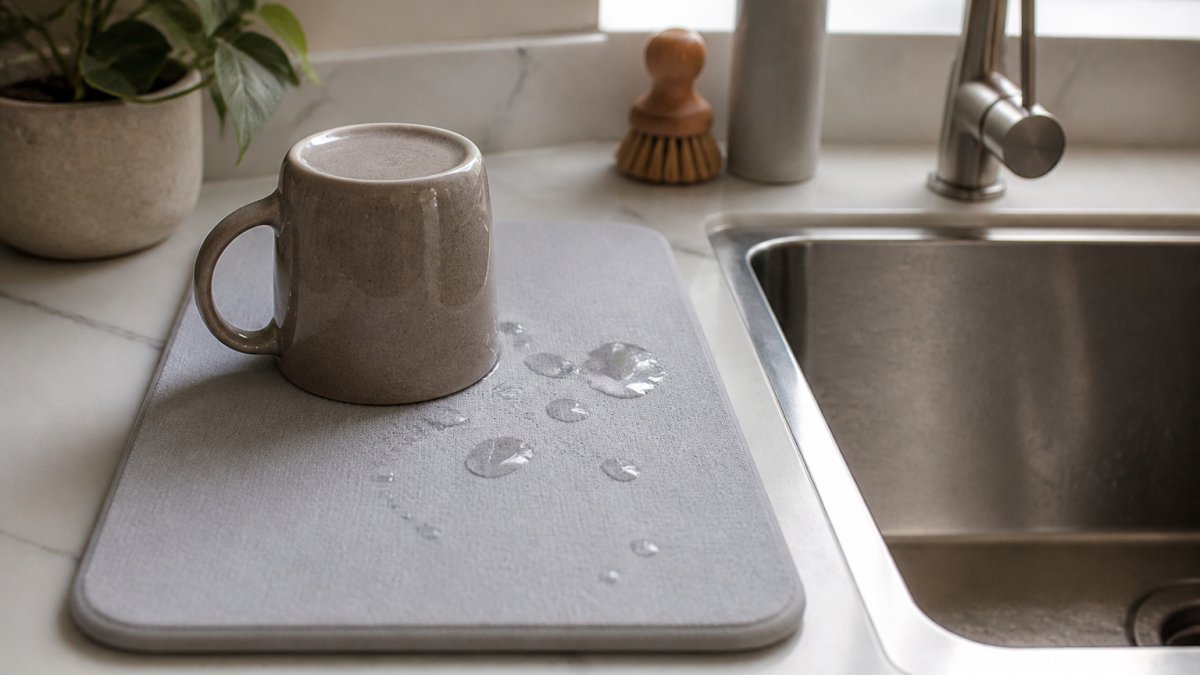
Diatomite is full of microscopic pores, so water spreads thin and evaporates quickly instead of beading up.
The Sinkelle DryStone Quick-Dry Kitchen Mat pairs a diatomite surface with a non-slip backing.
Where it falls short: a stone mat is rigid, so it does not fold away, and it needs occasional resurfacing to keep absorbing at full speed.
Silicone Sink Mats: Flexible Splash and Drainage Control
Silicone sink mats are flexible, waterproof, and built to channel water rather than absorb it.
The SinkElle AquaShield Faucet Guard fits around the faucet base and catches drips before they reach the counter, draining water back into the basin; the flexible silicone lifts out easily to rinse.

Neither replaces a drying mat. A faucet mat guards the faucet; a basin mat or drying pad handles dishes. Many kitchens end up with one of each.
| Mat type | Material | Best for | Drying behavior |
|---|---|---|---|
| Stone drying mat | Diatomite | Dish drying, coffee stations | Absorbs and evaporates fast |
| Silicone splash mat | Waterproof silicone | Faucet splash, wide counter coverage | Channels water back to basin |
| Faucet guard | Flexible silicone | Drip at the faucet base | Drains, air-dries quickly |
Stone Faucet Mat Pros and Cons Before You Buy
Weighing a stone faucet mat comes down to honesty about its limits: best for fast drying, least forgiving if neglected. Since "fast" is vague, define what quick-dry actually means first.
Sinkelle DryStone Quick-Dry Kitchen Mat →
What "Quick-Dry" Should Mean
A surface is quick-dry when water leaves it within minutes rather than pooling or soaking in. Three things drive that:
- Porosity, how readily the surface pulls water off a mug or dish and spreads it thin
- Air exposure, how much of the mat's surface is open to room air rather than sealed against the counter
- Drainage path, whether excess water has somewhere to go besides sitting on top
A mat that scores well on all three feels dry shortly after a wet dish comes off it; fail any one and it stays damp, where odor and mildew start. When you shop, ask which of the three the product is designed around.
Material Comparison at a Glance
Here is how the main materials differ on what matters for a quick-dry mat:
| Material | Absorbs water? | Typical drying behavior | Durability notes | Best use |
|---|---|---|---|---|
| Diatomite (stone) | Yes, pulls water into pores | Fastest; surface feels dry in minutes | Rigid; can crack if dropped; needs periodic resurfacing | Dish drying, coffee stations, landing zones |
| Silicone | No, sheds water | Air-dries quickly once water runs off | Flexible, long-lasting; can trap film underneath if seated flush | Faucet splash, wide counter coverage |
| Stainless grid | No, water passes through | Dries fast because air reaches both sides | Very durable; can scratch delicate items; clatter is louder | Inside-basin use over the drain |
| Fabric or foam | Yes, holds water in structure | Slowest; stays damp for hours | Breeds odor if not laundered often | Not recommended for quick-dry use |
No single material wins everywhere: diatomite and open grids dry fastest, silicone channels rather than absorbs, and fabric is the odd one out.
Pros of a Stone Faucet Mat
- Dries visibly faster than fabric or foam, the surface is dry to the touch shortly after a wet mug is lifted
- Rigid surface holds dishes and mugs steady, so they do not slide
- Minimalist look suits modern and Scandinavian-style kitchens
Cons of a Stone Faucet Mat
- Rigid, so it will not fold or tuck into a drawer
- Can crack if dropped or knocked against a hard edge
- Needs periodic cleaning and light resurfacing to keep absorbing at full rate
The Honest Verdict
Buy a stone mat for drying performance and looks, not flexibility. If your counter has a curved edge or tight corner, measure first, a mat that overhangs defeats the purpose. If you move the mat constantly, silicone is the better fit even though it does not absorb.
How to Clean a Sink Mat and Keep It Mold-Free
Knowing how to clean a sink mat separates one that lasts years from one that smells within months. The routine differs by material, but the principle holds: remove residue before it clogs the surface.
For a diatomite mat:
- Wipe the surface with a damp cloth after heavy use.
- For a deeper clean, sand the surface lightly with fine sandpaper to reopen the pores.
- Stand it on edge to air-dry fully before putting it back.
- Keep it out of the dishwasher, which damages the structure.
For a silicone mat or guard:
- Lift it and rinse both sides under warm water.
- Wipe with mild dish soap and a soft sponge.
- Dry completely before reseating it.
- Check the underside weekly for trapped water.
Mold, mildew, and odor come from trapped moisture, not the mat itself. A mat that airs out fully between uses resists all three; if you smell something sour, check the counter underneath.
Fit, Placement, and Choosing the Right Mat for Your Sink
Fit decides whether a mat helps or gets in the way. Fit is not one number, it is four checks, and skipping any one is why mats end up shoved in a cabinet.
The Four Fit Checks
- Landing zone, Measure the strip of counter where dishes actually get set down, not the full sink width. A mat sized to the sink opening usually overhangs the landing zone.
- Sink dimensions, For a basin mat or grid, measure the interior length and width at the widest point, then subtract at least half an inch on each side so the mat seats without binding.
- Drain access, A grid or mat inside the basin must leave the drain clear. If the mat covers the drain, water backs up and the quick-dry benefit disappears. Check that the openings line up with the drain.
- Faucet clearance, A faucet guard must not block the handle travel or the spout swing. Test the full range of motion before you commit.
Placement Rules That Hold Up in Practice
- Keep the mat clear of the drain so water can still flow freely
- Leave a small gap at the counter edge so air reaches underneath
- Match the mat size to the landing zone, not the full sink width
- Confirm the faucet guard does not block the handle travel
Safety and Accessibility
A wet counter is a slip risk, and a mat that shifts under a dish is a breakage risk. Three safeguards:
- Stability, A non-slip backing that grips without sealing the whole underside keeps the mat in place while still letting air circulate. A mat that slides when you set a cast-iron pan down is the wrong mat.
- Trip and slip risk, Keep the mat inside the counter edge, not overhanging it. An overhanging corner catches sleeves and towels and is the most common cause of a mat ending up on the floor.
- Accessibility, If you have limited grip strength or reach, a lighter silicone mat is easier to lift and rinse than a rigid stone mat. A stone mat that is too heavy to move daily will not get cleaned, and an uncleaned mat defeats the purpose.
Sink-Finish Compatibility
Not every mat suits every sink finish. Ceramic and composite chip at the edges, so a cushioned mat at the landing zone takes the abuse. Stainless steel develops fine scratches that trap mineral deposits, so a soft backing is gentler than a bare grid. Stone and fireclay sinks are unforgiving, a dropped rigid mat can chip them, another reason to size carefully and seat the mat fully.
Durability and Easy Cleaning Beat Design
Durability and easy to clean matter more than striking design. A mat you can rinse in seconds gets rinsed; one that needs a project gets ignored. Before you buy, ask: can I lift this with one hand and rinse it without disassembling anything? If either answer is no, keep looking.
Frequently Asked Questions
Do quick-dry sink mats really prevent water damage to countertops?
They reduce the exposure, but they are not a seal. A quick-dry sink mat catches splashes, drips, and the water that runs off dishes before it spreads across the counter. That cuts the standing water that causes water stains and dulls a countertop finish over time. The mat itself has to dry between uses to keep working, so choose one with a quick-drying surface and lift it now and then to wipe underneath. For faucet-area splashing, a sloped silicone mat that channels water back into the sink adds a second layer of protection.
Are stone or silicone sink mats better?
It depends on where the mat sits. A diatomaceous earth sink mat absorbs water fast and dries quickly, which makes it a strong pick for dish drying and coffee stations. A silicone sink mat is better around the faucet, where a sloped surface can push splashes back into the basin and the flexible material fits tight corners. Many kitchens use both: stone for drying, silicone for splash control. Match the material to the job rather than picking one for the whole sink area.
How do you clean a quick-dry sink mat?
For a stone mat, rinse the surface, wipe it with a damp cloth, and let it air dry standing up so both sides breathe. Skip the dishwasher and harsh cleaners, which can clog the porous surface. For silicone, wash with warm water and mild dish soap, then dry it flat. Either way, wipe up coffee and oil spills promptly, since both can leave marks. A weekly rinse and a monthly deeper clean keeps odor and mildew from settling in.
Do sink mats help prevent mold and mildew?
They help by removing the conditions mold needs: standing water and a damp, warm surface. A quick-dry mat sheds water instead of holding it, so the area under dishes and around the faucet dries faster. That said, no mat prevents mold on its own. Lift the mat regularly, dry the counter underneath, and clean the mat itself. A mat that stays wet for days will grow mildew regardless of material, so airflow and routine drying matter as much as the product.