


Last Updated: October 23, 2026
Quick Summary
Sustainable kitchen cabinets are built from FSC-certified solid wood, bamboo, or reclaimed timber paired with low-VOC finishes to eliminate chemical off-gassing and ensure durability. According to IST Cabinets' 2026 analysis, 71% of homeowners chose solid hardwood like maple and white oak, with well-built systems lasting 25 to 40 years compared to 10 to 15 years for low-grade alternatives.
- Solid hardwood cabinets last 50+ years with proper care, while engineered alternatives typically need replacement within 15-20 years.
- Strand-woven bamboo reaches harvest maturity in 3-5 years versus 20-40 years for oak or maple, making it a genuinely renewable option.
- Low-VOC water-based finishes eliminate months of chemical off-gassing, reaching safe air-quality levels within days instead of months.
- Solid wood cabinets are 90% biodegradable and recyclable, while composite materials with plastic resins typically end up in landfills.
- Ask for TSCA Title VI or CARB Phase 2 documentation when comparing engineered panels to verify formaldehyde compliance.
Table of Contents
- Why Sustainable Materials Matter for Kitchen Cabinets
- Solid Wood and FSC-Certified Wood Cabinets
- Bamboo Kitchen Cabinets: Rapid Renewal and Durability
- Reclaimed Wood Kitchen Cabinets: History and Performance
- Non-Toxic Kitchen Cabinets: Finishes and Emissions Control
- Engineered Wood and Composite Alternatives
- Durability, Cost, and End-of-Life Considerations
- Frequently Asked Questions
Why Sustainable Materials Matter for Kitchen Cabinets
Sustainable kitchen cabinets aren't just a trend, they're becoming the standard choice for homeowners who care about both their living spaces and environmental impact. When you invest in cabinetry made from responsible materials, you're making a decision that affects indoor air quality, durability, and long-term value. According to IST Cabinets' 2026 cabinet trends analysis, 71% of homeowners selected solid hardwood, including maple and white oak, for cabinet door frames and fronts, reflecting a clear market shift toward durable, sustainable options.
Materials determine more than aesthetics: how long cabinets last, whether they off-gas chemicals, and what happens at end-of-life. A beautifully organized kitchen starts with quality materials, and sustainability is core to that quality.
Conventional cabinets can emit volatile organic compounds (VOCs) for years after installation; low-VOC finishes and responsibly sourced wood eliminate this concern. Sustainable materials deliver performance and peace of mind, creating a healthier kitchen while reducing your environmental footprint.
Solid Wood and FSC-Certified Wood Cabinets
Solid wood remains the gold standard for kitchen cabinet construction. Unlike engineered alternatives, it can be refinished, repaired, and repurposed. FSC-certified wood guarantees materials come from responsibly managed forests where harvesting protects ecosystems and worker rights.
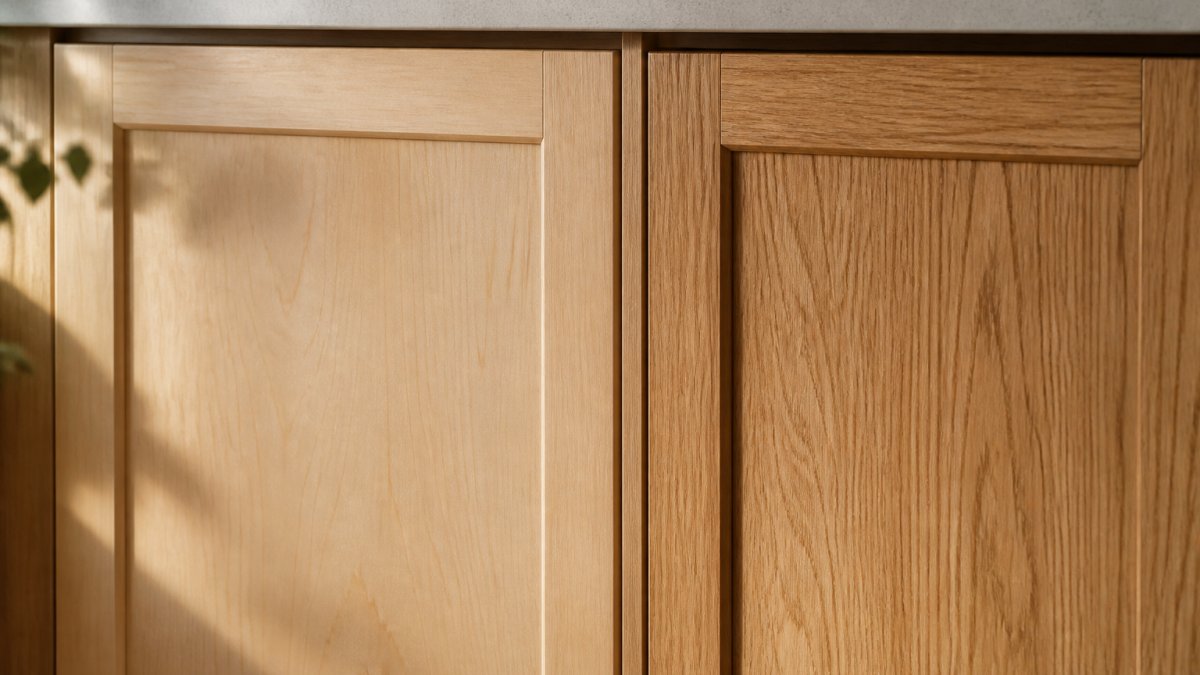
FSC certification verifies a chain of custody from forest to kitchen, meaning wood was harvested under strict environmental standards: no clear-cutting, protection of wildlife habitats, and respect for indigenous communities. Maple and oak are popular because they combine durability with grain patterns that age gracefully.
The durability advantage is measurable. Solid hardwood cabinets routinely last 50+ years with proper care, while engineered alternatives typically need replacement within 15-20 years. This longevity translates to real savings: one quality cabinet system beats three cheaper replacements over a lifetime.
One limitation: solid wood costs more upfront. But calculated per year of use, sustainable solid wood is the more economical choice, and you're protected against future price increases in lower-quality materials as environmental regulations tighten.
Bamboo Kitchen Cabinets: Rapid Renewal and Durability
Bamboo is a genuinely renewable alternative to traditional hardwoods, reaching harvest-ready maturity in 3-5 years versus 20-40 for oak or maple, making it an excellent choice if sustainability is your primary concern.
Bamboo is harder than most oak varieties and resists moisture and warping better than some traditional woods. It machines cleanly, takes finishes beautifully, and develops a warm patina, offering understated elegance in modern, minimalist kitchens.
What most guides miss about bamboo: not all bamboo products are created equal. Strand-woven bamboo (compressed bamboo strands bonded together) outperforms solid bamboo in durability. Solid bamboo cabinets work well in dry climates but can expand and contract in high-humidity kitchens. Understanding this distinction prevents costly mistakes.
Bamboo pairs exceptionally well with low-VOC finishes, creating a fully non-toxic system. The material contains no formaldehyde, and with water-based stains and topcoats you get zero chemical off-gassing, ideal for households with respiratory sensitivities or young children.
| Material | Growth Cycle | Hardness | Moisture Resistance | Best Climate |
|---|---|---|---|---|
| Bamboo (strand-woven) | 3-5 years | High | Excellent | Any |
| Bamboo (solid) | 3-5 years | Medium | Good | Dry to moderate |
| Oak | 20-40 years | Medium | Good | Any |
| Maple | 20-40 years | High | Good | Any |
Reclaimed Wood Kitchen Cabinets: History and Performance
Reclaimed wood tells a story: every grain pattern and weathered mark reflects decades of history from barns, factories, or old buildings being demolished. Using reclaimed timber gives these materials a second life while creating one-of-a-kind kitchen designs.
The sustainability argument is straightforward: no new trees are harvested, material is diverted from landfills, and demand for fresh timber drops. The environmental impact per board foot is dramatically lower than new wood, even accounting for reclamation and milling.
Reclaimed wood from old-growth sources is often superior to modern lumber: trees that grew slowly over centuries develop denser grain and greater stability, so cabinets rarely warp or cup, even in challenging moisture conditions.
The trade-off is consistency and cost. Reclaimed wood varies in color, grain, and character; some love the variability, others find it chaotic. Pricing runs 30-50% higher than new hardwood because sourcing, milling, and quality control require more labor, and inventory is limited.
Non-Toxic Kitchen Cabinets: Finishes and Emissions Control
The cabinet box matters, but the finish matters more for indoor air quality. Water-based, low-VOC finishes eliminate the off-gassing that makes conventional kitchens smell like chemicals for months; they cure through evaporation rather than chemical reactions, releasing minimal volatile compounds. Learn best non-toxic cleaners for kitchen cabinets to maintain these finishes safely.
Low-VOC doesn't mean zero-VOC: trace emissions still occur, but far below health thresholds. A kitchen finished with low-VOC products reaches safe air-quality levels within days, not months, a substantial difference for families with asthma, allergies, or chemical sensitivities.
Research from Make It Right's guide to non-toxic kitchens recommends natural wood, bamboo, or stainless steel and advises avoiding vinyl-wrapped or laminate cabinets unless verified for low-emission compliance. Formaldehyde-free plywood and medium-density fiberboard (MDF) are acceptable when bonded with soy-based adhesives rather than urea-formaldehyde resins.
The Kitchen Cabinet Manufacturers Association notes that solid wood cabinets are 90% biodegradable and recyclable, while composite materials with plastic resins often end up in landfills because their components cannot be separated. This end-of-life consideration should factor into your decision if sustainability extends beyond the installation phase.
Engineered Wood and Composite Alternatives
Engineered panels are the workhorses of modern cabinetry, usually in the box while doors are solid wood or veneer. Plywood, medium-density fiberboard (MDF), and particleboard behave very differently in a kitchen.
Plywood is built from thin wood veneers glued in alternating layers. The cross-grain construction gives it strong screw-holding and good resistance to racking, which is why it is the preferred core for cabinet boxes and drawer boxes in better-built systems. MDF is made from fine wood fibers pressed with resin into a dense, uniform panel.
The critical variable is the binder. Urea-formaldehyde resin can emit formaldehyde for years; no-added-formaldehyde (NAF) and ultra-low-emitting-formaldehyde (ULEF) panels are now widely available, and phenol-formaldehyde binders in exterior-grade plywood are more moisture-resistant and lower-emitting.
This is where most buying guides stop, so here is the part that actually protects you. In the United States, the relevant benchmark is the California Air Resources Board (CARB) Airborne Toxic Control Measure, Phase 2, which sets formaldehyde emission limits for composite wood products, and the federal Toxic Substances Control Act (TSCA) Title VI rule, which extends comparable limits nationwide (arb.ca.gov).
Durability claims deserve the same scrutiny. Modern MDF is more moisture-resistant than older formulations when edges are sealed and all faces finished, but it is still not a wet-area material. The realistic failure points are the sink base, dishwasher surround, and cabinets against exterior walls; specifying plywood for the sink base and sealing cut edges cheaply avoids the most common engineered-panel failure.
The sustainability case for engineered wood is real but conditional. Panels use mill byproducts and small-diameter trees that would otherwise be burned or landfilled, making efficient use of fiber. The trade-off is end-of-life: resin-bonded panels are hard to separate and usually landfilled, while solid wood can be refinished or repurposed.
Durability, Cost, and End-of-Life Considerations
The cheapest cabinet is rarely the most economical one, but the arithmetic is more complicated than a single division problem. Durability, repairability, moisture exposure, and end-of-life handling all interact, and differently depending on which part of the cabinet you mean.
Start with construction, because a cabinet is a system, not a material. The box, door and drawer fronts, veneer or laminate face, edge banding, and finish each have their own service life and failure modes. A solid-wood door on a particleboard box is common, and the door may outlast the box by decades.
Service life is where the environmental math actually happens. Most practitioners find that a well-built cabinet with a plywood box, solid or quality veneered doors, and a water-based finish can reasonably serve 25 to 40 years with care, while a low-grade particleboard box with vinyl-wrapped doors may need replacement in 10 to 15 years.
Repairability is the underrated variable. A solid-wood or veneered door with a dent can often be sanded and refinished; a thermofoil or vinyl-wrapped door usually cannot and must be replaced as a unit.
Moisture is the great unequalizer. Discover how to protect kitchen cabinets from water damage in moisture-prone areas like sink bases and dishwasher surrounds. Explore waterproof kitchen cabinet storage solutions for protecting cabinets in high-moisture areas.
End-of-life options vary more than most guides admit. Solid wood can be refinished, repurposed as shelving or furniture, or in some markets chipped and composted. Plywood can sometimes be reused but is hard to recycle because of its adhesives. Particleboard and MDF bonded with plastic resins are generally landfilled, and laminated composite faces are hard to separate.
On cost, verifiable sustainable specifications carry a premium. FSC-certified solid wood, quality bamboo, and NAF panels with documented low-VOC finishes typically run above builder-grade options, and the gap widens with custom sizing and specialty finishes.
Frequently Asked Questions
What is the most sustainable material for kitchen cabinets?
FSC-certified solid wood, bamboo, and responsibly sourced reclaimed wood are the most sustainable options. FSC certification ensures responsible forestry practices. Bamboo grows rapidly and regenerates quickly, making it a renewable resource. Reclaimed wood diverts existing timber from landfills and eliminates new harvesting. Each material's sustainability depends on sourcing, manufacturing emissions, and how long the cabinets last, durability matters as much as material choice.
Are bamboo kitchen cabinets more sustainable than wood cabinets?
Bamboo and solid wood each have distinct advantages. Bamboo is a rapidly renewable resource that reaches maturity in 3-5 years, whereas hardwoods like oak take decades. However, solid hardwoods like maple and oak offer superior durability and can last 50 years or more, reducing replacement frequency. The sustainability comparison depends on your priority: rapid renewability (bamboo) versus longevity and lower replacement impact (solid hardwood). Both outperform composite materials in recyclability.
What cabinet materials have the lowest VOC emissions?
Non-toxic kitchen cabinets use water-based, low-VOC finishes and formaldehyde-free or no-added-formaldehyde panels. Natural solid wood with water-based stains, bamboo with certified finishes, and plywood with low-emission adhesives all minimize volatile organic compounds. Look for cabinets labeled low-VOC, formaldehyde-free, or certified by third-party standards. Avoid vinyl-wrapped or standard laminate unless the laminate specifically meets low-emission qualifications, as these can off-gas chemicals affecting indoor air quality.
How can I verify that kitchen cabinets are sustainably sourced?
Check for third-party certifications: FSC (Forest Stewardship Council) for responsible forestry, KCMA (Kitchen Cabinet Manufacturers Association) eco-friendly guidance, and certifications for low-VOC finishes. Ask manufacturers for chain-of-custody documentation and material sourcing details. Reclaimed wood should come with documentation of its origin. Request emissions testing reports for finishes. Reputable makers provide transparency on wood species, adhesives, and manufacturing practices, if a company won't share this information, that's a red flag.
