


Table of Contents
- Why Non-Toxic Cleaners Matter for Kitchen Cabinets
- How to Clean Greasy Kitchen Cabinets Naturally
- DIY Non-Toxic Cabinet Cleaner Recipe You Can Make Today
- Safe Cleaning Products for Painted Cabinets
- Store-Bought Non-Toxic Cleaners: Comparison and Cost Per Use
- Protecting Cabinet Finishes Long-Term
- Conclusion
- Frequently Asked Questions
Last Updated: September 21, 2026
Why Non-Toxic Cleaners Matter for Kitchen Cabinets
The best non-toxic cleaners for kitchen cabinets protect both your finish and your indoor air. Cabinet finishes are thinner than most people assume, and harsh solvents strip them faster than grease ever will. This guide from SinkElle walks through what actually works on cabinet surfaces, what to avoid, and how to clean greasy kitchen cabinets naturally without dulling the wood.
What Makes a Cleaner Truly Non-Toxic
A non-toxic cleaner is a product formulated without volatile organic compounds, synthetic fragrance, phthalates, or parabens, and one that breaks down safely after use. Plant-based surfactants and biodegradable ingredients do the cleaning work instead of petroleum solvents.
Look for these markers on a label:
- pH-neutral or close to it, so the finish stays intact
- Synthetic fragrance-free, since fragrance is a common irritant
- Biodegradable ingredients that break down in wastewater
- Ingredient transparency, meaning the brand lists everything
Ingredients to Avoid in Kitchen Cleaners
Ammonia, bleach, and abrasive powders are the three biggest offenders for cabinetry. Each one attacks a different part of the finish: ammonia dulls clear coats, bleach fades color, and abrasives scratch the surface permanently.
Watch for these on ingredient lists:
- Ammonia and ammonium hydroxide
- Chlorine bleach
- Synthetic fragrance and phthalates
- Petroleum distillates
- Micro-abrasives
How to Clean Greasy Kitchen Cabinets Naturally
Cleaning greasy cabinets naturally means loosening the grease before you wipe, not scrubbing harder. Heat and dwell time do the work. A microfiber cloth lifts the softened film without scratching.
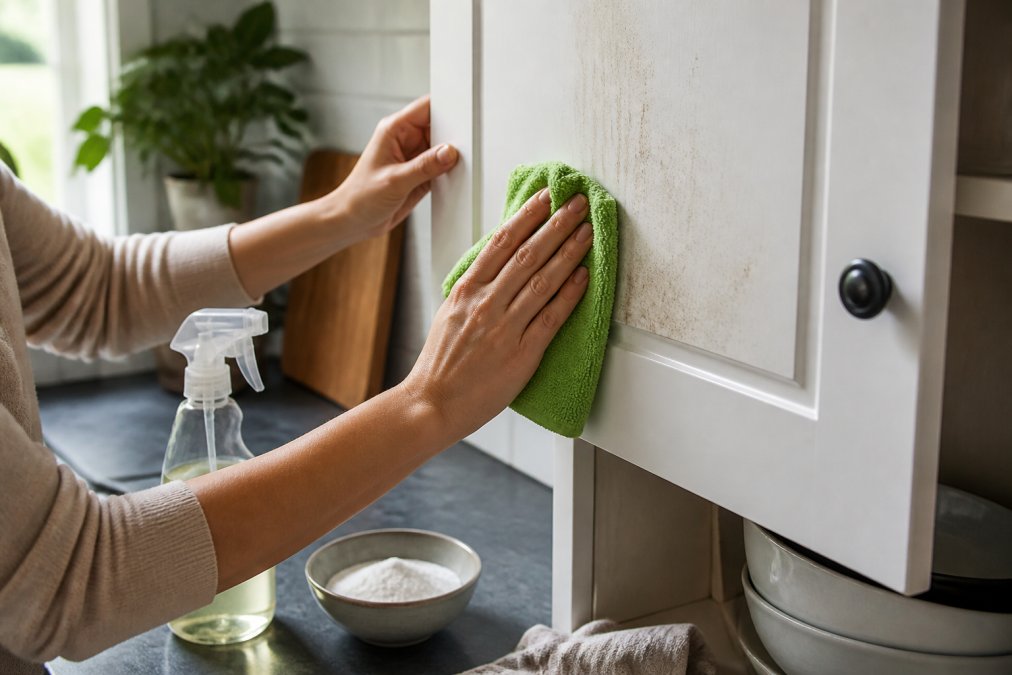
Follow this sequence for the best result:
- Clear the counter beneath the cabinets
- Mix a gentle degreaser solution in a spray bottle
- Spray one door section at a time, never the whole run
- Let it sit for 30 to 60 seconds
- Wipe top to bottom with a microfiber cloth
- Dry immediately with a second cloth
Step-by-Step Grease Removal Without Harsh Chemicals
Start with the least aggressive method and escalate only if needed. Most cabinet grease comes off with warm water, a drop of castile soap, and patience.
Work in this order:
- Warm water and castile soap for light film
- Baking soda paste for sticky spots near the stove
- White vinegar diluted with water for lingering residue
- A dedicated plant-based degreaser for heavy buildup
DIY Non-Toxic Cabinet Cleaner Recipe You Can Make Today
A DIY non-toxic cabinet cleaner recipe takes about two minutes and uses three ingredients. This mix handles everyday grease without stripping finish.
Everyday cabinet spray:
- 1 cup warm water
- 1 tablespoon castile soap
- 1 tablespoon white vinegar
- 5 drops essential oil, optional
Heavy grease paste:
- 3 tablespoons baking soda
- 1 tablespoon water
- Mix into a paste, apply to the spot, wait 5 minutes, wipe
Safe Cleaning Products for Painted Cabinets
Safe cleaning products for painted cabinets are pH-neutral and free of ammonia and alcohol. Painted finishes sit on top of the surface, so anything that softens the paint film leaves streaks and wear marks.
What works on painted surfaces:
- pH-neutral dish soap diluted in warm water
- Castile soap solutions
- Ready-to-use plant-based sprays labeled for painted surfaces
What ruins them:
- Ammonia-based glass cleaners
- Alcohol and solvent wipes
- Abrasive sponges
- Heavy scrubbing around hardware
Store-Bought Non-Toxic Cleaners: Comparison and Cost Per Use
The cheapest bottle on the shelf is rarely the cheapest per cleaning. Cost-per-use is the number that matters, and it favors concentrated formulas by a wide margin, but cost is only half the decision. The other half is whether the formula is safe for your specific cabinet finish.
Here's how the main formats compare:
| Format | Cost Per Use | Best For | Main Trade-Off |
|---|---|---|---|
| Ready-to-use spray | Highest | Quick touch-ups | You pay to ship water |
| Concentrated liquid | Lowest | Weekly deep cleans | Requires dilution |
| Concentrate tablets | Low | Small storage spaces | Limited formula choice |
| Refillable system | Low | Reducing plastic waste | Upfront bottle cost |
Match the Formula to the Finish, Not Just the Label
This is where most buying guides stop and where cabinet damage actually starts. A cleaner can carry every eco-certification on the shelf and still be wrong for your doors.
- Painted and lacquered cabinets: Choose pH-neutral, ammonia-free, alcohol-free formulas. Ammonia dulls clear coats and softens paint film; alcohol flashes off too fast and can leave a haze on cured lacquer. A diluted castile soap or a plant-based spray explicitly labeled for painted surfaces is the safe default.
- Stained and sealed wood: Avoid anything acidic on a routine basis. Diluted white vinegar is fine for occasional spot work, but repeated use on a shellac or wax finish slowly dulls the sheen and can cloud the surface. A pH-neutral wood-safe spray preserves the sealant.
- Laminate and thermofoil: These tolerate slightly more, but abrasives are still off the table. A micro-abrasive powder that feels gentle on a sponge will scratch a laminate door in one pass, and the scratch cannot be polished out.
- Matte finishes: Matte topcoats show streaks and burnish marks more than gloss. Use the least aggressive formula you can and dry immediately, buffing a matte finish with a dry cloth is what creates shiny patches.
How to Read a Cleaning Product Label in 30 Seconds
You do not need a chemistry degree. Scan for these, in this order:
- pH statement. "pH-neutral" or "pH-balanced" is the fastest green light for cabinetry.
- Ammonia and ammonium hydroxide. If either appears, put it back.
- Chlorine bleach. A color-fader on painted and stained doors.
- Synthetic fragrance and phthalates. Common irritants and a marker of a less transparent formula.
- Petroleum distillates. Strong solvents that strip sealants over time.
- Full ingredient disclosure. A brand that lists everything is easier to trust than one that hides behind "fragrance."
Concentrated Formulas vs Ready-to-Use Sprays
Concentrated formulas win on cost and packaging; ready-to-use sprays win on convenience. Pick based on how often you actually clean.
Protecting Cabinet Finishes Long-Term
Finish degradation is slow, cumulative, and almost always caused by the wrong cleaner rather than by grease. The damage rarely shows up in the first month. It shows up after a year of small mistakes, which is why the mechanism matters more than the product name.
What Actually Degrades a Cabinet Finish
- Acid attack on sealants. Diluted white vinegar is a legitimate degreaser, but repeated use on a shellac, wax, or oil finish slowly breaks down the sealant layer. Once the sealant is compromised, moisture reaches the wood and the grain raises. This is the single most common cause of "my cabinets look dull and I don't know why."
- Water swelling at the edges. Cabinet doors are typically MDF or particleboard under a veneer or paint. Standing water at the bottom edge wicks into the core, swells it, and lifts the finish. This is why drying after every wipe matters more than which spray you used.
- Heat and steam cycling. The cabinets directly above a stove and dishwasher see the most temperature swings. That cycling stresses the finish and accelerates cloudiness on lacquer and varnish. Wiping those doors more often with a gentler formula beats scrubbing them occasionally with a strong one.
- Abrasion and burnishing. Microfiber is safe; sponges, scrub pads, and dry buffing are not. On matte finishes, dry buffing creates shiny patches that cannot be blended back in.
A Maintenance Schedule That Preserves the Finish
| Interval | Task | Why It Matters |
|---|---|---|
| Weekly | Wipe high-touch doors with pH-neutral spray, dry immediately | Removes grease before it polymerizes into a sticky film |
| Monthly | Clean the underside of uppers and top edges of lowers | These surfaces collect the most airborne grease and are almost always skipped |
| Every 3-6 months | Reapply a thin coat of cabinet wax or conditioning oil on sealed wood | Restores the sacrificial layer that protects the finish underneath |
| Annually | Inspect edges, hinges, and the area around the dishwasher | Catches water intrusion and finish lifting before it spreads |
Surface integrity also depends on what you don't do. Skip the "one strong clean" approach. Regular light cleaning beats occasional heavy scrubbing every time, because each heavy session removes a little more of the protective layer.
When to Refinish vs. When to Maintain
If the finish is intact but dull, maintenance is enough, a wax or conditioning coat restores the sheen. If the finish is cloudy, cracked, or lifting at the edges, no cleaner will fix it. That is a refinishing job, and continuing to clean with the same product will only widen the damaged area.
Conclusion
Cabinet care rewards consistency over intensity, and the products you choose determine whether your finish lasts five years or fifteen. The right approach combines pH-neutral formulas, microfiber cloths, and a drying habit that takes seconds.
Frequently Asked Questions
What is the best non-toxic cleaner for kitchen cabinets?
The best non-toxic cleaners for kitchen cabinets use plant-based surfactants, are pH-neutral, and skip synthetic fragrances and volatile organic compounds. Look for formulas labeled biodegradable and food-safe that work on grease without stripping finishes. Castile soap diluted in warm water handles most daily grime, while a concentrated plant-based degreaser works better for built-up residue. Always test on an inconspicuous area first, especially on painted or wood-friendly surfaces.
Is vinegar safe to use on wood kitchen cabinets?
Vinegar is acidic and can dull or degrade the finish on wood cabinets over time, especially if used undiluted or frequently. For sealed, non-corrosive surfaces it may be fine in a diluted solution, but for wood-friendly care, stick to pH-neutral cleaners or a mild castile soap solution. If you do use vinegar, dilute it with equal parts water and follow with a damp microfiber cloth rinse to prevent residue buildup.
How do I remove grease from cabinets without harsh chemicals?
Start by wiping with a dry microfiber cloth to lift loose grease, then apply a paste of baking soda and warm water to stubborn spots. Let it sit for a few minutes, then wipe away with a damp cloth. For heavier buildup, a diluted plant-based degreaser or a few drops of castile soap in warm water works well. Avoid abrasive scrubbing that can scratch the finish, and always dry the surface afterward to prevent streaks.
What ingredients should I avoid in cabinet cleaners?
Avoid cleaners containing volatile organic compounds, synthetic fragrances, phthalates, parabens, and harsh solvents like ammonia or bleach. These can damage cabinet finishes, leave residue, and reduce indoor air quality. Also skip abrasive powders that scratch painted or wood surfaces. Look for ingredient transparency on the label and choose products that are biodegradable, pH-neutral, and free of synthetic fragrance to keep your kitchen safe for pets and children.