


Table of Contents
- Small Kitchen Organization Ideas That Start With a Quick Declutter
- Small Kitchen Counter Organization: Clear the Surface You Cook On
- Best Small Kitchen Storage Ideas for Cabinets and Drawers
- Under Sink Organization Ideas for Awkward Plumbing and Disposals
- Small Apartment Kitchen Organization: Renter-Friendly, No-Drill Fixes
- How to Organize a Small Kitchen by Layout and Dimensions
- Keeping It Organized: A 15-Minute Weekly Reset
- Conclusion: Pick Three Zones and Start There
- Frequently Asked Questions
Last Updated: October 6, 2026
Small Kitchen Organization Ideas That Start With a Quick Declutter
Small kitchen organization ideas work best when they begin with subtraction, not shopping. Empty one cabinet at a time and sort every item into three piles: keep, relocate, and let go.
Most people skip this step, buy organizers first, and end up storing things they never use in a prettier container.
Decide What Stays, What Goes, and What Moves
If you have not used an item in a year, it does not earn shelf space in a small kitchen. Duplicates go first, two can openers, three spatulas you never reach for. Relocate anything that belongs in a dining area, garage, or pantry, and let go of the rest.
Ask where an item lives in your cooking routine: frequently used items stay within arm's reach; everything else moves up, down, or out.
Small Kitchen Counter Organization: Clear the Surface You Cook On
Small kitchen counter organization comes down to one principle: the counter is a workspace, not a shelf. Keep only daily items on the surface; move everything else into a cabinet, onto a wall, or over the sink.
The fastest win is a single tray or tiered shelf that gathers loose items near your stove and coffee maker.
Trays, Tiered Shelves, and the One-In-One-Out Rule
A tray corrals oil, salt, and pepper into one movable unit you can lift out of the way to chop.
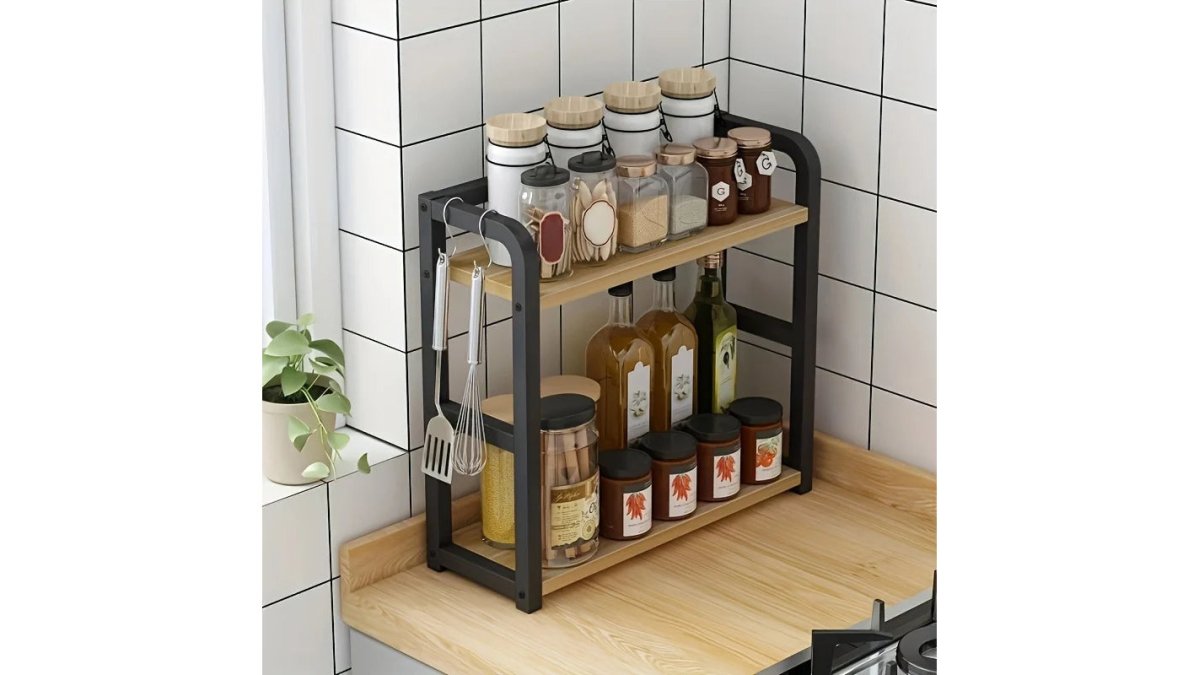
Our CounterRise 2-Tier Shelf is built for exactly this. Its rust-resistant metal and two-tier layout hold mugs, spices, condiments, and coffee essentials without spreading across the counter.

Then enforce the one-in-one-out rule: buy a new mug, and one leaves. This habit keeps the counter clear for good.
A Zone-by-Zone Counter Plan (The Step Most Guides Skip)
Work left to right so you never re-clutter a zone you just finished:
- Prep zone, the stretch of counter between the sink and the stove. Keep only a cutting board, one knife block or magnetic strip, and a small bowl for scraps. Everything else moves.
- Cooking zone, the counter beside the stove. One tray for oil, salt, pepper, and a spoon rest. Nothing tall that blocks your reach to the burners.
- Coffee or beverage zone, a single tiered shelf or tray. This is where a two-tier unit earns its space, because mugs and canisters stack up instead of out.
- Landing zone, the spot where you drop keys, mail, and groceries. Give it one shallow basket and nothing more, or it becomes the default clutter pile.
- Sink rim, a draining caddy only. No bottles lined up along the backsplash.
Measure usable counter depth before you buy. Standard counters are about 25 inches deep, but a small kitchen often has only 18 to 24 inches of clear depth once the backsplash and appliances are counted.
What Actually Belongs on the Counter
A simple test: if you touch it fewer than three times a week, it does not live on the counter. That usually leaves a coffee maker, knife storage, a cutting board, one cooking-oil tray, and a sink caddy.
For renters avoiding permanent changes, a countertop tiered shelf or freestanding riser does the same vertical work as a wall-mounted rail without drilling.
Best Small Kitchen Storage Ideas for Cabinets and Drawers
Small kitchen storage ideas make cabinets and drawers work harder, not bigger. You cannot add square footage, but you can add usable layers, pull-out access, and clear zones.
Start inside the cabinet you open most. If you have to move three things to reach one, the layout is the problem.
Adjustable Shelves, Shelf Risers, and Pull-Out Drawers
Adjustable shelves raise or lower to match what you store. Shelf risers create a second level inside an existing shelf, so a stack of plates becomes two tidy rows.
For cookware, a rack that stands pans on edge can be an effective alternative to stacking them. Our PanNest Adjustable Pot Organizer uses carbon steel and stainless steel construction with an adjustable layout, so pots, pans, lids, and baking trays each get a slot.

For dry goods, clear stackable canisters make a pantry shelf readable at a glance. Our FreshSeal Pantry Storage Canister uses an airtight silicone seal in five sizes, from 460ml to 1800ml, so rice, pasta, and flour line up instead of spilling sideways.
Drawer Trays That Stop Silverware From Sliding
A loose utensil drawer can waste depth because everything shifts into one corner. An expandable tray adjusts to the drawer's width and gives each category its own compartment.
Our FlexiTray Adjustable Silverware Organizer expands to fit different drawer sizes and keeps forks, spoons, and knives separated. It is $39.99, made from durable plastic, and light enough to lift out for a quick rinse.
Under Sink Organization Ideas for Awkward Plumbing and Disposals
Under sink organization ideas have to respect one hard constraint: the plumbing and garbage disposal often occupy the center of that cabinet.
Measure the clear height on each side of the disposal before buying anything; most cabinets have more usable room there than people assume.
Here is how to plan that cabinet in order:
Sinkelle CabinetFlow Hanging Organizer →
- Photograph the pipes and disposal from inside the cabinet
- Measure clear height and width on both sides
- Group supplies by task: dishwashing, surface cleaning, trash bags
- Place the most-used group at the front edge
- Use a caddy to contain small items that would otherwise scatter
- Leave the disposal area completely clear
- Recheck that nothing touches a hot water line
A compact caddy keeps sponges, scrubbers, and soap together and lets water drain away instead of pooling.
| Zone | What Goes There | Why It Works |
|---|---|---|
| Left of disposal | Tall spray bottles | Clear height for uprights |
| Right of disposal | Stacked refills | Flat, stable surface |
| Front edge | Daily cleaners | Reach without bending deep |
| Sink rim | Sponge and soap caddy | Drains directly into sink |
| Door back | Thin racks | Uses unused door depth |
Small Apartment Kitchen Organization: Renter-Friendly, No-Drill Fixes
Small apartment kitchen organization often requires non-permanent solutions. Renters may have restrictions on drilling into cabinets or tile, so solutions that attach, hang, or rest without leaving a mark are often preferred, and some strong options need no hardware at all.
Magnetic mounting can be a clean answer for metal surfaces. If your refrigerator is magnetic, its side wall can offer unused storage space.
Magnetic, Hanging, and Over-the-Sink Options That Leave No Marks
Our Magnetic Refrigerator Storage Shelf attaches to compatible metal refrigerator surfaces with a magnetic mounting system, no drilling or permanent wall mounting.
For under-cabinet space, our CabinetFlow Hanging Organizer hangs beneath cabinets and shelves using durable metal construction.

Over the sink, our ExtendDry Retractable Sink Rack extends to fit different sink sizes and drains directly into the basin, so washed dishes and rinsed produce never occupy the counter.
How to Organize a Small Kitchen by Layout and Dimensions
Layout decides which storage ideas actually fit. A galley kitchen with two parallel runs needs different solutions than an L-shape with a corner. Match the product to the shape before you buy.
| Layout | Main Constraint | Best Fix | SinkElle Pick |
|---|---|---|---|
| Galley | Narrow walkway | Wall and under-cabinet storage | CabinetFlow Hanging Organizer |
| L-shape | Dead corner | Tiered and riser storage | CounterRise 2-Tier Shelf |
| U-shape | Deep lower cabinets | Pull-out and rack access | PanNest Pot Organizer |
| Studio | Almost no counter | Over-sink and magnetic storage | ExtendDry Sink Rack |
| One-wall | No upper cabinets | Vertical stacking | SpiceRise 3-Tier Organizer |
Measure These Numbers Before You Buy
Many organizing purchases can be more successful with careful measurement. Write down four figures before you shop:
- Counter depth, the clear distance from the backsplash to the front edge. Standard residential counters run about 25 inches, but small kitchens often have 18 to 24 inches of clear depth once appliances are counted.
- Clear cabinet height, the space between two shelves, measured at the shortest point. A riser or tiered shelf taller than this will not fit, no matter how good the reviews are.
- Lower-cabinet depth, many base cabinets are about 24 inches deep, which is why items at the back disappear. Anything past the front 12 inches needs a pull-out or rack to stay reachable.
Those four numbers can help reduce wrong purchases. A tiered organizer too tall for your cabinet may not be functional.
A Zone-by-Zone Sequence That Works in Any Layout
Instead of buying organizers room-wide, organize one zone at a time in this order, a sequence that can help maintain organization in a small kitchen.
- Counter and prep zone, clear it first, because it is the surface every other zone feeds into.
- Everyday cookware cabinet, the one you open most. Add a rack or riser so pans stand on edge.
- Lower cabinets, add pull-out access so the back half becomes usable.
- Under-sink cabinet, build around the plumbing and disposal, not over them.
- Pantry or dry-goods shelf, group by category and use clear, stackable containers.
- Refrigerator, last, because it depends on what you already moved out of the pantry.
Weight, Safety, and Accessibility Limits
Storage ideas only work if they hold up and stay safe. A few practical limits:
- Heavy cookware goes low. Cast iron, Dutch ovens, and stockpots belong in lower cabinets or on a sturdy pull-out, not on a high shelf where lifting them is awkward and risky.
- Respect rated weight. Pull-out drawers and glides list a weight capacity. Overloading them bends the track, and a bent track usually cannot be repaired.
- Keep chemicals away from food and kids. Store cleaning supplies in the under-sink cabinet with a child safety latch, separate from anything that touches food.
Match the Fix to the Shape
For a galley kitchen, the walkway is the constraint, so favor wall-mounted and under-cabinet storage that keeps the floor clear. For an L-shape, tiered and riser storage reclaims the dead corner.
For a compact spice setup, our SpiceRise 3-Tier Organizer uses an adjustable three-tier layout with a built-in storage drawer, keeping seasonings visible and within reach for $58.99.
Keeping It Organized: A 15-Minute Weekly Reset
A system can be more effective if it is maintained. A 15-minute weekly reset can help keep a kitchen organized.
Set a timer and work in this order:
- Clear the counter completely
- Return every item to its assigned zone
- Wipe the sink area and caddy
- Check the spice rack for anything expired
- Reset the silverware drawer
- Empty the under-sink caddy and let it dry
- Put one thing in the donate bag
Fifteen minutes, once a week. That is the whole commitment. The U.S. Department of Agriculture's food safety guidance is a useful reference when you are checking pantry items for freshness during that reset.
Conclusion: Pick Three Zones and Start There
You do not need to reorganize the entire kitchen this weekend. Pick three zones: the counter, the cookware cabinet, and the sink area.
SinkElle builds minimalist, Scandinavian-inspired organization for exactly these zones. Our systems use waterproof materials, require no tools for installation, and maximize sink area space while reducing clutter.
Shop now at SinkElle and turn three small zones into a kitchen that finally works the way you cook.
Frequently Asked Questions
What is the best kitchen organizer for a small kitchen?
The best pick depends on where your space disappears. If counters are the problem, a two-tier countertop shelf at $34.99 or a retractable over-sink rack at $24.99 frees the surface you cook on. If cabinets are jammed, an adjustable pot organizer at $38.99 lets you stack pans vertically instead of nesting them. For drawers, an expandable silverware tray at $39.99 adapts to odd widths. Start with the zone that frustrates you most, not with the biggest organizer you can find.
How can I maximize counter space in a small kitchen?
Move anything you touch less than daily off the counter entirely. Paper towels, cutting boards, and pot lids can hang beneath a cabinet instead of sitting on the surface. Sponges and soap belong in a compact sink caddy that drains, not in a puddle beside the faucet. A tiered shelf lets mugs and spices stack upward rather than spread outward.
What are the common mistakes to avoid in small kitchen layouts?
Buying organizers before decluttering can be a common mistake. This can lead to storing unused items in containers that then block the items you do use. Second: stacking pots and pans without a rack can scratch cookware and make it harder to access what you need. Third: ignoring weight limits, especially on magnetic and hanging mounts, can lead to issues. Fourth: choosing opaque bins can hide duplicates you keep rebuying. Clear containers and open racks can help keep inventory visible.
How do I keep the area around my kitchen sink organized?
Give every sink item one fixed home. A compact caddy with an open, ventilated base holds sponges, scrubbers, and soap while letting water drain away instead of pooling. A retractable rack that sits over the sink handles dishes and rinsed produce without eating counter space. Wipe the caddy weekly and rinse the rack so residue does not build up. When each item has a slot, the sink area resets itself in seconds after every meal.
What are the trends for small kitchens in 2026?
Vertical and magnetic storage are the two shifts showing up most in compact kitchens. Magnetic shelves that attach to refrigerator sides add storage without drilling, which matters for renters. Adjustable organizers that flex to fit odd cabinet and drawer widths are replacing fixed-size trays. Bamboo and matte black metal finishes are replacing bright plastic. The throughline: fewer permanent installations, more pieces that move with you and adapt as your kitchen changes.