


Last Updated: October 29, 2026
Quick Summary
Choose sustainable wood kitchen storage by checking where the wood comes from, how it is made, and how long it will last. Look for a named forest or region, a third-party certification such as FSC, a low-VOC finish, and a sturdy build that can be repaired.
- Ask whether the seller names the forest or region the wood came from.
- Check the FSC license code on the FSC public database and confirm whether it is FSC 100% or FSC Mix.
- Choose a low-VOC finish and let finished pieces air out before installing them.
- Use solid wood or plywood where water and load are likely; reserve MDF and particleboard for dry, light-duty storage.
- Treat "eco" or "green" labels as meaningless without a specific certification or sourcing detail.
Table of Contents
- What Makes Wood Kitchen Storage Sustainable
- Solid Wood vs. Engineered Wood Cabinets
- Checking FSC-Certified Wood Kitchen Cabinets
- Using Reclaimed Wood Kitchen Shelves
- Choosing Low-VOC Wood Finishes for Kitchens
- A Buying Checklist for Small-Kitchen Wood Storage
- Booking Your Sustainable Storage Upgrade With SinkElle
- Frequently Asked Questions
What Makes Wood Kitchen Storage Sustainable
Choosing sustainable wood kitchen storage starts with where the wood comes from and how it is made.
Sustainability has several parts. Wood should come from forests that are managed on purpose, so that trees are replaced as they are cut.
Research on wood sourcing supports this broader view. A Sustainability journal study comparing imported wood from different regions looked at harvesting and manufacturing together, not just the raw timber.
Use these four checks as a starting point:
- Source: Does the seller name the forest or region the wood came from?
- Certification: Is there a third-party label such as FSC?
- Finish: Is the coating low in volatile organic compounds (VOCs)?
Watch out: a "natural" or "eco" label on its own tells you nothing. Ask for the specific certification or sourcing detail before you pay for it.
Solid Wood vs. Engineered Wood Cabinets
Solid wood is cut from a single piece of timber. For a deeper guide to sustainable cabinetry materials and their tradeoffs, see sustainable cabinetry materials guide. Engineered wood, plywood, medium-density fiberboard (MDF), and particleboard, glues layers, veneers, or fibers together into panels.
Most buyers treat this as an appearance decision. It is really a whole-life decision: where the fiber came from, how much processing and adhesive went into it, how it handles moisture and load, whether it can be repaired, and what happens at end of life.
How Each Type Performs in a Kitchen
Kitchens are hostile to wood. Steam from a dishwasher, splashes at the sink, heat from an oven, grease in the air, and repeated wiping all stress the material. Performance depends less on the species than on how the panel is built and sealed.
- Solid wood expands and contracts with humidity. A solid shelf or door near a sink or dishwasher can cup, warp, or open at the joints if it is not sealed on every face and edge. It is heavy, so wall mounting needs proper anchors and studs. It can be sanded and refinished, which extends its life.
- Plywood is dimensionally stable because the layers cross-grain. Good plywood holds screws well at the edges and resists warping better than solid wood in humid spots. The adhesive between plies is the emission concern.
- MDF is dense and smooth, which makes it good for painted doors and routed profiles. It swells badly if water reaches an unsealed edge, and it does not hold screws as well as plywood. Keep it away from the sink base and any spot that can flood.
A practical rule: use solid wood or plywood where water and load are likely, and reserve MDF and particleboard for dry, light-duty storage such as upper pantry shelves and drawer boxes.
Load, Hardware, and Drawer Construction
Storage fails at the joints and the hardware before the wood itself gives out. Check these details on any cabinet or shelf you consider:
- Shelf span. A shelf that spans too far without a center support will sag over time, especially in MDF and particleboard. Look for a mid-support or a thicker shelf on wide spans.
- Drawer boxes. Dovetail joints and solid-wood or plywood sides outlast stapled particleboard boxes. Metal-sided drawer boxes are common and durable but add a different material to the life-cycle picture.
- Runners and hinges. Undermount soft-close runners and metal hinges are replaceable. Confirm the hardware is a standard pattern so you can source a replacement years later.
Cost, Lifespan, and Repairability
Cost tracks material and construction, not just the wood species.
Lifespan follows the same order. A well-built plywood or solid-wood unit can be refinished and re-hardwared for decades. A particleboard unit that takes on water is usually a replacement, not a repair.
Repairability is the quiet advantage of solid wood and plywood. Scratches sand out, dents steam out, and a failed hinge can be re-drilled and re-mounted.
Where Solid Wood Falls Short
Solid wood is heavy, and it costs more to ship. A buyer's guide on sustainable kitchen cabinet door styles notes these practical drawbacks and says solid wood can carry a higher price.
Plan for these issues before you buy. Keep solid wood shelves away from direct water, and seal every edge, including the back and the underside, which are the faces most often left raw.
Checking FSC-Certified Wood Kitchen Cabinets
FSC certification means the wood came from a forest managed under the Forest Stewardship Council's standards, and that the chain of custody was tracked from the forest to the product.
Here is how to verify a claim:
- Find the FSC license code on the product page or packaging.
- Confirm the code on the FSC public database.
- Check whether the label says "FSC 100%" or "FSC Mix." The first means all the wood is certified. The second means a blend.
- Ask the seller which part of the product carries the certification.
Some sellers mention a price premium for certified wood. One source estimates a 20 to 40 percent premium over non-certified wood, but treat that figure as an unverified claim. Compare quotes from several sellers before you accept a premium.
Sinkelle SpinSpice Bamboo Rack →
Using Reclaimed Wood Kitchen Shelves
Reclaimed wood comes from old barns, factories, warehouses, and furniture. Reusing it keeps timber out of new harvests and gives older boards a second life.
Most guides stop at that feel-good point. The practical question is whether a specific reclaimed board is safe, stable, and verifiable for kitchen use. That is where reclaimed wood differs most from new certified lumber, and where a little checking saves a lot of regret.
What Reclaimed Wood Can Carry
Old boards were not made for food storage. Before you put one above a counter or inside a pantry, ask what the wood was previously used for and how it was cleaned.
- Fasteners. Nails, staples, and screws are common, and a hidden nail can ruin a saw blade or a drill bit. Ask whether the seller has de-nailed and metal-detected the stock.
- Old finishes. Lead paint, creosote, and older oil finishes are the main concern on barn and exterior wood. Any board with unknown coating should be stripped and refinished before it goes near food.
- Pests and rot. Barn wood can carry insect damage or rot pockets. Check for soft spots, frass, and powdering.
A seller who cannot answer these questions is not a safe source for kitchen storage, however good the board looks.
How to Verify a Reclaimed Claim
"Reclaimed" is not a regulated label the way FSC certification is. Anyone can use the word. Verify it the way you would verify a sourcing claim:
- Ask for the origin. A specific building, region, or salvage source is a good sign. "Reclaimed wood" with no origin is a marketing phrase.
- Ask for the chain of custody. Who salvaged it, who milled it, and who finished it? A short, named chain is easier to trust than an anonymous one.
- Ask for a finish schedule. What was removed, what was applied, and is the final finish low-VOC? Get it in writing.
- Ask about testing. For older painted wood, a lead test is inexpensive and worth requesting.
- Check the moisture content. Kiln-dried reclaimed stock is more stable indoors than air-dried barn wood. Ask for the reading.
Cost and Where Reclaimed Fits
Reclaimed wood pricing varies widely with species, age, character, and how much milling the seller has done.
Reclaimed works best for visible, dry, light-load storage: open shelves, pantry inserts, and freestanding racks.
For a shelf in a tight space, measure carefully and check the mounting points. If you plan a corner or pull-out install, read our guide on how to install pull out shelves in corner cabinets before you drill.
Choosing Low-VOC Wood Finishes for Kitchens
Finishes seal wood against water and grease, but some release VOCs into the air for weeks after application.
Look for water-based or oil-based finishes marked low-VOC or zero-VOC. Let any finished piece air out in a ventilated room before you install it.
A Kitchen Cabinet Manufacturers Association buyer's guide on eco-friendly kitchen cabinets says quality wood cabinets are recyclable and biodegradable and need less energy to process than metal and plastic.
A Buying Checklist for Small-Kitchen Wood Storage
Small kitchens leave little room for mistakes, so measure first and buy second. If you want minimalist layouts, browse Scandinavian kitchen storage design ideas for space-saving approaches. Use this checklist before you order:
- Measure the exact width, depth and height of the space, including the sink and stove clearances.
- Confirm the wood species and whether it is solid or engineered.
- Check for an FSC license code and a low-emission rating.
- Confirm the finish is low-VOC.
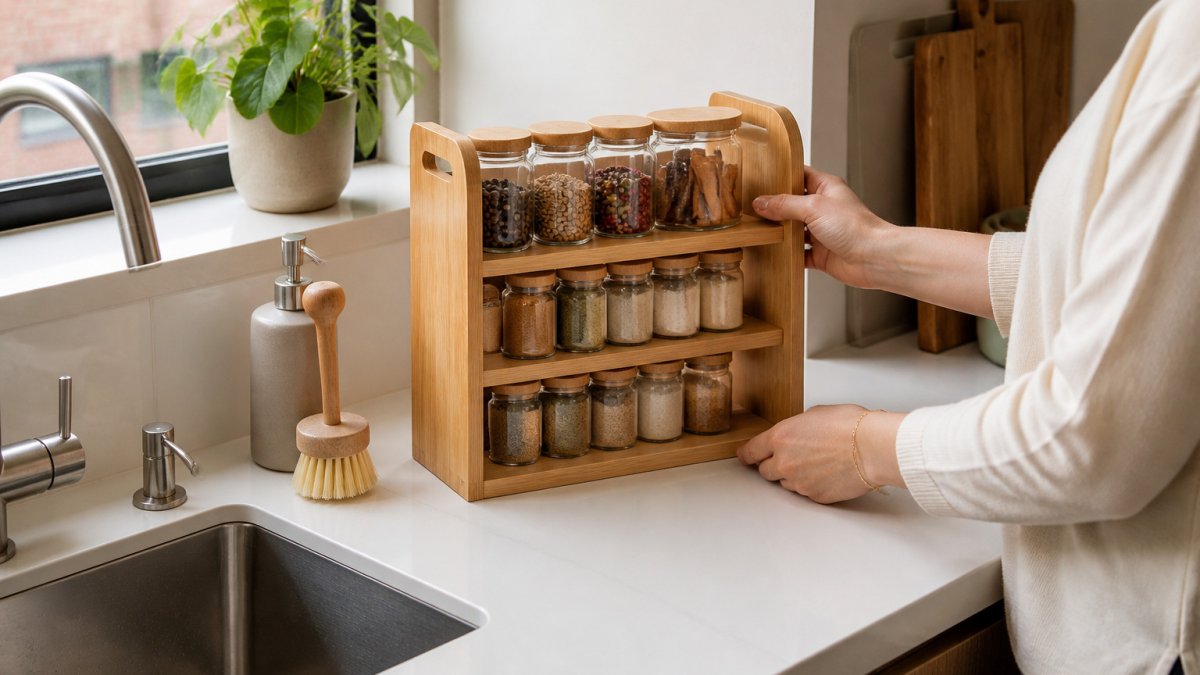
A bamboo spice rack is a practical example. The Sinkelle SpinSpice Bamboo Rack at $29.99 uses a rotating, multi-layer design to organize spices and seasonings. It is made from bamboo.

Other options fit different needs. The Sinkelle VineNest Bamboo Wine Rack at $64.99 holds bottles on the counter, and the Sinkelle 2-Tier Pantry Storage Rack at $71.99 adds shelf space in a pantry or cabinet.


Before you order, compare the main options and their key details.
| Item | Value | Note |
|---|---|---|
| SinkElle SpinSpice Bamboo Rack | $29.99 | Rotating, multi-layer spice organizer |
| SinkElle VineNest Bamboo Wine Rack | $64.99 | Holds bottles on the counter |
| SinkElle 2-Tier Pantry Storage Rack | $71.99 | Adds shelf space in a pantry or cabinet |
Booking Your Sustainable Storage Upgrade With SinkElle
Choosing sustainable wood storage is easier when you know the sourcing, the finish and the fit before you buy. Our bamboo racks are made from natural bamboo. Start with the checklist above, measure your sink area, and pick the piece that matches your layout.
Frequently Asked Questions
What makes wood kitchen storage sustainable?
Wood kitchen storage is more sustainable when the wood comes from responsibly managed forests, the panels and finishes avoid high formaldehyde and VOC emissions, and the piece lasts long enough to avoid replacement. Look for FSC certification to confirm forest sourcing, check whether engineered panels are labeled low-emission, and favor solid or durable pieces you can repair. Durability is often the biggest factor, because a storage piece that lasts decades has a smaller footprint than one replaced every few years.
Is solid wood more sustainable than engineered wood?
Not automatically. Solid wood is a renewable material and can be very long-lasting, but it is heavier, costs more to ship, and moves with humidity. Engineered wood uses less timber per piece by bonding veneers or wood fiber, but the adhesives can emit formaldehyde unless the panel is labeled no-added-formaldehyde or low-emission. For a small kitchen, a well-made engineered shelf with a low-emission label can be a sound choice, while solid wood suits pieces you expect to keep for years.
How can I tell whether wood is responsibly sourced?
Look for an FSC label and ask the seller for its chain-of-custody certificate number, which you can check on the FSC public database. A claim such as 'eco-friendly' or 'sustainable' without a certification number is not verified. Be aware that certified wood often carries a price premium, and one search source estimates it at 20-40% over non-certified wood, though that figure is unverified and should be checked against the seller's own pricing.
What finishes are safer for kitchen storage?
Choose water-based or low-VOC finishes, and check the product's technical data sheet for VOC content. Low-VOC finishes release fewer volatile compounds into your indoor air, which matters in a small kitchen where air circulates less. Let any new finish cure fully and ventilate the room while it dries. Pieces finished this way are also easier to clean and maintain, which supports a longer product life.
