


Last Updated: October 27, 2026
Quick Summary
Smart kitchen organization for daily cooking starts with mapping your cooking zones before buying anything, so every tool sits within one reach of where you use it. Items used fewer than three times a week do not earn counter space, and organizers should pass a 12-inch footprint test. Measure every drawer and cabinet first, then place organizers by zone rather than by category.
- Map the sink, prep, stove, and storage zones by walking through one dinner prep.
- Anything stored in the wrong zone gets moved twice per use.
- Give countertop organizers a 12-inch footprint test before they earn space.
- Wall rails typically need 24 to 36 inches of clear wall above the counter.
- Set a 10-minute weekly reset and a quarterly audit to keep the system working.
Table of Contents
- Why Cooking Routine Should Drive Your Kitchen Organization
- Kitchen Counter Organization: What Earns Space and What Doesn't
- Kitchen Drawer Organizers That Survive Real Cooking
- Kitchen Cabinet Organization for Pots, Pans, and Pantry Overlap
- Small Kitchen Organization Ideas for Apartments and Tight Galley Layouts
- Fit, Food Safety, and Material Checks Before You Buy
- A Step-by-Step Setup and Maintenance Plan
- Build Your System Around Your Sink Area
- Frequently Asked Questions
Why Cooking Routine Should Drive Your Kitchen Organization
Most kitchen organization fails for one reason: it is built around storage capacity instead of cooking motion. Smart kitchen organization systems for daily cooking start with how you actually move through the room, not how much you can cram into a cabinet.
The principle is simple. A kitchen organization plan should put every tool within one reach of the moment you need it. Anything that breaks your cooking flow costs you time on every single meal.
Map Your Cooking Zones Before You Buy Anything
Walk through one dinner prep and note where you stand. You will find three or four zones: the sink, the prep counter, the stove, and the storage wall. Write down what your hands reach for in each one.
- Sink zone: sponges, dish soap, scrubbers, a drying surface
- Prep zone: knives, cutting boards, mixing bowls, spices
- Stove zone: cooking utensils, oils, pot lids
- Storage wall: pots, pans, pantry staples, containers
Anything stored in the wrong zone gets moved twice per use. Fix the zone map first, then buy organizers that fit it. Shelf Theory's guide to smart pantry organization makes the same point about digital labeling tools: the system only works if it matches the routine.
Kitchen Counter Organization: What Earns Space and What Doesn't
Counter space is the scarcest surface in a small kitchen, and most of it gets lost to items that never move. Kitchen counter organization is a filtering exercise, not a storage exercise.
What earns permanent counter space:
- The appliance you use daily, plugged in and ready
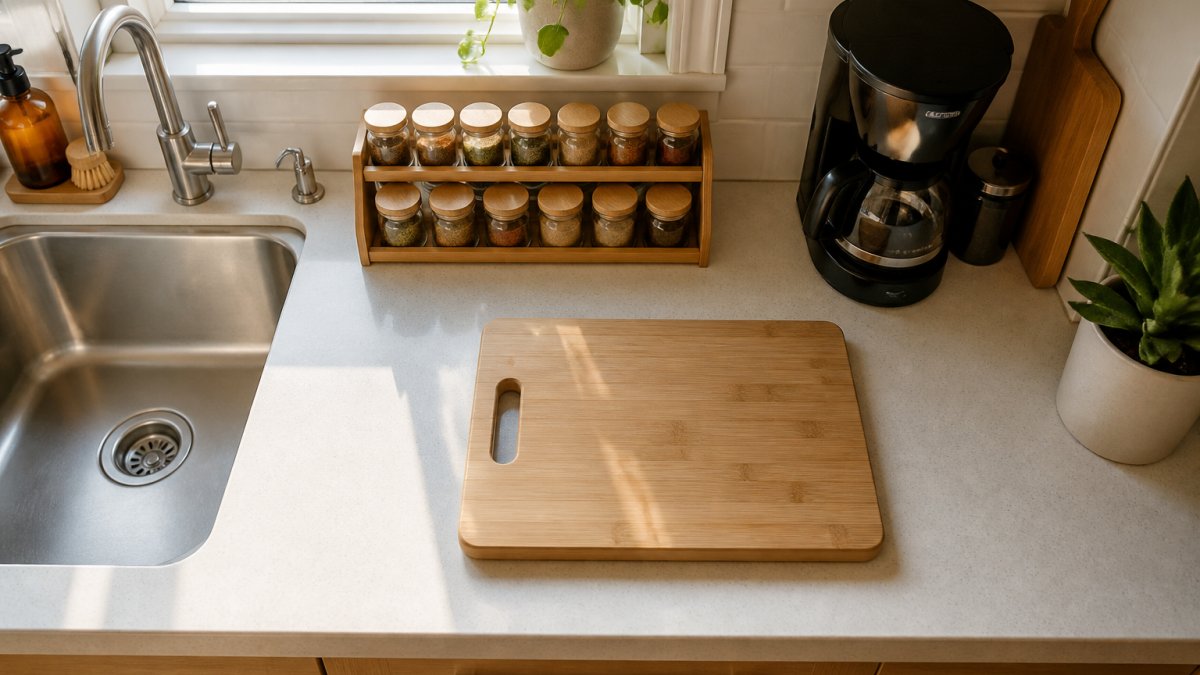
- A cutting board you reach for every meal
- One spice station, tiered or rotating, holding only what you cook with
- A single catch-all tray for oil, salt, and utensils
What does not: bread boxes, decorative canisters, appliance duplicates, and anything you have to move before you can cook.
The 12-Inch Rule for Countertop Organizers
Give any countertop organizer a 12-inch footprint test. If it takes more than 12 inches of depth or width, it had better replace at least two other items or hold something you use every day.
Our Sinkelle SpinSpice Bamboo Rack passes this test because it stacks seasoning vertically on a rotating base instead of spreading bottles across the counter. Bamboo construction keeps it light enough to lift for cleaning, and the rotation means you are not shuffling jars to find cumin mid-recipe.
Kitchen Drawer Organizers That Survive Real Cooking
A common mistake is buying a matching set for every drawer before measuring. Measure first, buy second. Before you shop, read our breakdown of kitchen drawer organizer buying mistakes so you skip the sizing errors that force a return.
Kitchen Cabinet Organization for Pots, Pans, and Pantry Overlap
For cookware, an adjustable rack that holds lids separately prevents the stack-and-scrape cycle that damages nonstick surfaces. Our Sinkelle PanNest Adjustable Pot Organizer uses carbon steel and stainless steel construction with adjustable dividers, so you can resize the slots as your cookware changes.
For dry goods, clear labeled containers do two jobs: they show you what is running low, and they keep staples sealed. Our Sinkelle FreshSeal Pantry Storage Canister uses an airtight silicone ring and stackable clear bodies in five capacities, from 460ml to 1800ml, so rice, flour, and pasta each get the right size. Browse the full pantry and food storage organizers collection to match capacities to your shelf depth.
Small Kitchen Organization Ideas for Apartments and Tight Galley Layouts
Three moves that work in tight layouts:
Sinkelle SpinSpice Bamboo Rack →
- Go vertical on the wall with a rail or rack for utensils and towels. A wall rail typically needs 24 to 36 inches of clear wall above the counter to stay useful without crowding the backsplash. In a rental, use adhesive-backed rails rated for the weight you plan to hang, and test the adhesive on an inconspicuous spot first.
- Use a rolling cart as movable prep space that tucks away when you are done. Measure the gap between the counter edge and the opposite wall before buying: most standard carts are 15 to 20 inches deep, and a cart that leaves less than 30 inches of walkway turns a galley into a one-person kitchen.
- Exploit the cabinet door with over-the-door organizers for lids and foil. Door organizers add roughly 3 to 5 inches of depth inside the cabinet, so confirm the door still closes over the items you load and that the hinge swing is not blocked.
Our Sinkelle RollCrest Kitchen Island Cart fits this approach: a drop-leaf top extends to 22.8 inches for prep, then folds flat to reclaim floor space, and locking casters hold it steady while you work. A built-in power strip means you are not fighting for wall outlets. Before you commit floor space to a cart, run the walkway test: stand where you cook, extend the cart to its open position, and confirm you can still open the oven door and reach the sink without sidestepping.
Working Around Under-Sink Plumbing and Disposals
Measure the cavity before you buy. A typical under-sink cabinet is about 30 to 36 inches wide, but the disposal housing and P-trap often leave only 8 to 12 inches of usable depth on one side and a shallow shelf in front. For a deeper walkthrough of these constraints, see our guide to under sink cabinet organization tips for small kitchens.
Fit, Food Safety, and Material Checks Before You Buy
Run this checklist before you buy:
- [ ]
- [ ]
- Check door clearance: does the organizer block the hinge swing?
- [ ]
- [ ]
- [ ]
- [ ]
For under-sink environments specifically, our guide to durable materials for under sink storage covers which finishes resist moisture and which warp. On food safety, the USDA Food Safety and Inspection Service guidance on food storage is the reference to follow for how long dry goods and leftovers keep.
| Check | What to Measure | Why It Matters |
|---|---|---|
| Cabinet width | Interior side to side | Prevents drawer and rack binding |
| Cabinet depth | Front to back wall | Ensures door closes fully |
| Door clearance | Hinge swing arc | Avoids blocked access |
| Seal type | Airtight ring | Keeps dry goods fresh |
A Step-by-Step Setup and Maintenance Plan
Most organization guides stop at the before-and-after photo.
Phase 1: Measure and Map (30 to 45 minutes)
- Measure every drawer, cabinet, and shelf you plan to reorganize. Record interior width, depth, and height, plus door clearance and hinge swing. Keep the numbers in a note on your phone so you can check them against product specs before ordering.
- Walk through one dinner prep and note where you stand. Mark the sink, prep counter, stove, and storage wall. Write down what your hands reach for in each zone.
- Set a reach standard. Items used daily belong between hip and shoulder height and within one arm's reach of the zone where they are used. Items used weekly go one shelf up or down. Items used monthly go high or low.
Phase 2: Sort and Zone (one afternoon)
- Empty one zone at a time. Do not pull everything at once, or you will end up with a counter full of clutter and no place to cook dinner.
- Sort into keep, relocate, and remove. Be honest about duplicates. A second garlic press is not a backup; it is a drawer blocker.
- Clean the empty surface before anything goes back.
- Place organizers by zone, not by category. A utensil crock belongs next to the stove, not in a drawer across the room because that is where the other utensils live.
- Load the most-used items at hand height and the rest above or below.
- Label containers so the system survives other household members. A label maker or a strip of masking tape and a marker is enough; the goal is visibility, not aesthetics.
Phase 3: Maintain and Measure (10 minutes a week)
- Set a 10-minute weekly reset. Return stray items to their zone, wipe the counter, and check that nothing has migrated.
- Do a quarterly audit. Pull one zone, check for duplicates and expired pantry goods, and adjust the placement if your cooking has changed.
- Track one outcome. Pick a single measure, such as how many times you have to move an item to reach the tool you need during dinner prep, or how long it takes to clear the counter after cooking. If the number does not improve after two weeks, the zone map is wrong, not the organizers.
Build Your System Around Your Sink Area
SinkElle offers minimalist Scandinavian-inspired organization solutions designed to elevate the sink area.
Start with the sink zone, then work outward to prep, stove, and storage. If you want to see how the pieces fit together, explore our cabinet and pot organization collection and build the system one zone at a time.
Frequently Asked Questions
How do I organize my kitchen for everyday cooking?
Start with where you actually stand while cooking, not with the shelves. Put the tools and seasonings you touch every day within arm's reach of the stove and prep area, then move occasional items higher or further back. A rotating spice rack can keep seasonings visible and accessible. Group items by task (prep, cooking, cleaning) rather than by type, and leave one clear landing zone near the sink for items in transition.
What kitchen organizers are most useful for daily cooking?
The ones that remove a step from your routine. A rotating spice rack provides access to different spices, an adjustable pot organizer accommodates cookware of different sizes, and airtight stackable canisters provide clear storage for dry goods. Expandable drawer organizers and tiered shelving help too, but only if they match your drawer depth and cabinet height. Before buying, measure the space and count how often you reach for the item. Anything you use less than weekly can live further away.
How should I organize kitchen drawers for utensils?
Empty the drawer, keep only what you used in the past month, and lay the rest out flat to see the real footprint.
How can I make a small kitchen easier to cook in?
Use vertical space and wheels. A rolling island cart with a drop-leaf top provides a surface that folds flat when not in use. The Sinkelle RollCrest Kitchen Island Cart has a built-in power strip.
How do I organize kitchen cabinets for easy access?
Reserve the cabinet next to the stove for pots and pans and use an adjustable rack so lids and bakeware don't stack into a wall. Store everyday plates and glasses between waist and shoulder height, and push rarely used serving pieces to the top shelf. Keep one shelf for pantry overflow and store dry goods in clear, stackable canisters.
How can I keep a kitchen organized after cooking?
Build cleanup into the cooking flow instead of treating it as a separate job. Clear and wipe the counter while something simmers, put ingredients back as soon as you finish with them, and run a two-minute reset before you sit down to eat. Give every item a fixed home so nothing lands on the counter by default. A weekly ten-minute check, refilling canisters and returning stray tools, stops small messes from turning into a full re-organization.
Your kitchen will not organize itself, and generic bins will not survive a real cooking schedule. SinkElle builds waterproof, tool-free organization systems with a minimalist Scandinavian finish, designed to maximize sink-area space and cut counter clutter in minutes. Get started with SinkElle and turn your sink area into the most functional zone in your kitchen.
