


Table of Contents
- How to Maximize Kitchen Counter Space Without Permanent Changes
- Renter Friendly Kitchen Organization: Damage-Free Installation Rules
- Small Kitchen Sink Organization: Tension Rods, Caddies, and Drainage
- Under-Sink Storage Hacks That Work Around Plumbing
- Wall-Mounted and Hanging Storage: Adhesive Hooks, Rails, and Over-Door Racks
- DIY vs. Store-Bought: Budget Non Permanent Kitchen Storage Hacks
- Maintenance and Cleaning Routines for Long-Lasting Organization
- Conclusion: Building a System You'll Actually Maintain
- Frequently Asked Questions
Last Updated: September 16, 2026
How to Maximize Kitchen Counter Space Without Permanent Changes
Non permanent kitchen storage hacks are reversible organizing solutions that add usable space without drilling, screwing, or altering cabinets and walls. They rely on tension, adhesion, and freestanding design, which makes them the default choice for renters and anyone protecting a security deposit. This guide from SinkElle covers seven approaches, from vertical risers to over-door racks, that you can install in an afternoon and remove without a trace.
The core problem is simple: most apartment kitchens were designed for cooking, not storing. Countertops become landing zones for mail, appliances, and spice jars because there is nowhere else for those items to go. The fix is not fewer things. It is better use of the space you already pay for.
Below, we'll show you exactly how to reclaim counter real estate using vertical storage, cabinet risers, and wall-mounted systems that leave zero damage behind.
Renter Friendly Kitchen Organization: Damage-Free Installation Rules
Renter friendly kitchen organization starts with one rule: if it needs a drill, it needs your landlord's permission. Everything else, including adhesive hooks, tension rods, and over-door racks, is fair game in most leases. Check your lease language on wall adhesives first, since some agreements restrict even removable strips.
Three installation methods cover nearly every non permanent solution:
- Tension: Spring-loaded rods grip between two surfaces. Best for under-sink cabinets and inside drawers.
- Adhesion: Removable adhesive strips and hooks hold light loads. Clean the surface with rubbing alcohol first; grease is the number one reason adhesive fails in kitchens.
- Gravity and over-door: Hanging racks rest on cabinet tops or door panels with no fasteners at all.
A common mistake is loading adhesive hooks before the strip has cured. Wait the full recommended time, usually an hour, before hanging anything.
The U.S. Department of Housing and Urban Development tenant rights guidance is a useful starting point if you need to clarify what counts as normal wear and tear versus damage.
Small Kitchen Sink Organization: Tension Rods, Caddies, and Drainage
Small kitchen sink organization works best when you separate three jobs: holding, draining, and drying. A sink caddy holds sponges and brushes; a splash mat catches drips; a tension rod creates storage behind closed doors. Grouping these functions keeps the sink zone from becoming a wet clutter pile.
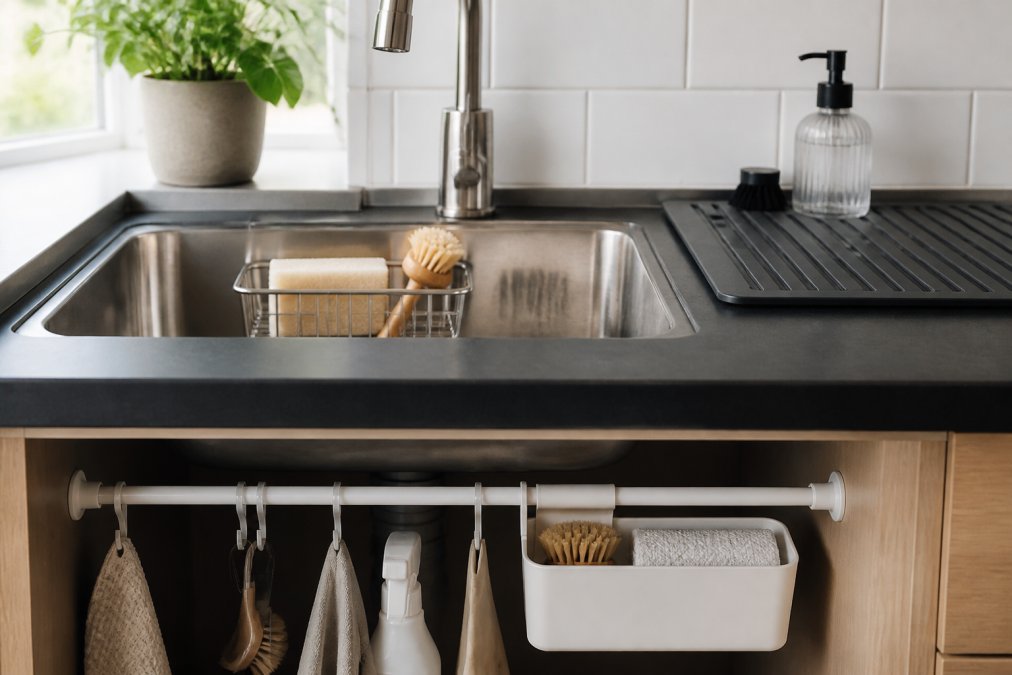
[IMAGE: A close-up of a small apartment kitchen sink area with a stainless steel sink caddy holding a sponge and dish brush, a tension rod under the sink, and a black silicone splash mat on the counter.
- Measure the gap, then buy slightly longer. A rod rated for the exact width will slip; a rod that compresses 1 to 2 inches into the gap holds.
- Mount between structural surfaces. Cabinet side walls and the underside of a shelf are ideal. Do not span a gap where one side is a flimsy back panel.
Common placements that survive daily use:
- One rod across the back of the under-sink cabinet, at mid-height, for spray bottles hanging by their trigger necks.
- A second rod lower and forward for scrub brushes and dish gloves.
- A short rod inside the sink base, just under the rim, for a folded dish towel.
One more renter-specific note: before you install a tension rod under the sink, confirm the cabinet floor is dry and the side walls are solid. Particleboard side panels can crumble under sustained pressure, and a rod that dents a cabinet interior is the kind of mark a landlord may charge for. A folded strip of shelf liner under each end cap spreads the load and protects the finish.
Under-Sink Storage Hacks That Work Around Plumbing
Under-sink storage is the most wasted cabinet in a rental kitchen, and the reason is almost always the garbage disposal and the P-trap. The workaround is to stop treating the cabinet as one open box and start treating it as zones. The center is blocked. The sides and the door are not.
Two layouts handle most plumbing configurations:
- Side stacking: Place a two-tier organizer on the left or right of the disposal, leaving the center clear.
- Perimeter shelving: Use narrow bins along the cabinet walls and reserve the back for items you rarely touch.
Wall-Mounted and Hanging Storage: Adhesive Hooks, Rails, and Over-Door Racks
Wall-mounted and hanging storage adds capacity without consuming a single square inch of floor or counter. Adhesive hooks and rails handle light tools; over-door and under-cabinet racks handle bulk. The trick is matching the load to the mount, because an adhesive hook that fails takes your pans with it.
Weight guidelines that hold up in practice:
- Adhesive hooks: keep to lightweight items such as towels, utensils, and measuring cups
- Hanging rails with S-hooks: mugs, small pans, and cleaning tools
- Under-cabinet racks: paper towels, cutting boards, and pot lids
- Over-door organizers: packaged goods, cleaning supplies, and linens
DIY vs. Store-Bought: Budget Non Permanent Kitchen Storage Hacks
| Need | DIY Option | Store-Bought Option | Best For |
|---|---|---|---|
| Drawer dividers | Cardboard and contact paper | Adjustable drawer inserts | Hidden storage |
| Spice storage | Shoebox lid riser | SinkElle SpiceRise 3-Tier Organizer ($58.99) | Countertops and cabinets |
| Sink drainage | None practical | SinkElle FlowRack Pro ($29.99) | Wet zones |
| Narrow gap storage | None practical | SinkElle FlowCart Storage Rack ($30.99) | Gaps under 20 cm |
| Cookware | None practical | SinkElle PanNest Adjustable Pot Organizer ($38.99) | Cabinet interiors |
A practical rule for renters: spend on the items that touch water or carry weight, and improvise everything else. The money you save on drawer dividers funds the one organizer that actually solves a problem you cannot work around.
Maintenance and Cleaning Routines for Long-Lasting Organization
A note on waterproof claims: silicone and stainless steel hold up to daily water contact far better than coated particleboard or untreated bamboo, which is why sink-adjacent storage should be specified differently from pantry storage.
Conclusion: Building a System You'll Actually Maintain
The hardest part of non permanent kitchen storage is not installation. It is keeping the system running after the novelty wears off. Most setups fail because they were built around an ideal of how you cook rather than the way you actually cook.
Frequently Asked Questions
What are some effective non permanent kitchen storage hacks for a small kitchen?
Start with tension rods under the sink to hang spray bottles, adhesive hooks on the inside of cabinet doors for measuring cups, and stackable bins on top of the fridge. A rolling utility cart fits narrow gaps between appliances and holds pantry items or cleaning supplies. For the sink area, a rust-resistant stainless steel rack keeps sponges and brushes off the counter without drilling. These non permanent kitchen storage hacks add usable space without damaging walls or cabinets, so you can rearrange them whenever you need.
How can I add storage to my kitchen without drilling holes?
Use tension rods inside cabinets, over-the-door organizers, adhesive hooks rated for the weight you need, and freestanding tiered shelves. Command strips and adhesive hooks work on tile, glass, and painted walls but may pull paint when removed, so test a small area first. For under-cabinet storage, a hanging organizer that hooks over the cabinet door or shelf edge adds space without screws. These renter friendly kitchen organization methods let you add storage and remove it cleanly when you move.
How do I maximize counter space in a small kitchen?
Move items up, not out. A 2-tier countertop shelf doubles vertical storage for mugs, spices, or coffee supplies while using the same footprint. A 3-tier spice organizer keeps jars visible and off the main prep area. For the sink, a splash mat with a sloped drain keeps the counter dry so you can use that zone for other tasks. Group items by task, like a coffee station or cooking prep zone, so you only keep what you use daily on the counter.
What are the best adhesive-based storage solutions for kitchens?
Adhesive hooks and strips work best for lightweight items: utensils, small pans, measuring spoons, and towels. Look for hooks rated at least 2 pounds more than the item's weight, and apply them to clean, dry, smooth surfaces like tile or glass. Avoid hanging cast iron or heavy pots on adhesive. For heavier items, use over-the-door racks or tension rods instead. Always remove adhesive slowly with a hairdryer on low heat to protect the wall.
How can I organize a kitchen without a pantry?
Create a pantry zone on open shelving, inside a cabinet, or on a rolling cart. A 2-tier bamboo rack fits on a countertop or shelf and holds jars, spices, and snacks. Use clear modular bins with labels so you can see what you have and avoid duplicates. A slim rolling cart fits beside the fridge or in a narrow gap and holds dry goods. Keep first-in-first-out in mind: put older items in front and newer ones behind so nothing expires.
The challenge is not finding storage ideas. It is choosing the few that fit your plumbing, your lease, and your daily habits, then maintaining them long enough to become automatic. SinkElle builds minimalist, waterproof, tool-free organization systems specifically for sink areas and small kitchens, with no drilling and no permanent installation. Browse the full range at SinkElle and start with the piece that solves your biggest daily friction point.