


Table of Contents
- The Real Problem: Your Kitchen Is Costing You Time
- How to Declutter Kitchen Counters: The 15-Minute Purge
- Create Functional Kitchen Zones for Workflow Efficiency
- Minimalist Kitchen Storage Solutions That Earn Their Space
- Time-Saving Kitchen Organization Tips for Maintenance
- What to Skip: Storage Trends That Waste Money
- Build a System That Survives Your Schedule
- Frequently Asked Questions
Last Updated: September 6, 2026
Kitchen organization is the practice of arranging your cooking space so that every tool, ingredient, and appliance has a designated home that supports efficient daily use. For busy professionals, a disorganized kitchen directly steals minutes from your morning routine and adds friction to every meal. The goal is not a picture-perfect pantry, but a functional system that survives your schedule.
The Real Problem: Your Kitchen Is Costing You Time
Most guides treat kitchen disarray as a visual problem, but for anyone working long hours, it is a time and decision problem. Every minute spent hunting for a spice jar, digging for a pot lid, or wiping a cluttered counter is cognitive bandwidth lost before your day starts (apa.org).
Buying more bins and baskets often just creates a more organized-looking pile. The actual fix is spatial planning: designing your kitchen so that the items you use most frequently live in the most accessible zones. Reducing the physical distance between your coffee mug and the machine, or your cutting board and your knives, reduces task time. This principle, known as workflow efficiency, is the foundation of every recommendation here.
How to Declutter Kitchen Counters: The 15-Minute Purge
The fastest way to reclaim countertop space is to remove everything that doesn't have a daily or weekly job. Kitchen counters should only host tools you use at least once a week; everything else belongs in a cabinet, a drawer, or the trash (extension.umn.edu).
Set a timer for 15 minutes and clear the entire counter. Sort every item into four boxes: Keep, Relocate, Donate, and Discard. This forces quick decisions and prevents analysis paralysis. Once clear, only return the "Keep" items to the surface, placing them in the functional zones we will build next. This purge is the single highest-impact step because it instantly creates visual calm and physical space.
The Four-Box Method for Kitchen Items
The Four-Box Method is a decision framework that makes decluttering fast and decisive. Here is how to apply it specifically to kitchen items:
- Keep: Daily-use items like your coffee maker, toaster, oil, salt, and your favorite chef's knife.
- Relocate: Items used weekly or monthly, such as the stand mixer, slow cooker, or specialty baking pans. These belong in cabinets or a pantry zone.
- Donate: Duplicates, gadgets you haven't touched in a year, and serving pieces that are not your style.
- Discard: Broken tools, mismatched lids, expired spices, and worn-out cutting boards.
Create Functional Kitchen Zones for Workflow Efficiency
Kitchen zones are designated areas where all related items live together, allowing you to complete tasks without crossing the room repeatedly. The five core zones are: Prep, Cooking, Cleaning, Coffee/Beverage, and Pantry. For the busy professional, the true goal is ergonomic workflow optimization, aligning storage with the professional mise en place method to shave minutes off every meal.
The Mise En Place Principle for Home Cooks
Professional chefs use mise en place, which translates to 'putting in place.' For a home cook, this principle translates into designing zones that minimize the physical distance between the three main workstations: the storage station (refrigerator/pantry), the preparation station (counter/cutting board), and the cooking station (stove/oven). The goal is a smooth, triangular flow between these points.
Consider the ergonomics of your movements. Your Prep Zone should not just be near the fridge; it should have a dedicated cutting board that is always out or easily accessible, with your chef's knife stored on a magnetic strip directly above it. This eliminates opening a drawer every time you chop an onion. The most efficient kitchens use a 'grab-and-go' approach: the tool and its primary surface are co-located.
Zone-Specific Ergonomics for Speed
Here’s how to apply ergonomic principles to each zone to reduce wasted motion:
- Prep Zone: Place a knife block or magnetic strip on the wall between the sink and the stove. Store cutting boards vertically in a nearby cabinet slot, not stacked flat. Keep a small bowl for compost or trash on the counter to avoid multiple trips to the bin. This creates a single, fluid motion from washing to chopping.
- Cooking Zone: Store your most-used pots and pans in a drawer or on a pull-out shelf directly beneath or beside the stove. Hanging heavy pans on a wall rack above the stove is ergonomic if you are tall enough to reach them without stretching. Keep oils, salts, and your primary cooking spoon in a caddy on the counter next to the burners. This prevents you from turning your back on the stove, which is both a time-saver and a safety improvement.
- Cleaning Zone: The sink is the pivot point of the kitchen. To make it ergonomic, place your dish soap in a pump dispenser and your sponge in a holder that attaches to the side of the sink, not on the back of the counter. This reduces the reach and keeps the counter clear. A roll-up drying rack placed next to the sink is more flexible than a built-in one and can be stored away when not in use.
- Coffee/Beverage Zone: This zone should be a self-contained 'pod.' If you have the counter space, use a tray to corral the machine, mugs, and coffee beans. This allows you to pull the entire zone forward if you need more counter space for a big meal prep, and then push it back. This is a unique strategy that adds flexibility to a fixed layout.
The 'One-Reach' Test
After you have arranged your zones, perform a 'one-reach' test. For your top three most-performed tasks (e.g., making coffee, preparing a salad, cooking pasta), simulate the process. If you have to take more than one step or make more than one reach to gather the primary items, the zone is not optimized. For example, for your coffee task, your mug, beans, and machine should all be within a single arm's length of each other. If you have to walk to a different cabinet for a mug, the system is broken.
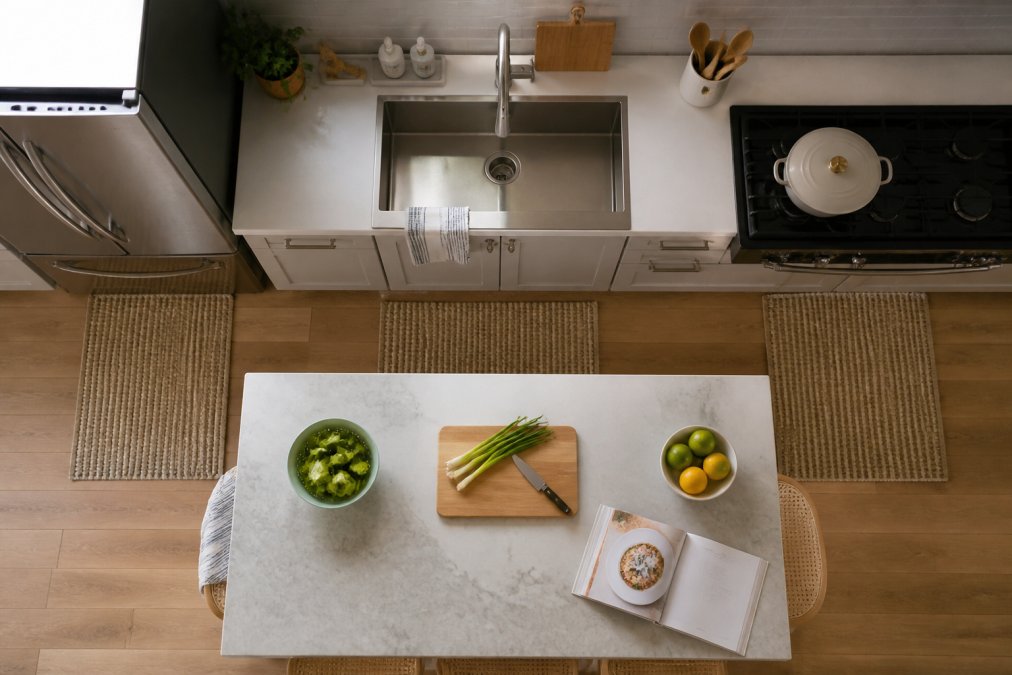
Minimalist Kitchen Storage Solutions That Earn Their Space
Minimalist kitchen storage solutions are about maximizing function per square inch. The best options use vertical space, keep items visible, and do not require permanent installation, which is ideal for renters.
Prioritize stackable containers, shelf risers, and magnetic strips to exploit unused vertical storage. Clear, stackable containers with labeling systems are essential for pantry staples, as they allow you to see inventory at a glance and apply a first-in-first-out approach to food safety (the FDA). Inside cabinets, drawer dividers prevent chaos, while a pot organizer like the SinkElle PanNest Adjustable Pot Organizer can transform a jumbled cabinet into a functional cooking zone by keeping lids and pans neatly separated.

The key is to choose pieces that serve multiple purposes. A tiered spice rack, such as the SinkElle SpiceRise 3-Tier Organizer, not only declutters the counter but also improves accessibility, so you can find the cumin without moving three other jars. This focus on accessibility and inventory management separates a minimalist aesthetic from a merely empty one.
Time-Saving Kitchen Organization Tips for Maintenance
Most organization systems fail not due to the initial setup but due to the lack of a maintenance routine that fits a professional's schedule. A system requiring a 30-minute weekend reset is unsustainable. The advantage lies in a proactive, time-boxed maintenance framework that leverages habit and technology to prevent clutter from compounding.
The 10-Minute Weekly Reset Framework
Instead of a daily deep clean, adopt a structured, 10-minute weekly reset. Schedule it for a low-energy time, such as Sunday evening or Monday morning, and set a timer. The framework has three phases:
- The 2-Minute Sweep (Minutes 1-2): Quickly scan all horizontal surfaces, counters, island, and dining table. Return any item that has migrated from its designated zone to its home. This is a rapid 'orphan retrieval' process, not a deep clean.
- The 5-Minute Zone Audit (Minutes 3-7): Open your two most-used cabinets and your refrigerator. Check for three things: items out of place, empty containers that need refilling, and any spoiled food. This audit prevents the 'out of sight, out of mind' problem that leads to food waste and last-minute scrambles.
- The 3-Minute Tech Check (Minutes 8-10): This is where you integrate digital tools. If you use a grocery app, add any items you noticed were low during the audit. If you use a digital inventory system, update it. If not, this is the time to clear the charging station of any non-essential devices.
Leveraging Smart Tech for Maintenance
Technology can automate and streamline the maintenance process. Consider these integrations:
- Digital Inventory Management: Apps like AnyList or Paprika can track pantry staples. When you use the last of an item, add it to your list immediately. This prevents overbuying and ensures you always have what you need for a recipe, eliminating the need for a separate 'pantry check' step.
- Smart Plugs for Routine Appliances: Place your coffee maker or kettle on a smart plug. Set a schedule to turn it on 10 minutes before your alarm. This not only saves time but also creates a 'ready' state that encourages you to use the designated zone, reinforcing the system.
- Camera-Based Pantry Scanners:
The 'One-Touch' Rule for High-Traffic Zones
In addition to the weekly reset, implement a 'one-touch' rule for your highest-traffic zones, like the coffee station and the sink. When you finish using an item, immediately return it to its home. After your morning coffee, rinse the mug and place it in the dishwasher, and wipe the counter. This takes 30 seconds but prevents the 'pile-up' effect. This habit, combined with the weekly reset, creates a sustainable system requiring minimal daily effort and no weekend deep cleans.
What to Skip: Storage Trends That Waste Money
Not every popular storage solution is worth the investment. Many trendy organizers are designed for aesthetic appeal but fail in real-world conditions.
Skip single-use gadgets that only do one obscure job, like avocado slicers or specialized herb keepers that take up prime real estate. Avoid open shelving if you do not have the time to style it regularly, as it simply displays visual chaos. Be wary of cheap plastic bins that warp or crack, and magnetic strips that are not strong enough to hold heavier knives safely. The most common mistake is buying storage before measuring the drawer or cabinet depth, resulting in items that do not fit. Instead, invest in durable, multi-functional pieces that solve a specific spatial problem you have already identified.
Build a System That Survives Your Schedule
A resilient kitchen organization system is built on three pillars: accessibility, visibility, and maintenance. If you cannot see it, you will forget you have it. If it is hard to reach, you will not use it. If it is hard to clean, you will abandon it.
Start by mapping your daily flow and identifying the top three tasks you perform most often. Then, design your zones to support those tasks with the fewest possible steps. Choose waterproof, easy-to-wipe materials to handle wear and tear. For the sink area, the command center of the kitchen, investing in a durable, rust-resistant system ensures longevity. The SinkElle CounterRise 2-Tier Shelf is designed to withstand moisture while keeping daily essentials within arm's reach.

The ultimate goal is not perfection, but efficiency. By combining a thoughtful layout with a quick daily reset, you create a space that serves you rather than demands your attention. This approach reduces stress, saves time, and makes cooking feel less like a chore and more like a moment of calm.
Organizing your kitchen requires more than just buying containers; it demands a system that respects your time and habits. SinkElle offers a range of minimalist, Scandinavian-inspired organizers, from the CounterRise 2-Tier Shelf to the CabinetFlow Hanging Organizer, all designed with waterproof materials and tool-free installation for effortless setup. These pieces help maximize your sink area and counter space so you can reduce clutter and improve your daily efficiency. Get started with SinkElle and build a kitchen that works as hard as you do.
Frequently Asked Questions
How do you organize a kitchen when you have no time?
Focus on a 15-minute daily reset rather than a weekend overhaul. Keep daily-use items on the counter in zones: coffee near the kettle, oils beside the stove. Use vertical storage like the SinkElle CounterRise 2-Tier Shelf to keep essentials visible without taking up footprint. Commit to one purge session per month and a 5-minute evening tidy so the system maintains itself.
What are the best minimalist kitchen organization tools?
The best minimalist kitchen storage solutions do two things: they hold items you use weekly and they take up no additional floor or counter space. Look for rust-resistant metal organizers with clean lines. The SinkElle CabinetFlow Hanging Organizer adds storage under existing cabinets, and the SpiceRise 3-Tier Organizer keeps jars visible without cluttering prep areas.
How can I maximize counter space in a small kitchen?
Start by removing everything that doesn't get used daily. Store small appliances in cabinets or on shelves, then add vertical layers for what remains. A two-tier shelf like the SinkElle CounterRise consolidates coffee and condiment items into half the footprint. Use wall-mounted magnetic strips for knives and hanging racks for mugs to keep the counter clear for food prep.
What are the most effective kitchen storage trends for 2026?
The strongest trend is modular vertical storage that adapts to your workflow, not just your aesthetic. Adjustable pot organizers, tiered spice racks, and under-cabinet hanging shelves are outperforming single-purpose bins because they make items visible and accessible. The SinkElle PanNest Adjustable Pot Organizer fits odd-shaped cookware and maximizes cabinet height, which matters more than color-coordinated containers.