


Table of Contents
- Minimalist Kitchen Organization vs Traditional Storage: Core Differences
- Best Minimalist Kitchen Sink Organizers and Setup
- Decluttering Kitchen Countertops: Minimalist Approach
- Small Kitchen Storage Solutions: Maximizing Limited Space
- Cost-Benefit Analysis: Retrofitting for Minimalist Design
- Ergonomics and Accessibility in Kitchen Organization
- Maintaining Your Chosen Storage System Long-Term
- Frequently Asked Questions
Last Updated: September 3, 2026
Minimalist Kitchen Organization vs Traditional Storage: Core Differences
The choice between minimalist kitchen organization and traditional storage fundamentally shapes how your kitchen functions and feels. These two approaches represent opposing philosophies about what belongs on your countertops, in your cabinets, and within your visual field.
Minimalist kitchen storage strips away everything except what you use regularly. It prioritizes empty countertops, hidden storage, and intentional placement of only essential items. Traditional storage, by contrast, embraces visible organization, open shelving, labeled containers, and accessible displays of your cooking tools and ingredients. The difference isn't just aesthetic; it's about spatial awareness, workflow efficiency, and the psychological impact of your environment.
At SinkElle, modern homeowners increasingly lean toward minimalist design, yet many struggle to maintain it without the right systems. The tension between these approaches reveals something important: neither is universally superior. What matters is which aligns with your lifestyle, your kitchen's physical constraints, and your tolerance for visual clutter.
| Aspect | Minimalist Kitchen Storage | Traditional Storage |
|---|---|---|
| Visual Appearance | Clean, empty countertops; hidden items | Visible organization; accessible displays |
| Countertop Space | Maximized; only essentials visible | Reduced; frequently used items on display |
| Accessibility | Requires opening cabinets; slower access | Quick grab-and-go; items always visible |
| Maintenance | Demands discipline; clutter returns quickly | More forgiving; visible items stay organized |
| Psychological Impact | Reduces mental load; promotes calm | Functional visibility; reduces decision fatigue |
| Best For | Small spaces; design-conscious homeowners | Busy cooks; frequent kitchen use |
| Installation Complexity | Moderate; requires strategic planning | Simple; works with existing layouts |
Best Minimalist Kitchen Sink Organizers and Setup
Minimalist kitchen sink organization means creating a functional hub that looks intentionally sparse. Your sink area becomes the anchor point, everything else flows from that decision. The goal is to eliminate visual noise while maintaining quick access to the items you use daily.
Start with vertical storage solutions that pull items off the countertop. Under-cabinet hanging systems are ideal for this. They create additional storage without expanding your footprint, keeping dishcloths, cutting boards, and pot lids within arm's reach but out of sight. The Sinkelle CabinetFlow Hanging Organizer ($44.99) exemplifies this approach, it mounts beneath cabinets and transforms dead space into functional storage for essentials, reducing countertop clutter while maintaining workflow efficiency.

For items that must live near your sink, use tiered shelving with flush fronts and handleless cabinetry aesthetics. A 2-tier shelf like the Sinkelle CounterRise ($34.99) keeps soap dispensers, sponges, and hand towels organized vertically, doubling your storage capacity without widening your footprint. The key is choosing organizers with slim profiles and neutral color palettes, they recede visually while doing heavy organizational lifting.
The minimalist sink setup requires ruthless editing. Ask yourself: Does this item live here because I use it daily, or because I haven't found a home for it? Items used weekly or less should move to closed storage. Your visible sink area should contain only what you touch multiple times per day: soap, a sponge, maybe a drying rack. Everything else, cleaning supplies, backup sponges, decorative items, belongs inside cabinets or under-sink storage.
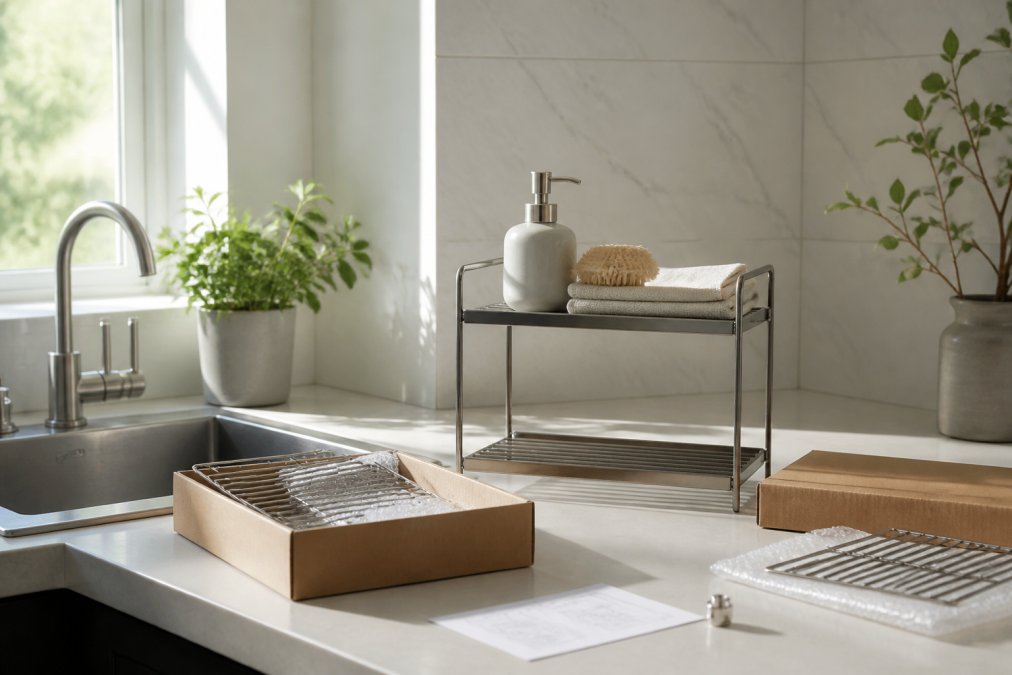
Waterproof materials are non-negotiable near sinks. SinkElle products use durable, water-resistant construction specifically designed for sink environments where moisture and splashing are constant.
:::pro The minimalist sink setup works best when you commit to a one-in-one-out rule: every new item that arrives near your sink displaces something else. This prevents the slow creep of clutter that undermines minimalist design. :::
Decluttering Kitchen Countertops: Minimalist Approach
Decluttering countertops is where minimalist philosophy proves its worth. Every item visible represents a decision your brain makes subconsciously. Empty countertops reduce this cognitive load, a measurable benefit when you're tired and cooking dinner (peer-reviewed research).
Start by removing everything from your counters. Yes, everything. Then ask three questions about each item: Do I use this weekly? Does it belong near the sink? Is it decorative enough to justify the space? Only items that answer "yes" to at least two questions earn counter real estate.
Small appliances are the primary culprit. Your coffee maker, toaster, and blender should live in cabinets unless you use them daily. If you brew coffee every morning, it earns a spot. If you make smoothies twice a month, it doesn't. This isn't about deprivation, it's about intentionality. You'll actually use these appliances more if you set them up deliberately rather than letting them languish on a cluttered counter.
Spices and cooking ingredients belong in closed storage or tiered organizers that maximize vertical space. The Sinkelle SpiceRise 3-Tier Organizer ($58.99) handles this elegantly, it stores 30+ spice jars in a compact footprint while keeping them organized and accessible. Tiered design improves visibility and prevents the "lost spice" problem where items vanish in the back of cabinets.

Countertop clearance isn't just about aesthetics. It changes how you move through your kitchen. With open counter space, you have room to prep meals, set down groceries, and work without constantly shifting items. This workflow efficiency translates to cooking faster and with less frustration.
Small Kitchen Storage Solutions: Maximizing Limited Space
Small apartments and compact kitchens demand ruthless space optimization. Every inch counts, and traditional storage, which relies on spreading items across multiple surfaces, wastes precious real estate. Minimalist kitchen organization becomes not a lifestyle choice but a necessity.
Vertical storage is your primary tool. Wall-mounted shelving, tiered organizers, and hanging systems pull storage off the floor and out of your limited counter space. A 2-tier bamboo rack like the Sinkelle 2-Tier Pantry Storage Rack ($71.99) expands your storage capacity without expanding your footprint. Bamboo construction adds warmth to small spaces while maintaining the minimalist aesthetic.
Under-sink organization is critical in small kitchens. Most people waste this space completely. Adjustable pot organizers like the Sinkelle PanNest ($38.99) let you store cookware vertically inside cabinets, freeing shelf space for other essentials. Cabinet inserts and drawer dividers create order in confined spaces.
Hidden storage becomes your secret weapon. Small kitchens benefit enormously from closed cabinets and drawers that keep visual clutter contained. Open shelving, popular in traditional design, makes small spaces feel cramped and chaotic. Every item on display competes for visual attention, making the space feel smaller than it actually is.
Modular storage systems work better than fixed solutions in small kitchens. You need flexibility to adapt as your needs change. Adjustable shelving and removable organizers let you reconfigure your setup without major renovation.
Cost-Benefit Analysis: Retrofitting for Minimalist Design
Retrofitting an existing kitchen for minimalist organization requires upfront investment, but the math often favors it over traditional storage solutions.
Many homeowners assume minimalist design costs more because SinkElle and similar brands charge premium prices compared to plastic bins from big-box retailers. This misses the calculation. A minimalist retrofit typically involves:
- 2-4 tiered organizers or hanging systems: $150-250
- Under-cabinet storage solutions: $45-75
- Cabinet dividers and drawer inserts: $30-60
- Total investment: roughly $225-385
Traditional storage retrofitting costs similarly but with hidden expenses: you buy multiple organizing systems that don't coordinate, replace them when they break, and often store backup supplies that clutter cabinets. The real cost difference emerges over time.
Minimalist systems from SinkElle use waterproof, rust-resistant materials that last without degradation. Over a 5-year period, you might replace cheaper systems 2-3 times, negating any initial price savings (the FTC).
The intangible benefits matter too. A minimalist kitchen saves mental energy daily. You spend less time searching for items, making decisions about where things belong, and feeling frustrated by clutter. For busy professionals, this psychological benefit translates to real quality-of-life improvement.
The cost-benefit equation shifts dramatically in small spaces. If you're renting and need temporary solutions, minimalist organizers with tool-free installation (like SinkElle's product line) avoid landlord conflicts and security deposits. If you own your home, minimalist design increases perceived value, clean, organized kitchens are a major selling point.
Ergonomics and Accessibility in Kitchen Organization
How you organize your kitchen directly impacts your physical comfort and injury risk. This is where minimalist and traditional approaches create measurable differences.
Minimalist design often places frequently used items in less accessible locations, inside cabinets, on high shelves, or in deep drawers. This creates friction. You reach for your coffee maker less often if it lives in a cabinet, which might be good for minimalism but bad for your actual workflow. The ergonomic principle is simple: items you use daily should live at waist height, within arm's reach, requiring no bending or reaching (osha.gov).
Traditional storage respects this principle better. Open shelving at eye level, countertop appliances, and visible organization mean less physical strain. If you have mobility limitations, arthritis, or back problems, traditional storage becomes not a preference but a necessity.
The solution is hybrid organization: minimalist aesthetics with ergonomic placement. Use the Sinkelle CounterRise 2-Tier Shelf to store items at waist and eye level, this maintains the visual minimalism while keeping frequently used items accessible. Tiered organizers create natural ergonomic zones where you don't have to bend or reach excessively.

Accessibility matters for aging in place. If you plan to stay in your home long-term, consider how your organization system will work as you age. Items stored on high shelves or in low cabinets become increasingly difficult to retrieve. Adjustable organizers let you modify your setup as your physical capabilities change.
Maintaining Your Chosen Storage System Long-Term
The psychological impact of kitchen environments reveals why many people abandon their organization systems within months. A minimalist kitchen requires constant maintenance. Without discipline, clutter creeps back, and the system collapses.
Traditional storage is more forgiving because visible organization is self-reinforcing. When items have obvious homes on open shelves, returning them is automatic. When everything is hidden, you need stronger habits to maintain the system.
Successful long-term minimalist maintenance requires three elements: ruthless editing (removing items regularly), intentional placement (every item has one specific home), and essentialism (resisting the urge to accumulate).
Implement a monthly review. Spend 15 minutes examining what's accumulated on your counters and in your cabinets. Remove items you haven't used in that month. This prevents the slow drift toward clutter that undermines minimalist design.
Traditional storage systems require different maintenance: regular relabeling, periodic reorganization as your needs change, and occasional decluttering of duplicate items. The maintenance burden is higher but more straightforward, you're managing visible items, not hidden ones.
SinkElle organizers are designed for easy maintenance. Waterproof materials wipe clean in seconds. No complicated disassembly or special cleaning required. This matters more than you'd think, if your organization system is annoying to maintain, you'll abandon it.
Create a sustainable rhythm that matches your lifestyle. If you're a minimalist by nature, a minimalist system works. If you're naturally chaotic, traditional storage with visible organization might suit you better. Fighting your personality type is the fastest way to organizational failure.
The choice between minimalist kitchen organization and traditional storage isn't about which philosophy is objectively superior, it's about which aligns with your kitchen's constraints, your cooking habits, and your psychological preferences. Minimalist design wins on space optimization and visual calm. Traditional storage wins on accessibility and forgiving maintenance.
Most successful kitchens use hybrid approaches. SinkElle's product line supports this flexibility. Our minimalist Scandinavian-inspired organizers maximize your sink area and countertop space with tool-free installation, giving you the clean aesthetic of minimalism without the friction of inaccessible storage. Discover how the right organization system transforms your kitchen into a functional luxury space. Shop Now.
Frequently Asked Questions
How can I organize my kitchen in a minimalist way without losing storage capacity?
Minimalist kitchen organization prioritizes vertical storage and hidden solutions to maintain capacity while reducing visual clutter. Use tiered shelves like the Sinkelle CounterRise 2-Tier Shelf ($34.99) to stack items upward rather than outward, install under-cabinet organizers to reclaim hidden space, and commit to keeping only essentials visible on countertops. The key is storing 80% of items behind closed doors or in high shelves while displaying only frequently used, aesthetically pleasing pieces. This approach actually increases functional storage while creating a calm, streamlined appearance.
Is minimalist kitchen storage better for small apartments with limited counter space?
Yes, minimalist storage is particularly effective for small kitchens because it maximizes vertical space and eliminates visual clutter that makes rooms feel cramped. Solutions like hanging organizers and multi-tier racks create the illusion of more space by keeping countertops clear. The Sinkelle CabinetFlow Hanging Organizer ($44.99) uses under-cabinet space that would otherwise sit empty, while the SpiceRise 3-Tier Organizer ($58.99) stacks items vertically. Traditional storage often spreads items across countertops, consuming precious real estate. For apartments, minimalist organization helps maximize usable counter space.
What's the psychological impact of choosing minimalist versus traditional kitchen organization?
Minimalist kitchens reduce cognitive load and decision fatigue by limiting visual stimuli and creating a sense of control. A minimalist kitchen with hidden storage promotes mental clarity and makes cooking feel more efficient because you're not visually processing dozens of items. Traditional storage, while functional, can feel overwhelming if items are visible. The minimalist approach creates a sanctuary feeling; traditional setups prioritize accessibility over aesthetics, which works better for high-volume cooks who need everything visible and within arm's reach.
Can I retrofit my kitchen cabinets for minimalist storage without major renovation costs?
Yes. Retrofitting for minimalism doesn't require expensive renovations. Start with affordable add-ons like the PanNest Adjustable Pot Organizer ($38.99) to maximize cabinet depth, drawer dividers to create zones, and tiered shelves to add vertical capacity. These solutions typically cost $35-$75 per cabinet area. For renters or those with budget constraints, freestanding pieces like the PantryRise 2-Tier Bamboo Rack ($71.99) provide minimalist aesthetics without permanent changes. Avoid costly cabinet replacements; instead, use inserts and organizers to transform existing storage. Most retrofits are accessible regardless of budget.
How do I maintain a minimalist kitchen organization system and prevent it from becoming cluttered again?
Maintenance requires establishing a weekly 15-minute reset routine and a strict rule: every new item must replace something old. Set designated zones for different categories (spices, cookware, coffee essentials) and return items immediately after use. Use clear containers so you can see when stock runs low and avoid overbuying. Schedule a monthly audit to remove items you haven't used. The Sinkelle organizers support this by creating visible, contained spaces that make clutter obvious immediately. Traditional systems sometimes hide mess in closed cabinets, delaying maintenance. With minimalist storage, you'll notice when something's out of place within seconds, making it easier to stay on track long-term.
This article was written using GrandRanker