


Table of Contents
- Why Minimalist Kitchen Organization Matters in Tiny Homes
- Best Minimalist Kitchen Sink Organizers for Small Spaces
- Vertical Storage Solutions for Small Kitchens
- How to Organize a Kitchen with No Pantry
- Maximizing Toe-Kick Space and Hidden Storage
- Decluttering and Minimalist Principles for Tiny Kitchens
- Weight Distribution and Load-Bearing Limits
- Maintaining Your Minimalist Kitchen System
Last Updated: August 27, 2026
Why Minimalist Kitchen Organization Matters in Tiny Homes
Living in a tiny home means every inch of kitchen space counts. Minimalist kitchen organization isn't just aesthetic, it's essential for maintaining functional efficiency in restricted footprints. When your kitchen is measured in feet rather than square footage, clutter makes cooking impossible.
The core challenge: tiny kitchens force you to choose between having things and having space to use them. Most people try to fit traditional kitchen storage into compact layouts, resulting in overcrowded cabinets and cluttered countertops. Minimalist principles flip this entirely. Instead of storing everything "just in case," you keep only what you actively use, then organize those items with precision.
At SinkElle, we design organization solutions specifically for compact kitchens, products that maximize vertical space, eliminate wasted dead zones, and create visual calm. The difference between a chaotic tiny kitchen and an organized one often comes down to choosing the right tools and committing to a minimalist mindset.
Best Minimalist Kitchen Sink Organizers for Small Spaces
The sink area is often the most wasted real estate in a tiny kitchen. The best minimalist kitchen sink organizers solve this by lifting items off the counter, draining water efficiently, and creating a clean visual baseline.
Sinkelle FlowRack Pro: Drying Rack with Built-In Drainage
The Sinkelle FlowRack Pro eliminates the soggy sponge problem that plagues most tiny kitchens. Sponges sitting in puddles stay wet, smell, and leave rings on your counter, a real problem when counter space is already at a premium. This organizer lifts everything off the surface and drains on an incline, sending water back into the sink.
The angled drain tray means sponges, brushes, and dishcloths dry in hours instead of days. The rust-resistant stainless steel construction handles daily water contact without degrading. At $29.99, it offers a durable solution for kitchen organization.
For tiny homes, the key advantage is that it clears your counter completely. One compact unit holds your sponge, dish brush, dishcloth, and soap, everything you need at the sink, nothing scattered across your limited counter space. No drilling, no tools, no permanent installation.
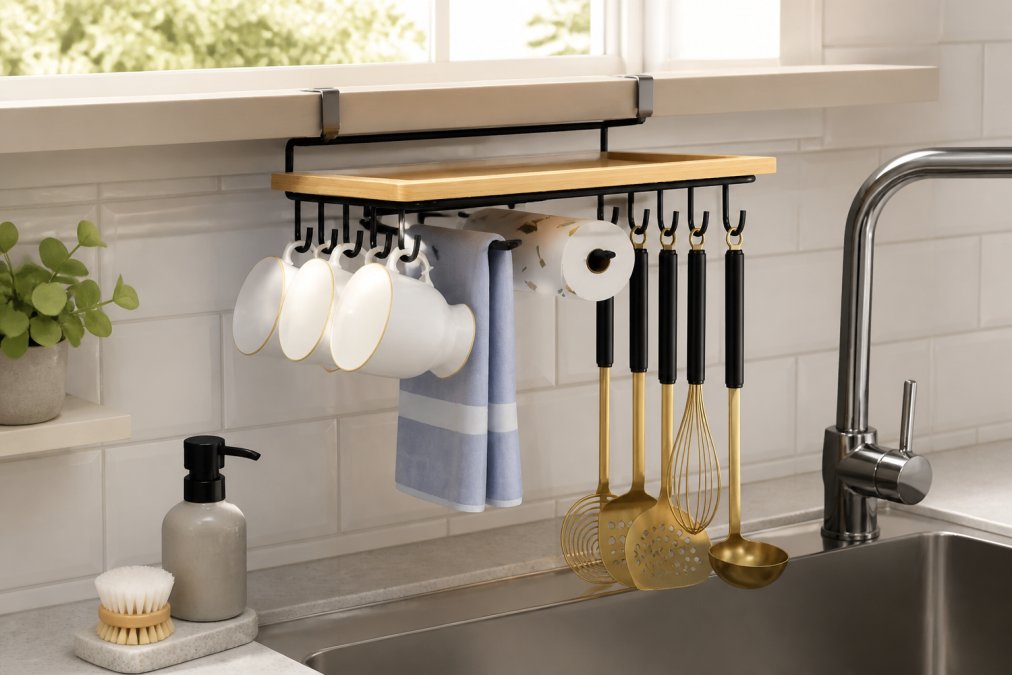
Sinkelle CabinetFlow Hanging Organizer: Under-Sink Hidden Storage
Most people waste the space directly under their sink. The Sinkelle CabinetFlow Hanging Organizer transforms that dead zone into functional hidden storage by hanging beneath cabinets instead of requiring under-sink real estate.
This organizer holds paper towels, dishcloths, cutting boards, pot lids, and kitchen wraps, items you need quick access to but don't want visible on your counter. At $44.99, it's an investment that creates extra storage without taking up any footprint. The durable metal construction supports repeated use without sagging.
For tiny kitchens, the real value is psychological. Hidden storage makes your kitchen feel larger because it removes visual clutter. When your essentials are organized and out of sight, your counter becomes a calm, open surface.
Sinkelle 2 SlideNest Organizer: Pull-Out Cabinet Access
The Sinkelle 2 SlideNest Organizer ($55.99) solves the accessibility problem in under-sink cabinets. Its smooth pull-out sliding system gives you quick access to stored items without reaching into dark corners. The 2-tier design maximizes vertical space while keeping everything visible and reachable.
This works particularly well for cleaning supplies and backup items you don't need daily but want organized. The pull-out mechanism means you can access back items without removing everything in front, critical when your storage is limited.
Vertical Storage Solutions for Small Kitchens
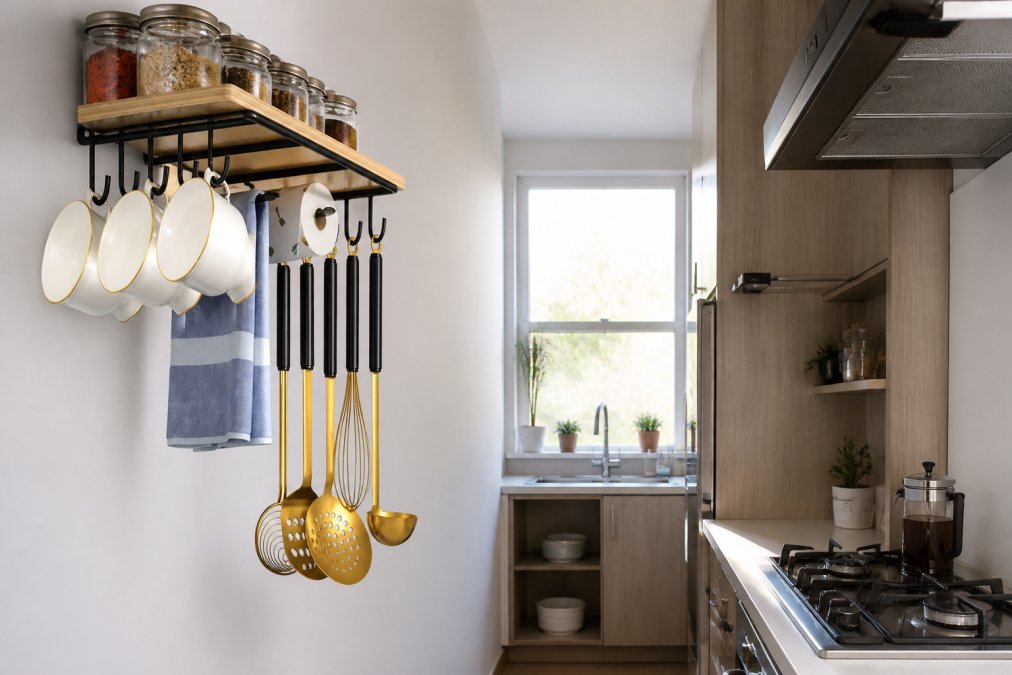
Vertical space is your best friend in a tiny kitchen. Wall-mounted racks, tiered shelving, and pegboards transform blank walls into organized zones that keep your kitchen functional without consuming precious real estate.
Wall-Mounted Racks and Pegboards
Wall-mounted racks and pegboards are the cornerstone of vertical storage optimization. They create accessible storage directly at eye level, eliminate the need for cabinet space, and make frequently used items instantly visible. A pegboard above your counter can hold knives, utensils, measuring tools, and hanging baskets, everything you reach for while cooking, organized and within arm's reach.
The minimalist approach is intentional: only mount items you use regularly. A pegboard with 12 carefully chosen tools looks clean and functional. For tiny homes, wall-mounted solutions are non-negotiable because they preserve floor and counter space.
Tiered Shelving for Spices and Essentials
Tiered shelving creates visual hierarchy while maximizing capacity in minimal space. The Sinkelle CounterRise 2-Tier Shelf ($34.99) organizes coffee essentials, mugs, condiments, and spices, items that typically scatter across your counter. The rust-resistant metal construction handles daily use without degrading.

Tiered shelving works because it displays items at different heights, making everything visible without stacking. Your spice collection becomes organized and accessible instead of hidden in a cabinet. For tiny kitchens, this transparency is essential, you want to see your inventory so you don't buy duplicates.
The Sinkelle SpiceRise 3-Tier Organizer ($58.99) offers an adjustable multi-tier layout, holding significantly more while maintaining the minimalist aesthetic.
How to Organize a Kitchen with No Pantry
Pantry-less kitchens are the norm in tiny homes. Without a dedicated pantry, your entire food storage system lives in cabinets and on shelves. Create zones: a dry goods zone, a spice zone, a baking supplies zone, each with its own storage logic.
Drawer Dividers and Cabinet Configurations
Drawer dividers transform chaotic drawers into organized zones. Each compartment holds one category: utensils in one, kitchen linens in another, measuring tools in a third. This prevents the "junk drawer" problem.
For cabinets, use vertical dividers for baking sheets and cutting boards. Use tiered organizers for pots and pans so you can access items in back without removing everything in front. The Sinkelle PanNest Adjustable Pot Organizer ($38.99) handles this specifically, accommodating cookware of different sizes while maximizing cabinet space.

The minimalist principle applies here: if you have five baking sheets, store five. Tiny kitchens force this discipline naturally because there's simply no room for excess.
Airtight Containers and Stackable Storage
Airtight containers are essential for pantry-less kitchens. They protect dry foods from moisture, dust, and humidity while creating uniform storage that stacks efficiently. The Sinkelle FreshSeal Pantry Storage Canister ($39.99) features an airtight silicone seal and crystal-clear design so you instantly see what's inside.
Stackable containers maximize vertical space within cabinets. Instead of storing rice, pasta, and flour in their original packaging, transfer them to uniform containers that stack neatly. This approach can significantly increase your effective storage capacity in the same cabinet footprint.
Clear containers with uniform labels create visual order. When your pantry is visible, you're less likely to overbuy because you can see your inventory at a glance.
Maximizing Toe-Kick Space and Hidden Storage
Toe-kick space, the gap at the base of your cabinets, is almost always wasted. Toe-kick drawers pull out like shallow filing cabinets and store flat items: baking sheets, cutting boards, serving platters, or kitchen linens.
Custom toe-kick drawers can offer substantial storage in a tiny kitchen. You gain 6-12 inches of height across your entire cabinet run, creating storage that's invisible when closed but accessible when needed.
For renters or those avoiding permanent modifications, the Sinkelle FlowCart Storage Rack ($30.99) provides similar functionality. Its slim, rolling design fits into narrow gaps between appliances and cabinets, creating accessible storage in spaces that would otherwise stay empty.
Decluttering and Minimalist Principles for Tiny Kitchens
Minimalist kitchen organization starts with honest decluttering. You can't organize what you don't need, and tiny kitchens make this painfully obvious. Every item that doesn't earn its place takes up real estate from items you actually use.
Start by identifying your core cooking activities. What do you actually cook? What tools do you actually use? Keep those items. Everything else is taking up space. This might mean letting go of that specialty pasta maker you used once or the bread machine gathering dust.
The maintenance principle is equally important. A minimalist kitchen system only works if you actively maintain it. Reassess what's in your cabinets every few months. If something hasn't been used in six months, it's probably not essential.
For tiny homes, this discipline becomes a lifestyle choice. You develop an instinct for quality over quantity. You buy tools that serve multiple purposes. You resist impulse purchases because you know every item has to justify its space.
Weight Distribution and Load-Bearing Limits
This is where most minimalist kitchen organization systems fail in practice. People overload shelves, wall-mounted racks, and organizers because they underestimate weight or ignore manufacturer specifications.
Wall-mounted racks and shelves have specific load-bearing limits. A typical metal shelf might safely hold 25-30 pounds distributed evenly. If you load it with 40 pounds, you're stressing the mounting hardware. Over time, this causes the shelf to sag, anchors to pull loose, or walls to develop damage.
For tiny kitchens, maximize doesn't mean overload. Distribute weight evenly across shelves. Heavy items (canned goods, cast iron cookware) belong on lower shelves. Lighter items (spices, dried pasta) go higher up. This principle protects your organization system from failure and prevents damage to rental walls.
The Sinkelle 2-Tier Pantry Storage Rack ($71.99) uses premium bamboo construction specifically to handle weight distribution effectively. Understanding your organizer's weight limit and respecting it is the difference between a system that lasts years and one that fails within months.
Maintaining Your Minimalist Kitchen System
Minimalist systems fail when people stop maintaining them. The first month looks perfect. By month three, items have migrated and clutter has crept back.
Maintenance requires regular small actions: putting items back in their designated spots after use, doing a quick declutter every few weeks, and reassessing what's actually working. If you find yourself constantly moving something to access other items, that's a sign the organization system needs adjustment.
The psychological component is real. A minimalist kitchen requires accepting that you can't keep everything "just in case." You have to trust that if you need something later, you can buy it then.
Use the right tools to make maintenance easier. The Sinkelle FreshSeal Pantry Storage Canister ($39.99) makes it simple to see when you're running low on staples. Clear containers and visible organization mean you're less likely to let clutter accumulate because disorganization is immediately visible.
For tiny kitchens, a minimalist system isn't optional, it's the foundation of functionality. When you maintain it actively, you create a kitchen that works smoothly despite limited space.
| Storage Solution | Price | Best For | Key Benefit |
|---|---|---|---|
| Sinkelle FlowRack Pro | $29.99 | Sink organization | Keeps sponges dry, clears counter |
| Sinkelle CabinetFlow Hanging Organizer | $44.99 | Hidden storage | Creates space without footprint |
| Sinkelle 2 SlideNest Organizer | $55.99 | Under-sink access | Pull-out system for easy retrieval |
| Sinkelle CounterRise 2-Tier Shelf | $34.99 | Countertop organization | Displays items efficiently |
| Sinkelle SpiceRise 3-Tier Organizer | $58.99 | Spice storage | Maximizes vertical space |
| Sinkelle FreshSeal Pantry Storage Canister | $39.99 | Dry goods | Airtight protection, stackable |
| Sinkelle 2-Tier Pantry Storage Rack | $71.99 | Cabinet organization | Bamboo construction, adjustable |
| Sinkelle FlowCart Storage Rack | $30.99 | Narrow spaces | Rolling design for tight gaps |
Minimalist kitchen organization for tiny homes works because it aligns with reality. You have limited space, so you keep only what matters. You organize with precision because disorganization is immediately visible. You choose tools designed for compact kitchens instead of forcing full-size solutions into restricted spaces.

SinkElle's product line addresses the specific challenges of tiny-home kitchens: maximizing sink area space, reducing clutter without sacrificing functionality, and creating systems that maintain their order over time. Start with one area, your sink, your under-cabinet zone, or your pantry-less storage, and build from there. The minimalist approach compounds: one organized zone makes maintaining others easier, and soon your entire kitchen reflects the calm efficiency that makes tiny-home living actually work.
Small space living design principles
Kitchen organization best practices
Minimalist lifestyle research and studies
Frequently Asked Questions
How do I organize a tiny kitchen without a pantry?
Use vertical space with wall-mounted shelves and tiered organizers. Store dry goods in airtight containers that stack efficiently. Maximize under-sink and cabinet storage with pull-out organizers. The Sinkelle 2 SlideNest Organizer ($55.99) pulls out for easy access to supplies. Use drawer dividers to create zones for different item types, keeping everything visible and accessible despite limited square footage.
What are the best minimalist kitchen sink organizers?
The Sinkelle FlowRack Pro ($29.99) drains sponges and supplies directly into the sink, eliminating soggy messes. The Sinkelle CabinetFlow Hanging Organizer ($44.99) creates hidden storage under cabinets for paper towels and cutting boards. Both use rust-resistant materials and require no tools. These organizers embody minimalist design by consolidating items into one functional space rather than spreading supplies across counters.
How can I maximize counter space in a tiny home kitchen?
Choose multi-purpose organizers that stack vertically rather than spread horizontally. The Sinkelle CounterRise 2-Tier Shelf ($34.99) holds mugs, spices, and essentials in a compact footprint. Store frequently used items in tiered racks that use height instead of width. Keep counters clear by moving supplies into wall-mounted storage and under-cabinet solutions. This approach maintains functional efficiency while preserving the minimalist aesthetic.
What's the difference between minimalist storage and just decluttering?
Minimalist storage is a system designed to keep only essentials visible and accessible, supporting a lifestyle of intentional consumption. Decluttering is a one-time purge. Minimalism requires ongoing maintenance: choosing multi-functional tools, using consistent container systems, and resisting impulse purchases. The goal is a kitchen where every item has a place and purpose, reducing daily decision fatigue and visual noise in tight spaces.
This article was written using GrandRanker