


Table of Contents
- Clever Kitchen Storage Ideas vs Standard Organizers: What's the Real Difference
- Minimalist Kitchen Sink Organization: Why Design Matters
- Best Kitchen Storage Hacks for Small Spaces
- How to Declutter Kitchen Counters: A Practical Framework
- Cost-Benefit Analysis: Custom vs Off-the-Shelf Storage
- Ergonomics and Accessibility in Kitchen Storage Design
- Making Your Choice: When to Invest in Clever Solutions
- Conclusion
Last Updated: August 26, 2026
Clever Kitchen Storage Ideas vs Standard Organizers: What's the Real Difference
The gap between thoughtfully designed kitchen storage and generic plastic bins determines whether your organization lasts six months or six years, and whether you'll maintain it or abandon it.
This guide explains when clever storage justifies its higher price tag, and when standard organizers suffice.
Minimalist Kitchen Sink Organization: Why Design Matters
Minimalist design reduces decision fatigue and makes maintenance easier. Scandinavian-inspired storage prioritizes clean lines, neutral colors, and materials that age well rather than degrade.
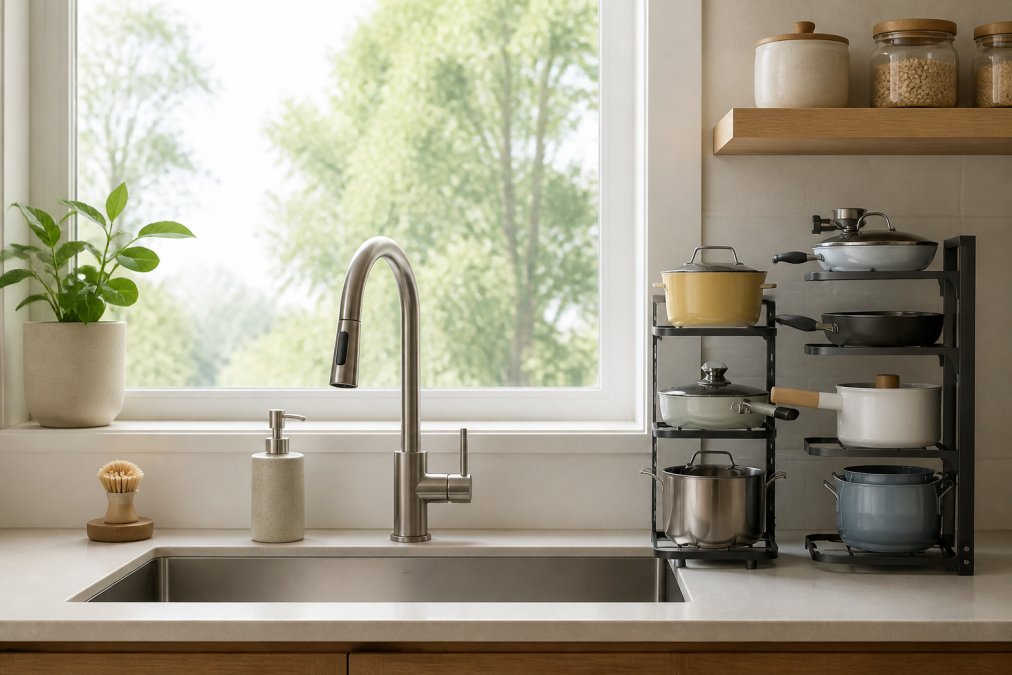
A cluttered counter creates friction every time you cook. Minimalist organization removes that friction by giving everything a designated spot and keeping only what you actually use visible. When your storage looks intentional, you're more likely to maintain it.
How Scandinavian-Inspired Design Reduces Clutter
Scandinavian design centers on "less but better", fewer items, higher quality, intentional placement. This directly reduces clutter because the system itself discourages hoarding. If your spice rack holds 12 jars beautifully, you're less likely to keep 25.
Standard organizers often enable clutter by making it easy to throw things in "for now." A well-designed system makes that harder. Material choice matters: waterproof, rust-resistant metals hold up in humid sink environments. Cheap plastic warps, discolors, and cracks within 18 months (the FDA). A metal system from SinkElle still looks intentional five years later.
Material Durability and Long-Term Value
A standard plastic organizer costs $15-25 and lasts 12-18 months (peer-reviewed research). A quality metal system costs $35-60 and works as well on year five as year one. Over five years, you've spent $60-75 replacing plastic bins multiple times, plus the friction of reorganization. A durable system costs more upfront but saves money and frustration.
Waterproof materials are essential in humid environments like under-sink cabinets. Standard plastic absorbs moisture and develops mold (the CDC). Metal systems resist moisture and dry quickly.
Best Kitchen Storage Hacks for Small Spaces
Small kitchens demand clever thinking. Standard organizers assume plenty of space; small kitchens need every inch to work harder. Clever solutions use vertical space, work around obstacles, and create accessibility without wasting depth.
Vertical Storage and Under-Cabinet Solutions
Vertical storage multiplies usable space without requiring more square footage. Instead of a single layer on a shelf, stack items vertically to create multiple layers in the same footprint.
Under-cabinet solutions address the most underutilized space in small kitchens, the 12-18 inches between countertop and cabinet above. Hanging organizers or mounted shelves create storage without eating into counter or cabinet space. The Sinkelle CabinetFlow Hanging Organizer ($44.99) mounts into this gap and holds cutting boards, pot lids, and dishcloths.

Standard organizers rarely address this space effectively. The trade-off: installation matters. For renters, adhesive strips (temporary, reversible) work best. For homeowners, brackets (permanent, requires drilling) are more stable.
Drawer Dividers and Cabinet Inserts
A basic divider tray costs $10-15; a modular, adjustable system costs $25-40. Standard dividers are fixed-size and don't work if your drawer dimensions differ slightly. Adjustable dividers let you customize the configuration. The Sinkelle PanNest Adjustable Pot Organizer ($38.99) uses adjustable dividers so the system works for any collection size.
Cabinet inserts follow the same logic. A standard shelf insert might not use your full cabinet width. Clever inserts are modular or adjustable, scaling to your exact dimensions.
Pull-Out Shelves and Accessibility
Pull-out shelves convert deep, dark cabinets into accessible storage by sliding the entire shelf forward. Items at the back of a 24-inch-deep cabinet become reachable without reaching to your shoulder. This matters for accessibility and reduces physical strain.
The trade-off is installation and cost. Pull-out shelves require mounting and custom-fitting, costing $40-80 versus $5-10 for a standard shelf. For accessibility concerns, it's transformative. For standard users, it's optional.
How to Declutter Kitchen Counters: A Practical Framework
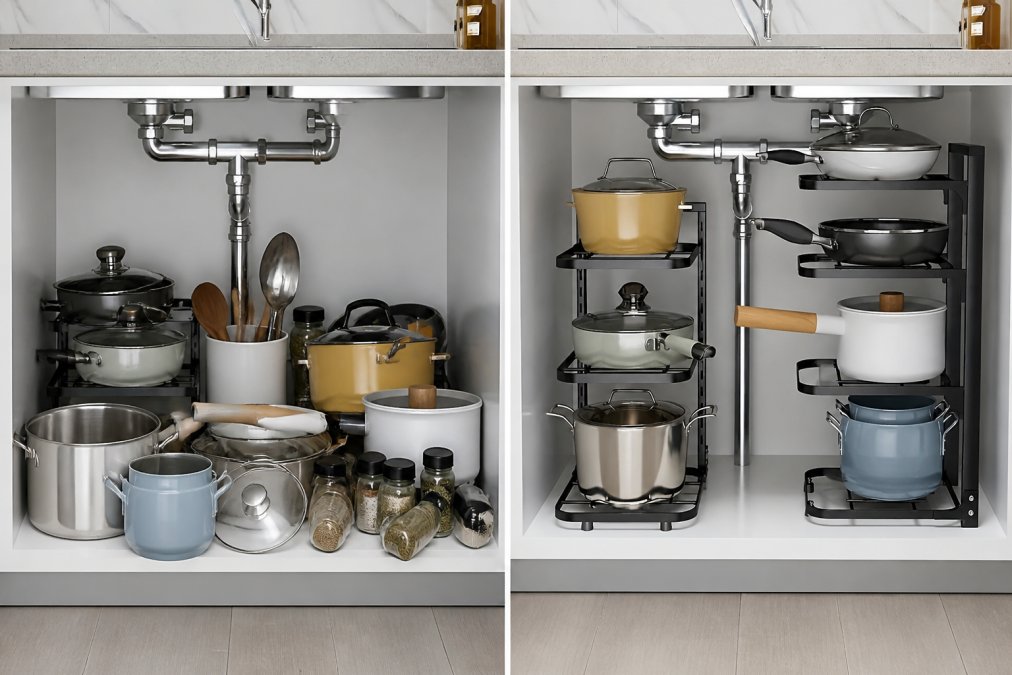
Kitchen counters are prime real estate. Most people approach decluttering as a one-time project, then revert to clutter within months because they didn't address the underlying system. Decluttering without storage is like bailing water from a boat with a hole in it.
Step 1: Assess What Actually Belongs on Your Counter
List everything on your counter. Sort into three categories:
Daily use: Items you touch every day (coffee maker, utensil holder, cutting board). These belong on the counter.
Weekly use: Items you use multiple times a week (spice rack, toaster, blender). These can stay if compact, otherwise move to cabinet or pantry.
Rare use: Items you use monthly or less. These do not belong on your counter.
Be ruthless. If you haven't used something in three months, it's not daily use. Counter space is too valuable to waste on items you barely use.
Step 2: Choose Storage That Matches Your Kitchen Workflow
Match the storage solution to your actual workflow, not generic best practices. If you cook frequently and need quick spice access, a tiered spice rack makes sense. The Sinkelle SpiceRise 3-Tier Organizer ($58.99) keeps spices visible while taking minimal counter space. If you rarely cook, a minimal rack suffices.
If you have many pots and limited cabinet space, a customizable organizer like the Sinkelle PanNest ($38.99) lets you fit your specific collection. If you have under-sink storage that's wasted, the Sinkelle 2 SlideNest ($55.99) transforms it into accessible storage.

Step 3: Install and Maintain Your System
Installation difficulty separates standard from clever organizers. Standard solutions sit in place with no installation. Clever solutions often require mounting or custom fitting.
For renters, reversible installation is critical. SinkElle's tool-free installation means no drilling and no landlord conflicts. For homeowners staying long-term, permanent installation is worth it.
Maintenance is the final piece. Set a weekly five-minute habit to return items to designated spots. This prevents reversion to chaos and is the difference between a system lasting six months versus six years.
Cost-Benefit Analysis: Custom vs Off-the-Shelf Storage
Upfront Costs and Installation Time
A standard plastic organizer costs $15-30 and takes five minutes to set up. A clever solution costs $35-60 and takes 15-30 minutes to install. The upfront difference is $20-40 per organizer.
However, upfront cost is only part of the equation. You must factor in longevity and replacement frequency.
Longevity and Replacement Frequency
A standard plastic organizer lasts 12-18 months in active use, especially in humid environments. A quality metal organizer lasts 5+ years with minimal degradation.
Over five years:
Standard plastic: $25 × 3-4 replacements = $75-100, plus multiple reorganization projects
Clever metal: $50 one-time purchase, no replacement needed
The clever option costs less over time and eliminates repeated reorganization friction. This math changes if you're renting and moving frequently. If you move every two years, standard organizers win on flexibility.
Flexibility and Future Changes
Standard organizers are fixed-size and fixed-function. Clever solutions often offer flexibility within a single system. The Sinkelle PanNest adjusts to fit different pot sizes. The Sinkelle SpiceRise has adjustable tiers. If your needs change, you reconfigure rather than buy new organizers.

This flexibility comes with a trade-off: complexity. An adjustable system has more moving parts. A standard organizer is simpler.
Ergonomics and Accessibility in Kitchen Storage Design
Kitchen storage often ignores ergonomics. Items are stored where they fit, not where they're easiest to access. This creates unnecessary strain, especially for people with limited mobility or those who cook frequently.
Reaching Heights and Bending Angles
The ideal storage zone is between knee height and eye level. Items here require minimal reaching or bending. Standard organizers follow whatever height the shelf happens to be at. Clever systems can be positioned to optimize the ergonomic zone.
Pull-out shelves bring items forward rather than requiring you to reach into a deep cabinet. Instead of reaching 24 inches back, you pull the shelf forward and items are within arm's reach. Counter-height organizers like the Sinkelle CounterRise 2-Tier Shelf ($34.99) sit at countertop level, in the ideal ergonomic zone.
Waterproof Materials and Maintenance Requirements
Waterproof materials reduce maintenance burden. A plastic organizer that absorbs water requires regular drying and mold prevention. A waterproof metal organizer just works. Maintenance burden affects whether you'll keep the system organized. If maintaining it requires special care, you're less likely to maintain it consistently.
SinkElle's waterproof metal construction cleans with a damp cloth and dries quickly. No special treatment required.
Making Your Choice: When to Invest in Clever Solutions
The decision comes down to three questions: Is your kitchen layout unusual? Are you renting or owning? How long do you plan to keep the system?
Tight Corners and Unusual Plumbing Layouts
Standard organizers assume typical kitchens with standard cabinet dimensions. If your kitchen has unusual angles, tight corners, or complex plumbing (garbage disposal, water lines), standard organizers often don't fit.
Clever solutions work around these obstacles. If your under-sink cabinet has a disposal and angled pipes, a standard shelf doesn't fit. A pull-out organizer designed for plumbing does. This is where the price premium becomes justified.
If your kitchen has standard dimensions and straightforward layout, standard organizers work fine.
Rental-Friendly and Non-Permanent Installation
Renters cannot drill holes or make permanent changes without risking security deposits. Standard organizers win because they require no installation. Clever solutions using adhesive strips and tool-free installation work for renters; those with mounting brackets don't.
SinkElle's tool-free installation lets renters get clever solutions without permanent changes. If you own your home and plan to stay 5+ years, permanent installation becomes an asset.
Conclusion
The choice between clever kitchen storage and standard organizers isn't about picking the more expensive option. It's about matching the solution to your situation: kitchen layout, ownership status, cooking frequency, and longevity goals.
Standard organizers win when your kitchen has straightforward layout, you're renting, and you want quick setup with minimal cost. Clever solutions win when you have unusual plumbing or tight spaces, you own your home, and you want a system lasting five years without replacement.
At SinkElle, we've built organizers around the principle that storage should be both beautiful and functional. Waterproof metal materials age well, adjustable designs fit your specific needs, and tool-free installation works for renters and homeowners alike. The Sinkelle CounterRise 2-Tier Shelf ($34.99), Sinkelle SpiceRise 3-Tier Organizer ($58.99), and Sinkelle 2 SlideNest Organizer ($55.99) solve problems that standard organizers leave unsolved.
Start by assessing what belongs on your counter, then choose storage matching your workflow and kitchen layout. The best system is the one you'll maintain consistently. Shop Now at SinkElle and transform your kitchen sink area into a functional, organized space that works as hard as you do.
Frequently Asked Questions
What are the main differences between clever kitchen storage ideas and standard organizers?
Clever storage solutions prioritize design, durability, and space optimization through features like vertical storage, pull-out shelves, and modular systems. Standard organizers focus on basic containment with plastic bins or simple shelving. Clever solutions often cost more upfront but last longer and improve kitchen workflow. Standard organizers are cheaper but may need replacing every 1-2 years and don't adapt well to tight spaces or unusual plumbing layouts.
How can I maximize counter space in a small kitchen with minimalist kitchen sink organization?
Use vertical storage by installing under-cabinet organizers like the Sinkelle CabinetFlow Hanging Organizer ($44.99) to hold cutting boards, and pot lids. Add tiered shelving such as the Sinkelle CounterRise 2-Tier Shelf ($34.99) to stack items upward rather than outward. Implement drawer dividers to organize utensils and tools below the counter. Store infrequently used items in cabinets using pull-out shelves or stackable containers to keep countertops clear.
Are minimalist storage systems more effective than traditional plastic organizers for reducing clutter?
Minimalist systems work better when you commit to maintaining them because their clean aesthetic makes disorganization obvious. They typically feature durable materials like metal and waterproof surfaces that resist warping and mold, common issues with plastic organizers. However, effectiveness depends on your habits. A well-designed system only works if you declutter regularly and return items to their designated spots. Plastic organizers can work just as well functionally if you maintain discipline, but they deteriorate faster and don't improve kitchen aesthetics.
Will a clever storage system work if my kitchen has a garbage disposal and tight plumbing angles?
Yes, but you need to plan carefully. Under-sink organizers like the Sinkelle 2 SlideNest Organizer ($55.99) are designed with adjustable tiers and pull-out drawers that fit around pipes and disposals. Measure your space first, noting pipe locations and disposal dimensions. Consider vertical storage above the sink or cabinet-mounted solutions instead. Avoid fixed shelving that doesn't account for plumbing. Many renters and homeowners with challenging layouts successfully use modular systems by customizing placement rather than forcing standard solutions into incompatible spaces.
How do I know if a waterproof storage system will actually hold up compared to cheaper alternatives?
Look for materials specified as stainless steel, carbon steel, or rust-resistant metal, these resist moisture and mold far better than plastic. Check product reviews mentioning long-term use in humid kitchen environments. Sinkelle products use durable metal construction rated for waterproof use. Test warranty coverage: longer warranties indicate manufacturer confidence. Avoid products labeled simply 'water-resistant' without material specification. The price difference usually reflects durability, paying $45-60 for a tiered organizer versus $15 for plastic bins often saves money over 3-5 years.
This article was written using GrandRanker