


Table of Contents
- Why a Lazy Susan Falls Short in Deep Corners
- What to Look For in Lazy Susan Alternatives
- Blind Corner Cabinet Organizers: Pull-Out and Swing-Out Options
- Pull-Out Corner Cabinet Shelves for Maximum Accessibility
- How to Organize Deep Kitchen Cabinets Without a Lazy Susan
- Retrofitting vs. New Construction: Which Route Fits Your Kitchen
- Maintenance, Cleaning, and Ergonomics for Corner Storage
- Frequently Asked Questions
Last Updated: September 22, 2026
Why a Lazy Susan Falls Short in Deep Corners
A standard lazy susan wastes the back half of a deep base corner cabinet. The round tray fits the door opening, not the cabinet's full footprint, so the deepest section stays empty and hard to reach. This guide from SinkElle covers the best lazy susan alternatives for deep corners, from pull-out shelves to swing-out units.
What to Look For in Lazy Susan Alternatives
The right replacement starts with two measurements: interior depth and expected load. Get those wrong and even a well-built organizer becomes a frustration.
Cabinet Depth and Corner Dimensions
Measure the interior depth from the cabinet face to the back corner, not the door width. A blind corner cabinet typically offers usable depth well beyond what a round tray can serve. That extra depth is exactly what a pull-out or swing-out mechanism is built to capture.
Weight Capacity and Hardware Durability
Weight capacity decides whether your organizer survives a year or fails in a month. Cast-iron skillets, stand mixers, and stacked bakeware add up fast, and a sliding mechanism carrying that load takes constant stress.
Look for these markers of heavy-duty hardware:
- Steel or carbon steel frames rather than thin plastic
- Ball-bearing or full-extension slides instead of simple runners
- Soft-close hardware to stop slamming and reduce wear
- A stated load rating from the manufacturer
Blind Corner Cabinet Organizers: Pull-Out and Swing-Out Options
Blind corner cabinet organizers fall into two families: pull-out units that slide straight toward you, and swing-out units that rotate contents out through the door. The right pick depends on your door style, the clear floor space in front of the cabinet, and how heavy the items you plan to store actually are.
Pull-Out Mechanisms
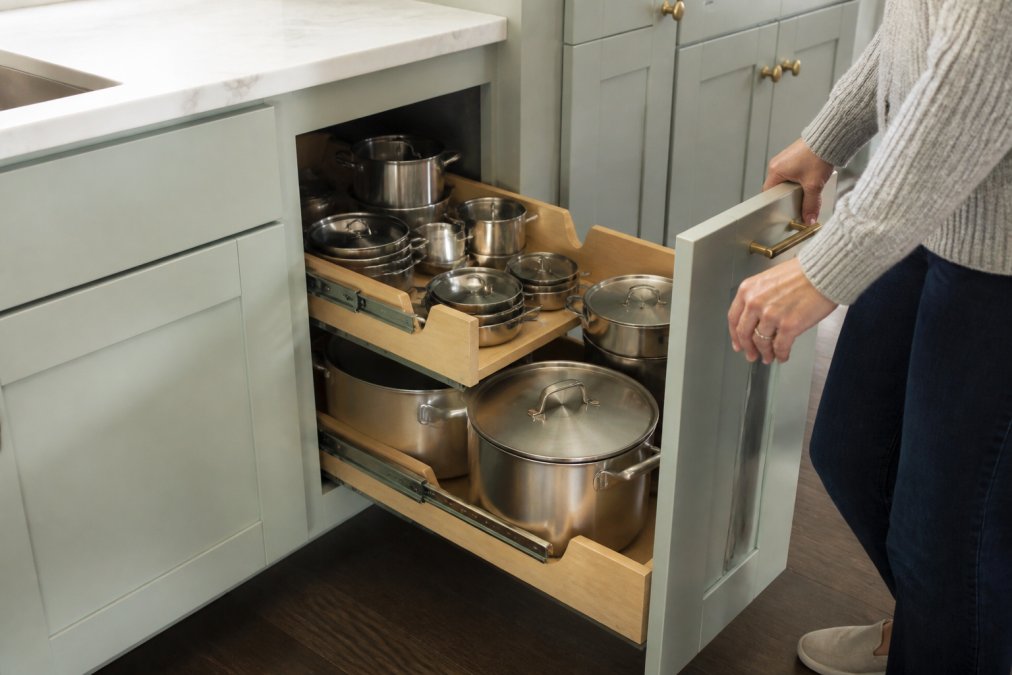
A pull-out mounts on a frame that extends from the cabinet face. Open the door, and the whole shelf glides forward on full-extension slides, bringing back items into reach. These work best when one door stays closed and a single access point serves the corner.
Common configurations you will see in listings:
- Single-tier pull-out, one shelf on a frame, best for a 12- to 15-inch-wide door opening.
- Two-tier pull-out, two stacked shelves on one frame; the top tier usually holds lighter items so the slide does not bind.
- Blind corner pull-out with a lazy susan on the back half, the front shelf pulls forward, and the rear tray rotates independently.
Swing-Out Mechanisms
Swing-outs rotate shelves out through the door opening. The classic version is a kidney-shaped tray (sometimes called a pie-cut or D-shaped carousel) mounted on a center post. The flat side of the kidney clears the door frame better than a full circle, which is why it shows up in so many corner units.
Variants worth knowing:
- Half-moon carousel, a single D-shaped tray on a post, often used in upper corner cabinets.
- Two-shelf kidney carousel, two trays on one post; the lower tray usually carries the heavier load.
- Swing-out frame with adjustable shelves, the whole frame pivots out, and shelf heights can be moved to fit tall stockpots.
Matching Mechanism to Door Configuration
| Door setup | Best-fit mechanism | Why |
|---|---|---|
| Single-door blind corner | Single- or two-tier pull-out | One access point, straight-line reach |
| Two-door corner (L-shape) | Kidney carousel or swing-out frame | Rotation clears both door frames |
| Corner with a lazy susan already installed | Add-on pull-out shelf or rear tray | Reuses existing post and mounting holes |
| Corner blocked by an island or appliance | Swing-out or half-moon carousel | Needs less forward clearance than a full pull-out |
A quick way to decide is to stand in front of the open cabinet and reach for the back corner. If your hand can reach it with a small forward step, a swing-out will feel natural. If you have to lean in past the door frame, a pull-out will save you the bend every time.
Pull-Out Corner Cabinet Shelves for Maximum Accessibility
Pull-out corner cabinet shelves deliver the best accessibility for deep corners because they bring stored items to the front instead of asking you to reach in. Full-extension slides let the shelf clear the cabinet entirely.
A few design details matter more than most buyers expect:
Sinkelle PanNest Adjustable Pot →
- Vertical storage dividers keep sheet pans and cutting boards upright
- Adjustable shelf heights accommodate tall stockpots
- A corner unit with two tiers doubles usable surface without eating floor space
How to Organize Deep Kitchen Cabinets Without a Lazy Susan
Knowing how to organize deep kitchen cabinets without a lazy susan comes down to zoning by use, not by category. Put daily items at the front and seasonal or heavy items toward the back.
Zone Your Corner by Frequency of Use
| Zone | Position | What to Store | Access Method |
|---|---|---|---|
| Daily | Front third | Skillets, spatulas, everyday pots | Direct reach |
| Weekly | Middle third | Baking sheets, mixing bowls | Pull-out shelf |
| Occasional | Back corner | Roasters, holiday cookware, backups | Swing-out or deep pull-out |
For cookware-heavy corners, an adjustable rack that holds pots and lids upright frees the floor of the cabinet for larger items. The Sinkelle PanNest Adjustable Pot Organizer uses a carbon steel and stainless steel frame with an adjustable layout, so it fits cookware of different sizes and keeps stacked pots from scratching each other.

Retrofitting vs. New Construction: Which Route Fits Your Kitchen
Most guides assume you are tearing out cabinets. This section is for the far more common case: you already own the kitchen, the cabinets are staying, and you want the corner to work better without a remodel.
What Retrofitting Actually Involves
A retrofit organizer has to fit the box you already own. That means working within three fixed constraints:
- Interior depth, measure from the cabinet face to the back corner, not the door width.
- Door opening width and height, the organizer has to pass through the frame during installation.
- Mounting surface, the cabinet floor, the side wall, or an existing center post.
- Floor-mounted pull-out, screws into the cabinet floor; needs a flat, solid bottom panel.
- Side-wall-mounted frame, anchors to the cabinet side; good when the floor is thin or already damaged.
- Post-mounted carousel, reuses the existing lazy susan post and mounting holes, which is the least invasive option and the easiest to reverse.
A Practical Retrofit Sequence
- Empty the cabinet and remove the existing lazy susan or shelf.
- Measure interior depth, door opening, and cabinet height. Write the numbers down.
- Check for obstructions: plumbing, electrical runs, a drawer box above, or a dishwasher panel beside the cabinet.
- Confirm the organizer's listed dimensions fit inside your smallest measurement, not the average.
- Dry-fit the unit before driving any screws.
- Load it gradually and test the slide or swing at half load before filling it.
Retrofitting vs. New Construction: The Honest Trade-Off
| Factor | Retrofit | New construction |
|---|---|---|
| Cost | Organizer only | Cabinets plus organizer plus labor |
| Timeline | An afternoon | Weeks |
| Reversible | Usually yes | No |
| Maximum load rating | Limited by existing cabinet floor and frame | Specified around the organizer |
| Best for | Renters, recently purchased homes, budget upgrades | Full kitchen remodels |
New construction lets you specify the box around the organizer, which opens up wider pull-outs, taller shelving, and heavier load ratings. It also costs far more and disrupts the kitchen for weeks. For most existing kitchens, retrofit wins on every measure except maximum capacity.
Renter-Specific Considerations
If you rent, prioritize organizers that mount with tension, adhesive, or a single existing screw hole. Post-mounted carousels that reuse the original lazy susan hardware are the cleanest option because they leave no new holes when removed. Avoid anything that requires cutting the cabinet floor or drilling into a side wall you do not own.
When New Construction Is Actually Worth It
New construction makes sense in three situations: you are already replacing the cabinet boxes, you need a load rating above what a retrofit frame can carry, or the existing corner has water damage or a warped floor that would compromise any mounted organizer. Outside those cases, a retrofit delivers most of the benefit for a fraction of the cost and disruption.
Maintenance, Cleaning, and Ergonomics for Corner Storage
Corner storage stays functional only if you can clean it and reach it without strain. Two habits keep a deep corner working for years.
Frequently Asked Questions
What is the best Lazy Susan replacement for a corner cabinet?
Pull-out corner cabinet shelves are the most common upgrade for deep corners. They slide the full shelf out of the cabinet so you can reach items at the back without crouching or removing front-row items. Blind corner organizers with a swing-out arm also work well because they bring the rear of the cabinet into view. The right pick depends on your cabinet's interior width and whether you want to keep the existing shelf height or adjust it.
Are pull-out shelves better than a Lazy Susan for deep corners?
For corners deeper than 24 inches, pull-out shelves usually win because they eliminate the dead space behind the rotating tray. A Lazy Susan rotates in place, so anything beyond its diameter stays hard to reach. Pull-out shelves use the full cabinet depth and let you load the entire shelf. The trade-off is that pull-out hardware needs solid mounting and a clear swing path, so measure your door opening before buying.
How do you organize a corner cabinet without a Lazy Susan?
Start by measuring the interior depth and width, then choose between a blind corner pull-out, a swing-out tray, or a tiered insert. Group items by how often you use them: daily cookware at the front, seasonal or backup items at the back. Add a pull-out organizer for pots and pans so nothing stacks. A slim rolling cart can also slide into the narrow gap beside the corner if the cabinet opening allows it.
Do Lazy Susan alternatives require professional installation?
Most pull-out and swing-out hardware needs at least two screws into a cabinet shelf or side panel, so some DIY skill helps. Freestanding organizers, tiered racks, and slim rolling carts need no drilling at all and can be placed inside the cabinet as-is. If you rent or want a reversible setup, start with non-mounted options and upgrade to mounted hardware only if the cabinet has a solid shelf to anchor into.