


Table of Contents
- Quick Comparison: Best Kitchen Sink Organizers 2026
- How to Choose a Sink Organizer That Fits Your Setup
- Sinkelle FlowRack Pro: The Sturdy Coated Steel Sink Caddy
- Under Sink Storage Ideas That Work Around Plumbing
- How to Organize Under the Kitchen Sink Without Damaging Cabinets
- Best Practices for Cabinet Organization: Materials, Hygiene, and Maintenance
- Small-Space and Apartment Solutions for Sink Areas
- Common Mistakes to Avoid When Buying Sink Organizers
- Frequently Asked Questions
Last Updated: September 17, 2026
Quick Comparison: Best Kitchen Sink Organizers 2026
The best kitchen sink organizers 2026 solve a problem most people ignore until it's too late: standing water. A sponge that never dries breeds bacteria and leaves stains on your counter. A sponge that never dries breeds bacteria and leaves stains on your counter. The answer isn't more scrubbing. It's drainage.
| Product | Price | Material | Installation | Best For |
|---|---|---|---|---|
| SinkElle FlowRack Pro | $46.99 | Sturdy coated steel | Over-the-sink, tool-free | Sponge and brush drying |
| SinkElle DryFlow Splash Mat | $19.99 | Waterproof silicone | Freestanding | Splash protection |
| SinkElle AquaShield Faucet Guard | $17.99 | Flexible silicone | Faucet mount | Drip control |
| SinkElle DryStone Quick-Dry Mat | $14.99 | Diatomite | Freestanding | Countertop drying |
How to Choose a Sink Organizer That Fits Your Setup
Choosing the right sink organizer comes down to four things: your sink's edge profile, your sink's surface material, how much counter space you have, and whether you can drill. Get those wrong and even a well-made caddy becomes clutter.

Suction Cup vs. Over-the-Faucet vs. Freestanding
Each installation method suits a different kitchen. Suction cups work on smooth tile and glass but lose grip on textured or porous surfaces. Over-the-faucet mounts sit directly on the faucet base and stay put without adhesive. Freestanding caddies rest on the counter and require zero installation, which makes them the safest choice for rentals and small spaces.
Sink Material Compatibility: The Spec Sheet Most Guides Skip
This is where most buying guides stop, and it's the reason so many organizers get returned. A suction cup that holds for a year on glazed ceramic can pop off a farmhouse apron front in a week. Match the mount to the surface before you match it to the color.
- Glazed ceramic and porcelain enamel: The easiest surface for suction cups. Smooth, non-porous, and flat, so a clean cup with a light film of water grips reliably. Wipe the cup and the surface with a mild dish soap solution before pressing.
- Stainless steel sinks: Suction works, but only if the cup lands on a flat section rather than a brushed or curved wall. Over-the-faucet mounts are the more stable choice here because the faucet base gives a fixed anchor point.
- Composite and quartz (granite composite, quartz composite): These surfaces are slightly porous and often have a matte finish. Suction cups typically fail within days. Use an over-the-faucet or freestanding organizer instead.
- Natural stone (granite, marble, soapstone): Suction cups are unreliable and adhesive pads can leave residue or pull sealer. Freestanding caddies and over-the-faucet racks are the safe picks. Never use an adhesive mount on unsealed stone.
- Farmhouse and apron-front sinks: The exposed front apron is usually a curved or textured face, so suction cups have nothing flat to grab. Over-the-sink racks that rest on the rim or over the faucet are the practical option.
- Fireclay and cast iron (enameled): Similar to glazed ceramic. Suction works on the smooth interior walls; avoid the rough underside of the rim.
Measuring Before You Buy
Three measurements prevent almost every fit problem:
- Sink rim width and depth. Over-the-sink racks need a rim they can straddle. Measure the outer rim, not the basin opening.
- Faucet base diameter and height. Over-the-faucet mounts clamp around the base, so a wide or unusually tall base can block the clamp.
- Clearance above the counter. A rack that sits too low can collide with a tall faucet spout or a pull-down spray head.
If you rent, or your sink is stone, composite, or farmhouse, treat freestanding and over-the-faucet as your default and skip suction entirely. That single rule eliminates most of the returns in this category.
Sinkelle FlowRack Pro: The Sturdy Coated Steel Sink Caddy
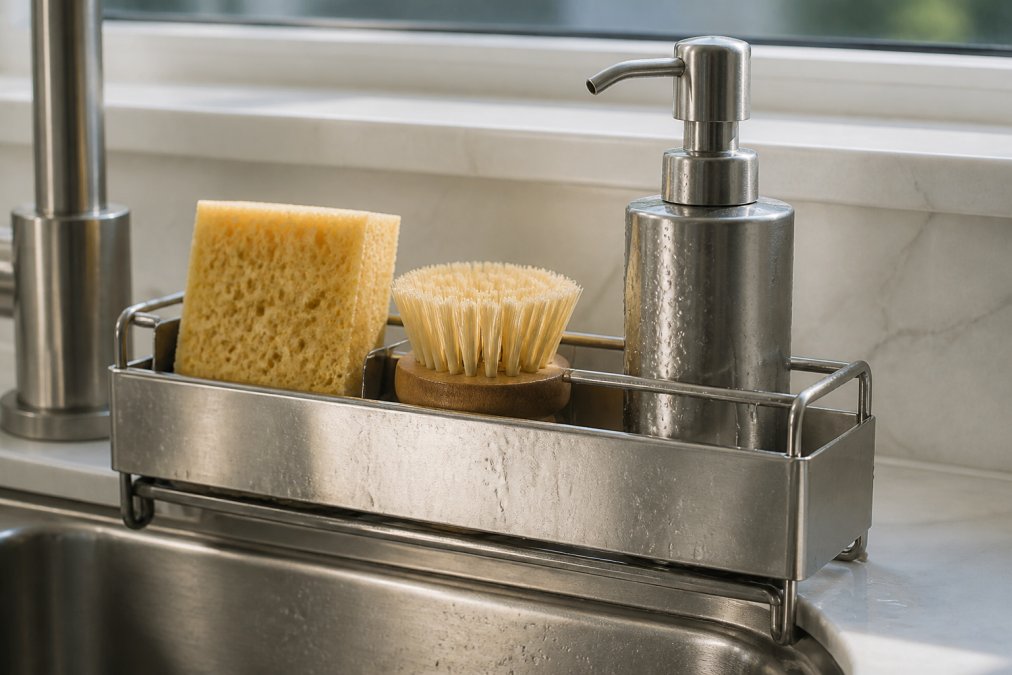
Where it falls short: it rests over the divider or edge, so an unusually narrow or single-bowl sink may not fit. Check the dimensions image first. At $46.99, it's the one that replaces three separate holders.
Under Sink Storage Ideas That Work Around Plumbing
Under-sink storage fails for one reason: people buy bins before they look at the pipes. A garbage disposal and angled plumbing eat most of the cabinet, so the fix is modular, not bigger. The goal is to fit storage into the negative space around the trap and disposal, not to fill the cabinet wall to wall.
Map the Obstacles First
Before you buy a single bin, open the cabinet, turn on a flashlight, and note four things:
- The disposal body. Measure its diameter and how far it hangs below the sink floor. This is the single biggest space thief in most cabinets.
- The P-trap or U-bend. Note the lowest point of the curve and how far it projects toward the cabinet door.
- The supply lines and shut-off valves. These are usually on the back wall and are the reason bins can't sit flush against it.
- The cabinet floor. Look for water stains, swelling, or soft spots. If the floor is already damaged, fix the leak before adding storage.
The Three-Zone Layout
Most under-sink cabinets break into three usable zones once you account for the plumbing:
- Side gaps beside the disposal. These are usually the tallest narrow spaces. Stackable bins or a slim pull-out caddy fit here. Choose bins no taller than the disposal's lowest point so they slide in and out without catching.
- The front strip in front of the trap. Shallow, wide, and easy to reach. This is the right spot for a low tray of sponges, scrubbers, and dish soap refills.
- The back wall above the supply lines. A shallow shelf or a wall-mounted rail clears the valves and uses vertical space that bins can't reach.
Renter-Safe Options
If you can't drill, skip anything that screws into the cabinet floor or walls. Tension rods, freestanding stackable bins, and lift-out caddies all work without a single hole. A tension rod across the cabinet width, set above the supply lines, holds spray bottles by their necks and costs a few dollars. A lift-out caddy lets you carry everything to the counter in one motion and put it back just as fast.
Sinkelle FlowRack Pro — Keeps Sponges →
What to Avoid
- Solid-sided bins against the back wall. Slow drips from supply lines soak whatever sits there, and you won't notice until the wood swells.
- Stacking bins directly on the disposal. Vibration from the disposal walks them out of place and can knock items into the trap area.
- Adhesive hooks on the cabinet interior. They fail in humid cabinets and leave residue that's hard to remove at move-out.
- Overfilling the front strip. If you can't see the shut-off valves, you can't reach them in an emergency.
A Simple Test Before You Commit
Load your planned layout, close the cabinet door, and open it again. If anything shifts, tips, or blocks the door swing, the layout is too tight. Under-sink storage should survive a door slam and a disposal cycle without moving.
How to Organize Under the Kitchen Sink Without Damaging Cabinets
Organizing under the kitchen sink without damage means avoiding adhesive, screws, and anything that traps moisture against the cabinet floor. Water leaks go unnoticed in a dark cabinet, and that's where warping and mold begin.
Best Practices for Cabinet Organization: Materials, Hygiene, and Maintenance
Best practices for cabinet organization come down to material choice and a short cleaning routine. Silicone and stainless steel resist water and wipe clean; untreated wood and cheap coated plastics absorb it and break down.
- Wipe stainless and silicone weekly with warm soapy water
- Rinse diatomite mats and let them air dry fully before reuse
- Check under-sink bins for moisture every few weeks
- Replace any sponge that stays damp for more than a day
Small-Space and Apartment Solutions for Sink Areas
Small kitchens don't need fewer organizers; they need ones that stack vertically. When counter space is measured in centimeters, the goal is to move items up and off the surface rather than sideways.
Common Mistakes to Avoid When Buying Sink Organizers
The most common mistake is buying a solid tray caddy. It looks tidy, but it holds water against your sponge and counter, which is the exact problem you're trying to solve.
Other frequent errors:
- Skipping the measurement check and ordering a rack that doesn't clear the sink edge
- Choosing suction cups for textured or porous surfaces where they won't hold
- Ignoring the disposal when planning under-sink storage
- Assuming "waterproof" means "drainage" when the two are different things
- Buying multiple single-purpose holders instead of one multifunctional organizer
Frequently Asked Questions
How can I effectively organize my kitchen sink area?
Start by lifting sponges and brushes off the counter with a sink caddy that has drainage holes so water returns to the basin. The Sinkelle FlowRack Pro uses an angled drain tray to dry sponges in hours, not days. Add a waterproof splash mat around the faucet to stop puddles, then keep only daily-use items on the counter. For under-sink storage, use stackable bins and sliding racks that work around plumbing angles.
What are the top kitchen sink organization trends for 2026?
Minimalist Scandinavian-inspired designs are popular in 2026, with a focus on rustproof stainless steel and waterproof silicone that resist warping and mold. Modular systems that fit tight apartment kitchens are replacing bulky plastic bins. Tool-free installation is also a priority, since renters want organizers that leave no marks and require no drilling. Fast-drying materials and easy-clean surfaces round out the top trends.
What are common mistakes to avoid when organizing under-sink cabinets?
Avoid using non-waterproof materials that warp or grow mold in damp conditions. Don't block the garbage disposal or plumbing angles with rigid shelving; instead, use stackable bins or pull-out drawers that work around pipes. Skipping a liner on the cabinet floor leads to water damage over time. Also, don't overload shelves with heavy bottles, which can cause sagging and make access harder.
Are waterproof materials necessary for under-sink organizers?
Yes. Under-sink areas see constant moisture from drips, humidity, and occasional leaks. Non-waterproof materials like untreated wood or standard plastic can warp, crack, or harbor bacteria. Look for rustproof stainless steel, waterproof silicone, or diatomite mats. The Sinkelle DryFlow Splash Mat, for example, is made from premium waterproof silicone and channels water directly back into the sink to prevent moisture buildup.