


Table of Contents
- Simplehuman vs Joseph Joseph: The Core Differences
- Design, Materials, and Kitchen Aesthetics
- Capacity, Compartments, and Waste Separation
- Operation and Lid Mechanisms: Step Pedal vs Touch-Top
- Best Kitchen Trash Cans: Odor Control and Maintenance
- Simplehuman Trash Bags Equivalents and Compatibility
- Joseph Joseph Recycling Bins and Dual-Compartment Performance
- Price, Value, and Long-Term Ownership Costs
- Frequently Asked Questions
Last Updated: October 14, 2026
Simplehuman vs Joseph Joseph: The Core Differences
Shopping for a kitchen trash can? The choice between Simplehuman vs Joseph Joseph comes down to design philosophy, functionality, and aesthetics. Both dominate the premium market but approach it differently.
Simplehuman focuses on minimalist stainless steel construction with sensor-activated lids and a focus on odor control. Joseph Joseph, by contrast, emphasizes dual-compartment designs that separate waste and recycling in a single footprint. The real question isn't which brand is objectively better, it's which one solves your specific kitchen problem.
At SinkElle, we know kitchen organization is about creating a space that feels intentional.
Design, Materials, and Kitchen Aesthetics
Simplehuman trash cans use brushed stainless steel finishes that resist fingerprints and blend into modern kitchens. The design is minimalist: clean lines, no unnecessary hardware, and a bin that disappears rather than stands out.
Joseph Joseph takes a different approach. Their bins often feature more sculptural forms, with curved edges and color options beyond stainless steel. While Simplehuman says "I'm functional," Joseph Joseph says "I'm a design statement." Both are sophisticated, but they speak different visual languages.
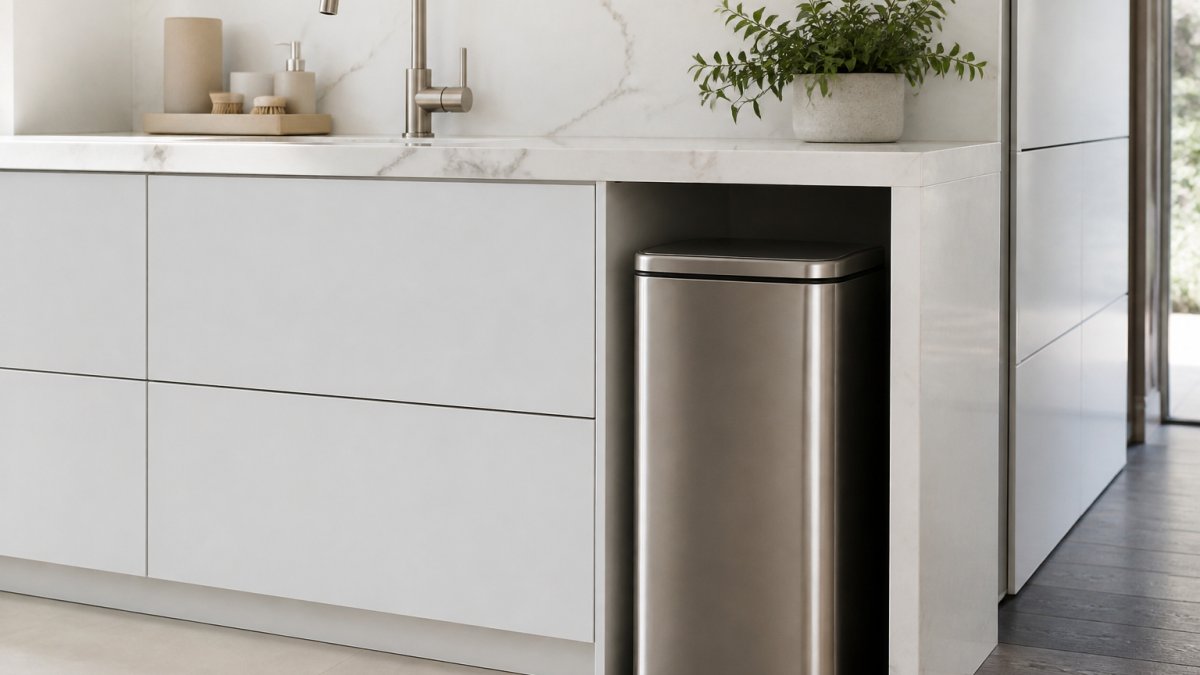
Simplehuman's stainless steel resists corrosion and holds its finish for years. Joseph Joseph's dual-compartment bins often use plastic components that show wear faster, though they're lighter and allow more flexible designs.
With limited space and a minimalist aesthetic, Simplehuman's compact footprint and neutral finish win. If you want your bin to be a design statement and accept plastic components, Joseph Joseph delivers more personality.
Capacity, Compartments, and Waste Separation
Here's where Simplehuman vs Joseph Joseph diverges most. Simplehuman offers single-compartment bins from 8 to 45 liters, prioritizing depth and height over width to keep the footprint small.
Joseph Joseph specializes in dual-compartment designs. Their most popular models split capacity between waste and recycling, allowing you to separate materials without needing two separate bins. A typical Joseph Joseph dual-compartment bin might offer 30 liters total (split 60/40 or 50/50 between waste and recycling).
The practical difference: with minimal space but a need for waste and recycling separation, Joseph Joseph solves it in one bin. If you already recycle elsewhere or want maximum single-stream capacity, Simplehuman gives more usable volume in the same footprint.
Capacity matters for household size: a single person or couple manages with 8-15 liters, while families of four or more benefit from 30+ liters. Joseph Joseph's dual-compartment approach splits that capacity, so a 30-liter model gives 15 liters each for trash and recycling.
Operation and Lid Mechanisms: Step Pedal vs Touch-Top
Simplehuman pioneered the motion-sensor lid that defines their brand. Wave your hand and the lid opens automatically, useful when your hands are wet or full, and it eliminates fingerprints on step pedals.
Joseph Joseph typically uses step-pedal operation: press the lever, the lid opens and closes. It's mechanical, reliable, needs no batteries or calibration, and works instantly, whereas sensors occasionally lag.
The trade-off: Simplehuman's touch-free operation is more hygienic and sleeker but needs batteries and occasional sensor cleaning. Joseph Joseph's step pedal is always ready, maintenance-free, and cheaper long-term. For mobility issues or arthritis, Simplehuman is easier; for mechanical simplicity, Joseph Joseph wins.
Best Kitchen Trash Cans: Odor Control and Maintenance
Simplehuman bins use activated charcoal odor-control filters replaced every few months, with sealed construction and tight lids that minimize odor escape. The stainless steel exterior wipes clean with a microfiber cloth.
Joseph Joseph relies on tight-sealing lids and compartment ventilation. Some models add deodorizing features, but they're less sophisticated than Simplehuman's filters. Cleaning is straightforward: wipe the exterior, empty the inner bins.
For households with strong food waste odors (families with young children, heavy cooking), Simplehuman's filter system is noticeably more effective. For apartments or smaller households where odor isn't a major concern, Joseph Joseph's sealed lid design handles the job adequately.
Maintenance differs: Simplehuman requires periodic filter replacement, while Joseph Joseph's pedal may need occasional lubrication but has no filters. Over five years, Simplehuman users spend more on filters, though the odor control may justify it.
Simplehuman Trash Bags Equivalents and Compatibility
Bag fit is Simplehuman's most opinionated ecosystem and the biggest ongoing cost. Their custom-fit liners use a Code naming system, each letter mapping to a bin family and capacity.
The mechanism matters more than branding. Simplehuman bins use a liner rim or liner pocket that holds the bag while you pull the drawstring tight, keeping it hidden below the rim. Generic bags often lack the drawstring length and taper to seat correctly, so they slide down the interior wall when the lid cycles. That's the practical reason proprietary bags exist, not just lock-in.
On cost, Simplehuman liners run $0.40 to $0.90 per bag depending on code and pack size, with bulk packs (100- to 240-count) at the low end. Generic 13-gallon bags run $0.10 to $0.25 per bag in bulk. Filling one 30- to 45-liter bag every two days is about 180 bags a year: at $0.60 per bag that's roughly $108 per year on Simplehuman liners versus about $32 for generics at $0.18. Over five years that's roughly $380, real money against a bin costing $80 to $200 upfront.
Joseph Joseph takes the opposite approach. Their dual-compartment bins use removable inner buckets that accept standard 8- to 13-gallon kitchen bags. You're not locked into proprietary liners, and you can run the buckets bagless and rinse them, common for recycling. That flexibility is Joseph Joseph's biggest ongoing-cost advantage, worth several hundred dollars over the bin's life.
A few practical notes if you go the generic route with either brand:
- Match the gallon size to the compartment, not the bin. A 30-liter dual-compartment Joseph Joseph bin has two roughly 15-liter buckets, so a 4-gallon bag fits better than a 13-gallon one.
- Buy the tall kitchen drawstring style for Simplehuman. The drawstring is what seats the bag on the liner rim; flat-top or twist-tie bags won't hold.
- Watch the bag thickness. Cheaper generics at 0.5 mil tear at the drawstring when you pull them out of a full 45-liter can. Look for 0.9 mil or thicker.
- Stock up on one code at a time. Because Code letters map to specific bins, buying the wrong letter in bulk is an expensive mistake.
If minimizing ongoing cost is your priority, Joseph Joseph wins this category outright. If you want the bag to disappear under the rim and never slip, Simplehuman's Code liners are the only reliable way to get that, and you should budget for it.
Joseph Joseph Recycling Bins and Dual-Compartment Performance
Joseph Joseph's dual-compartment bins have removable inner buckets for each section, making emptying straightforward: pull out the waste bucket, pull out the recycling bucket, replace them. No wrestling with a single large bin.
The compartment divider is fixed, so you can't adjust the waste-to-recycling ratio. Most models split 60% waste and 40% recycling, which works for many households but may not match your actual waste generation. If you produce more recycling than trash, you'll need to empty the recycling compartment more frequently.
Bag compatibility is more flexible: Joseph Joseph's compartments accept standard garbage bags, so you're not locked into proprietary liners, and the removable buckets can be used bagless for easier cleaning. This appeals to households minimizing ongoing costs.
Price, Value, and Long-Term Ownership Costs
This is the section most competing articles skip, and it decides the purchase. Here's what the two brands cost in real dollars and over five years of ownership.
Upfront price. Simplehuman's kitchen bins generally start around $80 for a 30-liter step can and climb to roughly $200 for a 45- to 58-liter sensor can, with the dual-compartment recyclers and butterfly models sitting in the $130 to $250 range.
Consumables. This is where the gap widens. Simplehuman's Code liners run roughly $0.40 to $0.90 per bag, and their activated charcoal odor filters run roughly $5 to $10 each, replaced every one to three months depending on the model and household. Joseph Joseph's bins accept standard bags at roughly $0.10 to $0.25 each and have no filter consumable on most models.
Five-year total cost of ownership. Here's a realistic scenario for a household of four that fills one kitchen bag every other day (about 180 bags per year):
| Cost line | Simplehuman (45L sensor) | Joseph Joseph (30L dual-compartment) |
|---|---|---|
| Purchase price | $180 | $120 |
| Liners, 5 years | ~$540 ($0.60/bag x 180 x 5) | ~$160 ($0.18/bag x 180 x 5) |
| Odor filters, 5 years | ~$150 ($7.50 x 4/year x 5) | $0 |
| Batteries, 5 years | ~$25 (AA, sensor models) | $0 |
| Likely repairs/replacement | ~$0 to $40 | ~$0 to $60 |
| Five-year total | ~$895 to $935 | ~$280 to $340 |
The headline is uncomfortable for Simplehuman fans: over five years, the sensor bin with proprietary liners and filters can cost roughly 2.5x to 3x what the Joseph Joseph dual-compartment bin costs to own, even though the Simplehuman costs only about 50% more upfront. The consumables, not the bin, are the real expense.
Where Simplehuman earns that back. The stainless steel body, sealed lid, and liner-rim mechanism are built to last well past five years, and Simplehuman's warranty on most kitchen bins is 10 years, which is unusually long for the category.
Where Joseph Joseph wins. Lower upfront cost, no proprietary liners, no filters, no batteries, and standard bags. For renters, students, or anyone who may move within a few years, the lower entry price and lower ongoing cost make Joseph Joseph the lower-risk purchase.
A note on sales and bundles. Both brands discount regularly at major retailers, and Simplehuman's bulk liner packs (100- to 240-count) cut per-bag cost versus 20-count boxes. If you commit to Simplehuman, buying liners in bulk is the easiest way to shrink the ownership gap; for Joseph Joseph, bulk standard bags do the same at a lower baseline.
Frequently Asked Questions
Is Simplehuman worth the price compared to Joseph Joseph?
Both brands command premium pricing, but they serve different priorities. Simplehuman excels in hands-free operation and odor control through sealed lids and carbon filters, making it ideal if you prioritize convenience and smell management. Joseph Joseph focuses on waste separation and dual-compartment designs for households committed to recycling. Your choice depends on whether you value ease of use or sorting functionality more. Neither is objectively 'worth it' without considering your specific kitchen habits and space constraints.
What are the best kitchen trash cans for small apartments with limited counter space?
For tight kitchens, look for models with a small footprint and wall-mountable or corner-fitting designs. Simplehuman offers compact step-can models around 8-10 liters that fit snugly beside sinks. Joseph Joseph's compact recycling bins also come in narrower profiles for dual-waste sorting without consuming excessive space. Measure your available area before buying, both brands publish exact dimensions. Vertical or under-sink storage can also free counter space if your plumbing permits.
Are Simplehuman trash bags equivalents available from other brands, or do I have to buy theirs?
Simplehuman custom-fit bags are proprietary, but universal trash liners in matching sizes work as substitutes. Generic bags cost less but may not fit as snugly or seal as effectively. Before committing to Simplehuman, factor in ongoing bag costs, proprietary liners add to total ownership expense. Some owners find the premium bags worth the tight fit and leak prevention; others switch to universal alternatives to reduce long-term costs. Check what bag options exist for your specific model size.
Do Joseph Joseph recycling bins actually keep waste and recycling separated effectively?
Joseph Joseph's dual-compartment designs physically separate waste from recyclables, which works well if household members respect the sorting. The real-world success depends on user discipline, a well-designed bin won't sort itself if people throw items in the wrong side. Their lids and compartment sizes are engineered to make sorting intuitive, but no bin can force compliance. If your household struggles with sorting habits, a clear labeling system and education matter more than the bin design itself.