


Table of Contents
- Why Non-Slip Matters on Granite Countertops
- Sink Caddy With Drip Tray: Managing Water on Stone Surfaces
- Non-Slip Sponge Holder for Kitchen Sink: Grip Performance on Polished Stone
- Sink Caddy That Won't Scratch Countertops: Material Selection and Contact Points
- Rustproof Stainless Steel Sink Caddy: Durability and Maintenance
- Fit, Dimensions, and Countertop Layout: Getting the Right Size
- Common Mistakes to Avoid When Choosing a Sink Caddy for Granite
- Frequently Asked Questions
Last Updated: October 4, 2026
Why Non-Slip Matters on Granite Countertops
A non-slip sink caddy granite countertop protector guards your investment from sliding, scratching, and permanent water marks. The wrong caddy can leave residue rings that won't disappear.

Granite is smooth and sealed, creating minimal friction. A standard caddy can migrate across the surface, exposing granite to moisture pooling underneath where damage starts, water sits, minerals concentrate, and discoloration follows.
A non-slip sink caddy for granite needs genuine grip on polished stone, a non-scratching base that doesn't absorb water, and a design that doesn't trap moisture underneath. Quality caddies cost more upfront but save refinishing costs later.
Sink Caddy With Drip Tray: Managing Water on Stone Surfaces
A sink caddy with drip tray capability keeps water from pooling on your countertop. Granite is porous despite sealant, and standing water seeps into microscopic gaps around the caddy's edges.
Choose a caddy with drainage channels, an integrated tray, sloped surfaces, or open-grid design that promotes airflow and lets water drain naturally.
A sink caddy with drip tray prevents mineral deposits, calcium, magnesium, and other minerals that create white spots when water evaporates on granite.
The Sinkelle FlexiDrain Sink Caddy addresses this directly. Its open structure promotes drainage and ventilation, preventing water from sitting around your cleaning tools. The design allows water and air to move freely, which is exactly what you need on a stone surface. At $24.99, it's an affordable way to protect your granite while keeping your sink area organized.
Non-Slip Sponge Holder for Kitchen Sink: Grip Performance on Polished Stone
A non-slip sponge holder for kitchen sink requires materials that grip polished granite without scratching. Budget rubber feet slide on sealed granite, and hard plastic bases damage the finish.
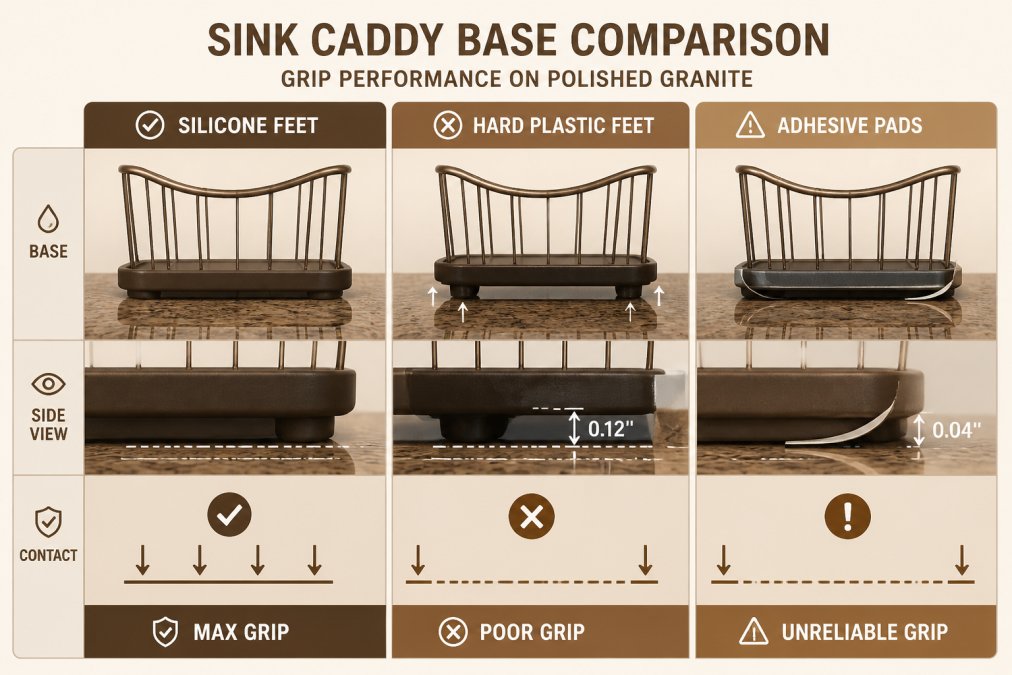
The best non-slip bases use silicone or specialized rubber compounds designed for polished stone. They create friction without micro-scratching and resist water absorption, preventing mold growth.
Testing Grip on Your Actual Granite
-
Dry polished granite test: Place the caddy on a clean, dry polished granite surface. Apply steady sideways pressure with your hand at waist height (simulating reaching past it). A quality non-slip base should resist movement under 5-10 pounds of force. If it glides easily, the grip isn't adequate for a busy kitchen where you're reaching past it regularly.
-
Wet granite test: Spray the granite lightly with water and repeat the pressure test. Many caddies perform well on dry stone but fail when wet. Silicone and soft rubber compounds should maintain grip; hard plastics often become slippery.
-
Soapy granite test: Apply a thin film of dish soap to the granite (simulating residue from wet hands or sponges) and test again. This is the most demanding condition. Premium non-slip bases maintain traction; budget options often slide noticeably.
Material Performance on Polished Granite
- Silicone feet: Excellent grip on all granite finishes, maintain traction when wet or soapy, don't scratch, resist water and mold. Best choice for stone.
- Soft rubber: Good grip on dry granite, adequate when wet, but can absorb water and develop mold. May leave faint marks.
- Hard plastic or suction cups: Poor grip on polished granite, especially when wet. Risk of sliding and scratching. Avoid.
- Felt or cork pads: Excellent for scratch prevention but inconsistent grip on polished granite and fail when wet.
- Adhesive-backed rubber strips: Strong initial grip but adhesive fails after 6-12 months. Residue is difficult to remove.
Grip performance depends on contact design. A caddy with multiple small feet (4-6 points) distributes pressure more evenly than one with 2-3 large feet, reducing pressure marks or scratches. Recessed feet prevent catching grit particles.
The Sinkelle HookNest Kitchen Sponge Holder ($29.99) holds sponges, scrubbers, and dish cloths with an integrated hanging hook.

Sink Caddy That Won't Scratch Countertops: Material Selection and Contact Points
A sink caddy that won't scratch countertops requires careful attention to contact points. Prioritize silicone feet, soft rubber, and felt or cork backing. Avoid hard plastic, rough rubber, unfinished wood, and unsealed metal. Granite is brittle; sharp pressure or repeated friction can chip edges or create hairline cracks.
Weight distribution matters, caddies that spread weight across a wider base cause less damage than those concentrating pressure on small feet. A caddy design that allows airflow underneath prevents water damage from expansion and contraction cycles.
Rustproof Stainless Steel Sink Caddy: Durability and Maintenance
Rustproof stainless steel resists corrosion and lasts, but requires regular maintenance to hide hard water deposits and mineral stains.
Fit, Dimensions, and Countertop Layout: Getting the Right Size
Measure your sink area systematically before buying. A caddy that's too large crowds your workspace; one too small won't hold what you need.
Step-by-Step Measurement Framework
- Counter depth: Most caddies are 6-8 inches deep. If your counter is less than 10 inches deep, choose a caddy no deeper than 6 inches.
- Counter width: Account for faucet footprint (4-6 inches). Most caddies are 7-10 inches wide; choose 7 inches or narrower if available width is less than 9 inches.
- Faucet height and reach: If spout extends more than 8 inches from sink edge, place caddy on opposite side or behind faucet.
- Sink edge height: Caddy should not exceed sink rim height (usually 8-10 inches) or it will obstruct access.
- Existing fixtures: Measure soap dispensers and other accessories; caddy should not overlap them.
Common Layout Scenarios and Solutions
Scenario 1: Tight space next to faucet
- Available width: Less than 9 inches
- Solution: Choose a compact caddy (7 inches wide or narrower). The Sinkelle FlexiDrain measures approximately 9.4 inches wide.
Scenario 2: Faucet with long reach
Sinkelle FlexiDrain Sink Caddy →
- Faucet spout extends 9+ inches from sink edge
- Solution: Place the caddy on the opposite side of the sink (away from the faucet) or on the counter behind the faucet if space allows. This prevents water splashing onto the caddy and keeps the faucet area clear.
Scenario 3: Corner sink or wall-mounted faucet
- Counter space is limited on both sides of the sink
- Solution: Use a caddy with a narrow footprint (6-7 inches deep) and place it at a corner angle or against the wall. Ensure the caddy doesn't block the faucet's spray pattern or make it difficult to reach the sink.
Scenario 4: Island or peninsula sink with access from multiple sides
- Counter space available on multiple sides
- Solution: Place the caddy on the side facing away from the main kitchen traffic flow. This keeps the sink area visually open and prevents the caddy from becoming an obstacle.
Scenario 5: Under-sink storage is full (garbage disposal or plumbing)
- No room for under-sink organizers
- Solution: A countertop caddy becomes essential. Prioritize a compact design (7-8 inches wide, 6 inches deep) to minimize visual clutter. The open-grid design of the Sinkelle FlexiDrain (approximately 9.4 × 3.9 × 2.8 inches) makes it compact enough for most tight spaces while still offering functional storage.
Granite-Specific Layout Considerations
Granite countertops often have seams, especially on larger islands or peninsula sinks. Avoid placing a caddy directly over a seam; water can seep into the seam line and cause damage over time. If your sink is near a seam, offset the caddy by 2-3 inches to keep it away from the joint.
Also consider the granite's finish. Polished granite shows water spots and mineral deposits more visibly than honed or leathered finishes. If your granite is polished, place the caddy where it will shade the area underneath, reducing the visibility of water marks and mineral deposits that accumulate around the base.
Capacity vs. Footprint Trade-Off
A larger caddy holds more items but occupies more counter space. A smaller caddy keeps your counter cleaner but requires more frequent emptying or reorganizing. Assess what you actually use near your sink daily:
- Daily items: Sponge, dish brush, soap dispenser (3-4 items)
- Weekly items: Scrubbers, cleaning cloths, drain strainer (2-3 items)
- Occasional items: Extra sponges, specialty brushes (1-2 items)
If you use 5-6 items daily, a medium caddy (8-9 inches wide) is justified. If you use 3-4 items, a compact caddy (7 inches wide) is sufficient and leaves more counter space for other tasks.
Testing Fit Before Committing
If ordering online, check the return policy, you should be able to return the caddy if it doesn't fit your layout.
Measure twice, buy once. A caddy that fits your space perfectly will be used consistently and maintained properly. One that's awkwardly sized will become clutter you eventually remove.
Common Mistakes to Avoid When Choosing a Sink Caddy for Granite
The biggest mistake is buying based on price alone. A caddy that slides across your granite or leaves water damage underneath costs far more in refinishing than investing in a quality option upfront.
Another common error is choosing a caddy without testing it on your specific granite first. Granite varies, some surfaces are more polished and slippery than others. A caddy that grips perfectly on one person's granite might slide on yours. If possible, test the grip on your actual countertop before committing.
Homeowners also underestimate water management. They pick a caddy based on how many items it holds, ignoring whether it promotes drainage underneath. This leads to water pooling, mineral deposits, and eventually discoloration that no amount of cleaning removes.
Ignoring the aesthetic is another trap. A caddy that doesn't match your kitchen style will feel out of place, and you'll be less likely to maintain it properly or keep it organized. SinkElle's minimalist Scandinavian design integrates with modern kitchens seamlessly, which is why many homeowners choose it, it looks intentional rather than cluttered.
Finally, don't assume all non-slip bases are equal. Some rubber feet work on tile but fail on granite. Test before buying, or choose a brand with clear specifications about stone compatibility.
Choosing the right non-slip sink caddy granite surface comes down to three priorities: genuine grip on polished stone, effective water management, and materials that won't scratch or damage your countertop. The upfront investment in a quality caddy protects your countertop from permanent damage while keeping your sink area organized and functional.
SinkElle's approach to sink organization combines durability with minimalist design. Both the FlexiDrain Sink Caddy ($24.99) and the HookNest Kitchen Sponge Holder ($29.99) are engineered with granite compatibility in mind, open designs for drainage, non-slip bases for stability, and finishes that complement modern kitchens. Get started with SinkElle and transform your sink area into an organized, protected space that works as hard as you do.
Frequently Asked Questions
How do you keep a non-slip sink caddy from sliding on granite?
The key is a silicone or rubber base that grips polished granite without adhesive. Look for caddies with wide contact points and textured undersides, these distribute weight evenly and create friction on smooth stone. Avoid suction-cup designs on granite; they're unreliable on polished surfaces. Ensure the caddy sits flat with no gaps. The Sinkelle FlexiDrain's open design allows water drainage around the base.
Can a sink caddy scratch or stain a granite countertop?
Yes, if the wrong materials touch granite. Avoid metal feet, rough plastic, or materials that hold moisture against the stone. Granite is porous and susceptible to staining from prolonged water contact. Choose caddies with soft silicone feet or rubber grips that won't etch or scratch the surface. Check that drip trays have waterproof liners to prevent pooling. Non-slip bases made from soft materials protect both the caddy and your countertop from damage over time.
What features should you look for in a sink caddy with a drip tray?
A drip tray should be integrated into the caddy's design to catch water from wet sponges and brushes before it pools on your countertop. Look for trays with sloped bottoms for drainage, waterproof materials that won't absorb moisture, and easy-to-empty compartments. The caddy's main storage area should have ventilation to allow air circulation around wet tools, preventing mildew. The Sinkelle FlexiDrain's open structure promotes drainage and prevents water from sitting around cleaning tools, reducing mold risk.
Are suction-cup sink caddies safe to use on granite?
Suction cups are unreliable on polished granite because the smooth, sealed surface doesn't create the seal needed for strong suction. They often slip or fall, especially when wet. For granite, stick with non-slip rubber or silicone base designs that rely on friction and weight distribution rather than suction. These provide consistent grip without risking damage from repeated removal and reattachment, which can mark or pit the stone over time.