


Table of Contents
- Start With a Clutter-Free Layout, Not a Shopping List
- Small Kitchen Counter Organization That Survives Real Cooking
- Renter-Friendly Kitchen Storage Solutions With Zero Drilling
- Minimalist Kitchen Sink Organization Ideas for Tight Corners
- Lighting Temperature and Mood: The Decor Detail Most Apartments Get Wrong
- Neutral Color Palettes, Eco-Friendly Materials, and Ergonomics in Tiny Kitchens
- Conclusion: Pick Three Changes, Then Stop
- Frequently Asked Questions
Last Updated: September 16, 2026
Start With a Clutter-Free Layout, Not a Shopping List
Minimalist kitchen decor for apartments begins with subtraction, not addition, and that holds true for minimalist kitchen decor in any small space. Before buying a single shelf or bin, clear every surface and see what your kitchen actually does all day, that blank slate reveals the real bottlenecks.
Small Kitchen Counter Organization That Survives Real Cooking
Small kitchen counter organization works when you cap the items allowed on the surface and give each a defined spot. The goal isn't an empty counter but one where every object earns its footprint. Start with the three messiest zones, coffee station, prep area, and sink, and give each one vertical organizer, nothing else.
Vertical Storage and Tiered Shelves
Vertical storage is the highest-return move in a small kitchen. The SinkElle CounterRise 2-Tier Shelf, at $34.99, is a rust-resistant metal tiered shelf that stacks coffee essentials, mugs, condiments, and spices upward instead of outward, and works on the counter, inside a cabinet, or on a pantry shelf.

| Problem | Fix | What It Changes |
|---|---|---|
| Counters covered in jars and mugs | Tiered countertop shelf | Frees flat surface area |
| Spices invisible at the back | Adjustable 3-tier rack | Cuts duplicate purchases |
| Pots stacked and scratched | Adjustable pot organizer | Protects cookware, speeds access |
| Sponges and brushes puddling | Over-sink draining rack | Keeps the sink zone dry |
Renter-Friendly Kitchen Storage Solutions With Zero Drilling
Renter-friendly kitchen storage solutions share one rule: they hold on by geometry, tension, or weight, never by screws, which protects your security deposit. Check your lease first: most prohibit drilling into cabinetry or tile, and some ban adhesive mounts on painted surfaces. Photograph the wall or cabinet before installing anything so you have a record of its original condition.
The Four Mechanisms That Actually Hold
Almost every renter-safe storage product works through one of four mechanisms. Knowing which one you're buying tells you how much weight it carries and where it fails.
- Tension: Spring-loaded rods grip between two parallel surfaces. Best inside cabinets and under sinks. Fails when surfaces are uneven or the span is too wide.
- Over-the-door or over-cabinet: A bracket hooks over the top edge of a door or cabinet. Carries the most weight of any renter-safe option because gravity does the work. Fails if the door gap is too tight.
- Adhesive: Pressure-sensitive strips or hooks bond to smooth, clean surfaces. Good for light items only. Fails in heat, steam, and grease.
- Magnetic: A magnet holds to a ferrous metal surface. Excellent for knives and small tools on a steel backsplash or refrigerator side. Fails on stainless steel that isn't magnetic and on painted or tiled walls.
Magnetic Knife Strips and Foldable Furniture
Magnetic knife strips and foldable furniture solve two problems: strips move knives off the counter and onto the wall without a hole, while foldable carts and drop-leaf surfaces expand when you cook and collapse when you don't. A wall-mounted magnetic strip carries real weight, but only on a ferrous surface, test with a refrigerator magnet first. On tile or painted drywall it won't hold, and an adhesive-backed strip limits you to lightweight utensils.
Tension Rods, Over-the-Door Racks, and the Weight Test
Tension rods are the most underrated renter tool in a small kitchen: one rod inside a cabinet can suspend spray bottles under the sink, hang brushes, or create a second tier for baking sheets. They slip on slick surfaces or spans over roughly 30 inches, so measure first. Over-the-door racks work the same way on cabinet doors, turning dead space into storage for cutting boards, foil, and wrap, but most fit doors between about 3/4 inch and 1 inch, so check before ordering.
What to Skip
Not every renter hack is worth the risk. Command strips rated for 5 pounds often fail at 3 in a humid kitchen, suction cups on tile lose grip within weeks, and anything needing a screw anchor is off the table unless your lease allows it. The practical test: if removing it would leave a mark, hole, or residue you can't clean, it isn't renter-friendly.
Minimalist Kitchen Sink Organization Ideas for Tight Corners
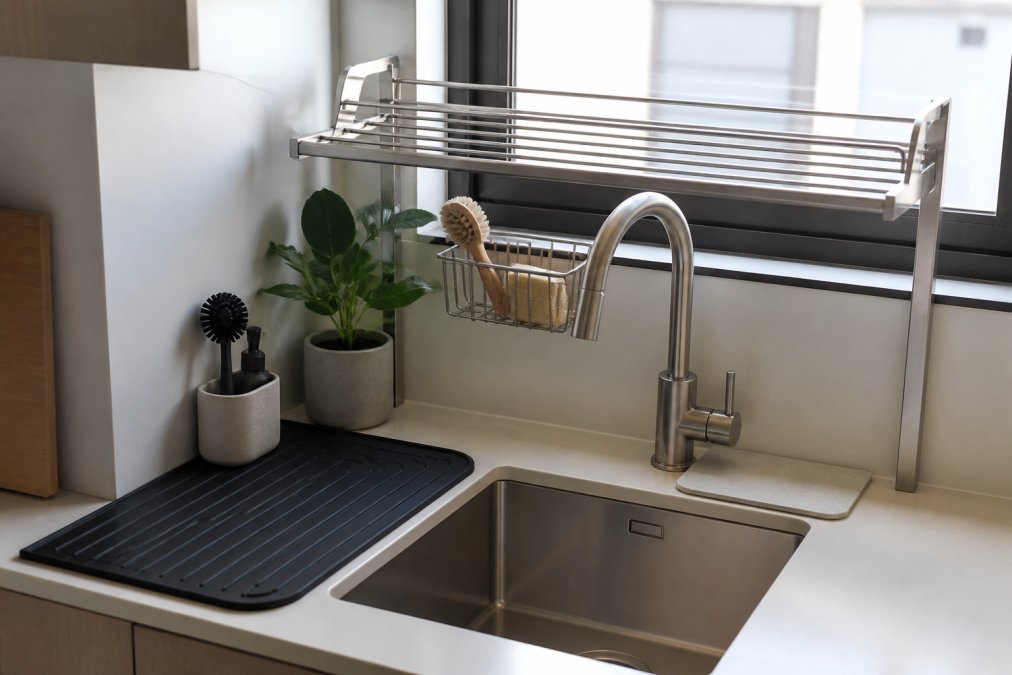
Minimalist kitchen sink organization ideas come down to keeping water where it belongs. A dry sink area looks intentional; a wet one looks neglected, no matter how good the cabinetry is.
Lighting Temperature and Mood: The Decor Detail Most Apartments Get Wrong
Lighting temperature is the most overlooked variable in small kitchens, and it decides whether a minimalist room feels calm or clinical. Color temperature is measured in kelvin, and the practical rule is warmer light where you eat, cooler light where you work, a single overhead fixture at one temperature flattens everything and makes even clean counters look tired.
Sinkelle CounterRise 2-Tier Shelf →
- 2700K to 3000K: warm, flattering, best for dining nooks and open shelving displays
- 3500K to 4000K: neutral, best for general kitchen overheads
- 4000K to 5000K: cooler, best for task lighting directly over the sink and prep area
Neutral Color Palettes, Eco-Friendly Materials, and Ergonomics in Tiny Kitchens
A neutral color palette does more for a small kitchen than any single accessory, because it removes the visual boundaries that make a room feel chopped up. Warm minimalist schemes lean on off-white, sand, oatmeal, and pale wood rather than stark white, which reads cold under cool lighting. Pick one base color, one wood tone, and one metal finish, then repeat them, three finishes in a 60-square-foot kitchen reads as clutter even when the counters are empty.
Eco-Friendly Materials That Actually Fit a Minimalist Kitchen
Minimalism and sustainability overlap more than most decor guides admit: fewer, better-made objects produce less waste than disposable organizers, and the materials that hold up best in a small, humid kitchen have the lowest long-term footprint.
- Bamboo: Fast-growing, water-resistant when sealed, and lighter than hardwood. Best for shelving, tiered racks, and drawer dividers. Trade-off: it can warp if left wet, so keep it away from the sink edge.
- Stainless steel: Non-porous, recyclable, and doesn't absorb odors. Best for racks, sink accessories, and canisters. Trade-off: it shows water spots, so a quick wipe matters.
- Glass: Fully recyclable, doesn't stain, and lets you see contents without opening a lid. Best for pantry canisters. Trade-off: heavier and breakable on a crowded counter.
- Food-grade silicone: Flexible, heat-resistant, and long-lasting. Best for mats, lids, and collapsible items. Trade-off: it can hold odors over time if not washed promptly.
Ergonomics in Tiny Kitchens: The Work Triangle at 60 Square Feet
Ergonomics rarely get mentioned in decor writing, but they decide whether a minimalist kitchen survives daily cooking. The classic work triangle, sink, stove, refrigerator, was designed for full-size kitchens; in an apartment it often collapses into a line. What matters in a tiny kitchen is vertical ergonomics: where things sit relative to your body, not the floor plan.
- Waist to shoulder height: Daily items, your most-used pan, cooking oil, salt, the knife you reach for every day. This is the zone you touch without bending or stretching.
- Below waist: Heavy items, pots, small appliances, bulk dry goods. Bending is fine for occasional use but punishing for daily use.
- Above shoulder: Occasional items, holiday dishes, the blender you use monthly, backup supplies. Anything you reach for weekly will annoy you here.
Putting the Three Together
Color, materials, and ergonomics aren't separate decisions. A warm neutral palette makes a small kitchen feel larger. Eco-friendly materials keep it from filling up with disposable clutter. And ergonomic placement means the objects you keep visible are the ones you actually use, which is what minimalism looks like in practice, not just in photographs.
Conclusion: Pick Three Changes, Then Stop
The hardest part of a minimalist kitchen isn't starting; it's knowing when to stop adding. Every organizer is another object in a small room, and past a certain point, more storage just means more to maintain.
Frequently Asked Questions
How do you keep a small kitchen minimalist when counter space is almost nonexistent?
Treat the counter as a working surface, not a shelf. Keep only items you use daily within reach, then move everything else into vertical or under-cabinet storage. A tiered shelf such as the Sinkelle CounterRise 2-Tier Shelf ($34.99) stacks mugs and coffee essentials upward instead of outward, and an under-cabinet hanging organizer frees the surface entirely. The rule that keeps it working: if it has not been used in two weeks, it does not belong on the counter.
What are renter-friendly kitchen storage solutions that will not damage walls or cabinets?
Look for organizers that hang, rest, or stand rather than mount. Over-sink racks rest on the sink edge, under-cabinet hanging organizers hook over existing cabinet bases, and tiered countertop shelves need no fixing at all. The Sinkelle CabinetFlow Hanging Organizer ($44.99) holds paper towels, cutting boards, and pot lids under a cabinet with no drilling. Check the product dimensions against your own cabinet depth before ordering, since apartment cabinet heights vary.
How do I stop sponges and dish towels from making my sink area look messy?
The mess comes from water pooling under things, not from the items themselves. An over-sink rack with an angled drain tray lifts sponges and brushes so water runs back into the sink instead of sitting on the counter. The Sinkelle FlowRack Pro ($29.99) uses a rust-resistant stainless steel frame with a bar basket and towel bar, and it sets up without tools. Pair it with a splash mat to catch drips around the faucet and the whole corner stays dry between cleanings.
What is the fastest way to make an apartment kitchen look more minimalist?
Change the lighting before you buy anything. Swapping a single cool-white overhead bulb for a warm bulb in the 2700K to 3000K range, plus one small under-cabinet light, softens a compact kitchen more than new decor does. After that, clear the counter of anything not used daily and group what remains on one tiered shelf. Two changes, one afternoon, and the room reads calmer without a single renovation.