


Table of Contents
- Start With a Corner Cabinet Measurement Plan
- How to Organize Pots and Pans in a Corner Cabinet
- Deep Corner Cabinet Storage Ideas That Recover Lost Space
- Choosing Corner Cabinet Organizers by Cabinet Type
- Is a Lazy Susan for Corner Cabinet Storage Worth It?
- Adjust Shelves and Add Slide-Out Storage
- Budget, Installation, and Safety Limits
- Keep Corner Cabinet Storage Working Long Term
- Frequently Asked Questions
Last Updated: October 17, 2026
Start With a Corner Cabinet Measurement Plan
Corner cabinet storage fails for one simple reason: people buy organizers before they know what will actually fit. A tape measure and ten minutes prevent most of the frustration that follows.
The awkward corner is usually the last space anyone tackles. That's exactly why it rewards a little planning. The corner holds the deepest, darkest, hardest-to-reach volume in the whole kitchen, and a plan turns it from a dead zone into usable capacity.
What to Measure Before You Buy Anything
Grab a notepad and measure these five things:
- Cabinet opening width: the clear distance across the door frame
- Interior depth: from the front edge to the back wall
- Interior height: floor of the cabinet to the underside of the top
- Door swing: how far the door opens and which way it travels
- Obstructions: hinges, pipes, outlets, or a garbage disposal in the way
Write the numbers down and subtract at least 2.5 cm from every dimension. Organizers need breathing room to slide.
How to Organize Pots and Pans in a Corner Cabinet
The best corner cabinet storage for cookware puts the heaviest items low and keeps every pan's handle facing out.
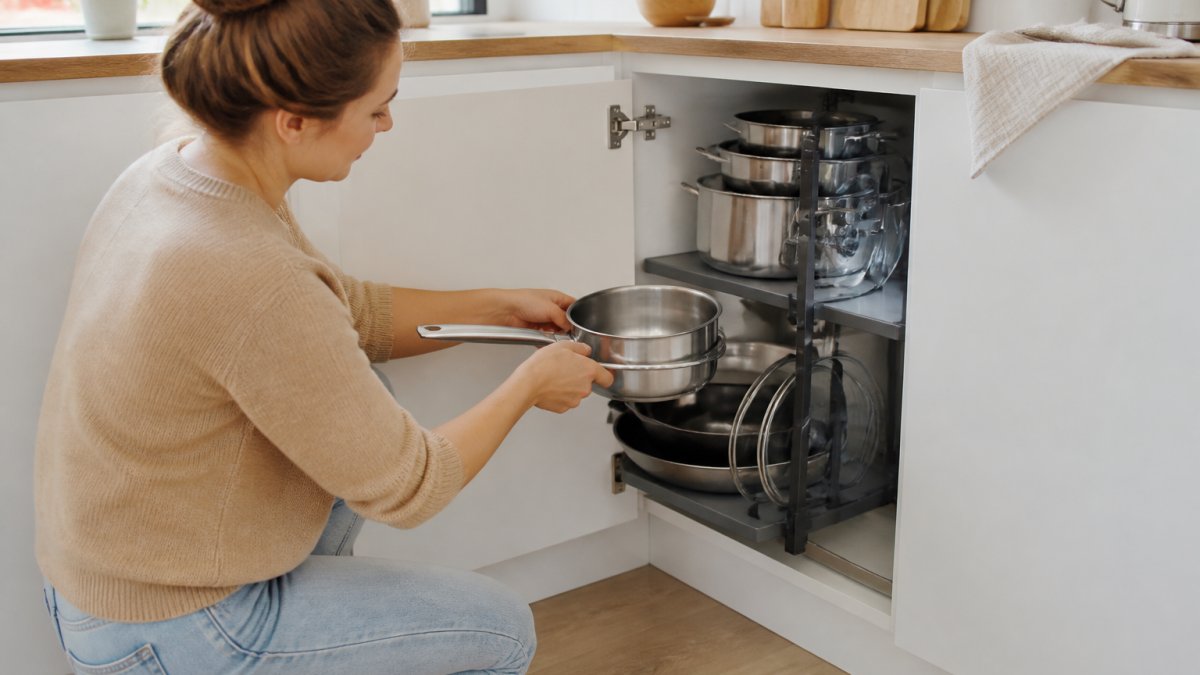
Start by pulling everything out. Group pots by size, then decide what earns a spot in the corner at all. A common mistake is storing the whole set there when you only reach for three pieces weekly.
A freestanding rack does the heavy lifting here. The SinkElle PanNest Adjustable Pot Organizer uses carbon steel and stainless steel construction with an adjustable layout, so different pan sizes sit side by side instead of in a pile.

Lids are the silent space thief. Stand them upright in a narrow bin or against the cabinet wall rather than laying them flat.
Deep Corner Cabinet Storage Ideas That Recover Lost Space
Deep corner cabinet storage ideas work best when they attack depth directly. The back of a deep cabinet is where items go to be forgotten, so the goal is to bring that back zone forward.
Try these approaches:
- Two-tier organizers that double the usable shelf area without widening the footprint
- Turntables that rotate the back items into reach
- Stackable containers in clear plastic so contents stay visible
- Vertical dividers for trays, cutting boards, and baking sheets
- Labeled bins grouped by use, not by size
The SinkElle 2 SlideNest Organizer takes a different angle: a two-tier pull-out system on a durable metal frame. The smooth sliding drawers bring the back of the cabinet to you. It costs $55.99 and fits under sinks, inside cabinets, or in laundry rooms.

Choosing Corner Cabinet Organizers by Cabinet Type
Corner cabinet organizers are not one-size-fits-all. The right pick depends on which corner you actually own.
| Cabinet Type | Best Organizer | Why It Works |
|---|---|---|
| Blind corner | Pull-out or sliding system | Reaches the dead zone without crawling |
| Diagonal corner | Turntable or lazy Susan | Follows the angled interior |
| Corner wall cabinet | Stackable bins or small turntable | Light items, easy visibility |
| Lower corner with plumbing | Two-tier slide-out | Works around pipes and disposal |
| Deep pantry corner | Adjustable tiered rack | Uses height and depth together |
For a blind corner, a sliding system beats a fixed shelf every time. For a diagonal cabinet, a round turntable matches the shape and spins the back items forward. For a corner wall cabinet, keep weight light and reach short.
If your corner sits near the sink, an under-cabinet hanging rack adds storage without touching the counter. The SinkElle CabinetFlow Hanging Organizer hangs beneath cabinets and shelves to hold paper towels, cutting boards, and pot lids.

Is a Lazy Susan for Corner Cabinet Storage Worth It?
A lazy Susan for corner cabinet storage is worth it when the cabinet is diagonal or round, and less useful in a square blind corner. The spinning shelf shines because it puts the back of the cabinet in front of you with one turn. But "worth it" depends on four trade-offs most guides skip: capacity, usable access, durability, and installation complexity.
The Four Trade-Offs That Decide It
| Criterion | Lazy Susan | Pull-Out System | Stackable Bins |
|---|---|---|---|
| Capacity | Good in round/diagonal cabinets; wastes square corners | High, uses full depth | Moderate, depends on shelf height |
| Usable access | One turn brings back items forward | Full extension brings everything out | Reach-in only; back items still buried |
| Durability | Simple bearing; few moving parts | Slides and tracks wear under load | No moving parts |
| Installation | Usually drop-in, no tools | Screws or adhesive mount; check load rating | None |
Use a lazy Susan when:
- The cabinet interior is angled or curved
- You store jars, cans, or bottles
- You want quick access without pulling anything out
- The opening is wide enough to lift items in and out
Skip it when:
Sinkelle PanNest Adjustable Pot Organizer →
- You store large pans or tall appliances
- The cabinet is a deep rectangular blind corner
- The opening is too narrow to lift items in and out
- You need full-depth access to heavy items
Sizing a Lazy Susan Before You Buy
Measure the cabinet's clear interior width and depth at the shelf level, then subtract at least 2 inches from the smaller number. A turntable needs that gap to spin without scraping the door frame or side wall. For a two-tier model, also measure the vertical clearance between the shelf and the one above; tall bottles need the top tier to clear the cabinet ceiling when it rotates.
Where a Lazy Susan Beats the Alternatives
In a diagonal corner, a round turntable follows the angled interior and recovers space a rectangular pull-out cannot. In a corner wall cabinet, a small turntable keeps light items visible without a slide mechanism. In those two cases, the lazy Susan is usually the simplest, lowest-installation option, and the one most likely to still be in use a year later.
Adjust Shelves and Add Slide-Out Storage
Adjustable shelves and pull-out storage are the two upgrades that change a corner cabinet most. Both move items toward you instead of making you reach.
Here's the order we'd follow:
- Empty the cabinet completely
- Check whether shelf pins sit in fixed holes or adjustable tracks
- Move shelves to match your tallest items first
- Leave a gap above each shelf for your hand to reach in
- Add a pull-out tray or sliding organizer to the lowest shelf
- Test the slide with a full load before filling the rest
Adjusting shelf height takes minutes and costs nothing. A pull-out shelf costs more but pays back every time you avoid kneeling on the floor.
Budget, Installation, and Safety Limits
Set a budget before you shop, and split it between organizers and any tools you need. Most corner cabinet upgrades fall into three tiers, and the gap between them is as much about installation effort as price.
Compare the Tiers Before You Buy
| Tier | Typical Options | Approx. Cost Range | Tools Needed | Difficulty |
|---|---|---|---|---|
| Low-cost DIY | Stackable bins, turntables, shelf risers | Under $50 | None | Drop-in |
| Mid-range | Pull-out trays, two-tier slide-outs, hanging racks | $50-$150 | Screwdriver, drill for some mounts | 30-60 minutes |
| Custom | Full corner inserts, custom pull-outs | $150 and up | Professional install common | Half-day or pro |
Prices vary by cabinet size and brand, so treat these as planning ranges, not quotes. The point is to match the tier to how much reaching and kneeling the corner currently costs you.
Installation Difficulty by Organizer Type
- Stackable containers and turntables: no tools; confirm the footprint fits the shelf before loading.
- Hanging racks: usually hook or adhesive mount; check the cabinet underside can take the load.
- Pull-out trays and slide-outs: typically a few screws into the cabinet floor or shelf; follow the rated load and leave clearance for the door swing.
- Custom inserts: measure the opening precisely and expect a pro for anything that replaces a shelf or anchors to the cabinet frame.
Safety, Weight, and Accessibility
Safety matters more than most guides admit:
- Weight limits: check the rated load on any pull-out before filling it with cast iron.
- Reach: keep heavy items below shoulder height.
- Clearance: confirm the door swing clears the organizer.
- Securing: anchor tall racks so they can't tip when loaded.
- Accessibility: if reach or mobility is limited, favor a turntable or a pull-out on the lowest shelf over deep reach-in storage, and keep the most-used items at the front.
A common pattern is to spend the budget on the one corner you use daily and leave the rest with simple bins. That usually delivers more usable capacity per dollar than upgrading every corner at once.
Keep Corner Cabinet Storage Working Long Term
Maintenance is what separates a system that lasts from one that becomes clutter again. A quick monthly check keeps the corner functional.
Do these four things:
- Wipe the interior every few months, especially under the sink where moisture collects
- Re-tighten any screws on sliding hardware
- Reassess what you actually use and move the rest out
- Rotate rarely used items to the front so they get used
For pantry-style corners, a tiered rack keeps jars and spices visible. The SinkElle 2-Tier Pantry Storage Rack is built from premium bamboo with an adjustable two-tier design.
The real test of any corner system is whether you still use it in six months. Label bins, keep the most-used items at the front, and clear the corner out once a season.
Frequently Asked Questions
What are the best storage options for a deep corner cabinet?
Pull-out shelves, two-tier sliding organizers, and turntables handle deep corner cabinet storage best because they bring items to the front instead of forcing you to reach. Measure the interior depth and the door opening first, then pick a system that clears the hinge side. Stackable bins work for lighter goods, while metal pull-outs support heavier pots. Whatever you choose, leave the back row for items you use weekly, not daily, so nothing gets buried.
Are lazy Susans a good option for corner cabinets?
A lazy Susan for corner cabinet storage works well when the cabinet has a square or pie-cut footprint and you store bottles, jars, or spices. It rotates everything into reach without bending. Skip it for heavy cast iron or wide sheet pans, which can tip or jam against the rim. Choose a model with a raised edge and a non-slip base, and check that the diameter leaves at least an inch of clearance from the door frame.
How do you organize pots and pans in a corner cabinet without stacking them?
Use a vertical rack or adjustable pot organizer so pans stand on edge rather than nesting. Measure the tallest pan and set shelf height to clear it by two inches. Place lids upright in a separate slot or hanging organizer, and keep the heaviest skillet at the front of the lower cabinet. If you rent and cannot drill, a freestanding carbon steel rack such as the Sinkelle PanNest Adjustable Pot Organizer ($38.99) sits inside the cabinet without hardware.
How much weight can a corner cabinet pull-out shelf hold?
Most full-extension metal pull-outs are rated between 50 and 100 pounds when anchored into cabinet framing, not just the shelf board. Check the manufacturer's rating before loading cast iron or stoneware. Distribute weight evenly and avoid stacking heavy items at the front edge, which strains the slide. If your cabinet has a particleboard base, add a plywood reinforcement plate under the mounting screws so the slides stay secure over time.
Corner cabinets stay frustrating when organizers are bought on guesswork instead of measurement. SinkElle builds minimalist, Scandinavian-inspired storage with waterproof materials and tool-free installation, so you can turn an awkward corner into usable space without drilling or permanent changes. Start with a measurement plan, pick the organizer that matches your cabinet type, and let the hardware do the reaching. Shop Now and give your corner the storage it deserves.