


Quick Summary
A minimalist home with children works when every belonging has a clear place and a set purpose. Families keep it running with a short weekly reset, a monthly check and a seasonal review, plus a daily cleanup routine that kids can join.
- Keep items that are used, loved or needed, and set a clear home for each category.
- Use the one-in, one-out rule for clothes and toys so new items always replace old ones.
- Run a 15-20 minute weekly reset as a family, with each person handling their own zone.
- Store out-of-season clothes and rotate toys at each season change during the seasonal review.
- Ask your child to choose five favorite toys to keep, and box the rest for one month.
Table of Contents
- What Minimalism Means for a Family With Kids
- Step 1: Start With Your Own Belongings and Habits
- Step 2: Declutter Toys With Kids Without a Battle
- Step 3: Build Toy Storage Ideas for Small Spaces
- Step 4: Set Up a Kids' Daily Cleanup Routine
- Step 5: Use a Family Decluttering Checklist for Maintenance
- Adapting the System by Age, Custody, and Gift Boundaries
- Your Next Step: Set Up a Starter Zone This Weekend
- Frequently Asked Questions
Maintaining a Minimalist Home with Children: A Practical Routine
Last Updated: October 29, 2026
What Minimalism Means for a Family With Kids
Keeping a minimalist home with children is harder than keeping one without them. Kids generate toys, art, clothes and school papers every single day.
For a family, minimalism means owning fewer things on purpose: choosing what comes in, deciding what stays, and making it easy to put things away.
Minimalism with kids means:
- Keeping items that are used, loved or needed
- Setting a clear home for every category of belongings
- Making cleanup fast enough that children can join in
The sections below walk through a repeatable routine you can build over a few weeks.
Step 1: Start With Your Own Belongings and Habits
Begin with yourself before you touch the kids' things.
Pick one drawer, shelf or closet and sort it into keep, donate and trash. Repeat in one new area each week.
Watch for habits that bring stuff in: impulse buys, saying yes to every freebie, and keeping duplicate kitchen tools or cleaning supplies.
Step 2: Declutter Toys With Kids Without a Battle
Decluttering toys works best when children help make choices. Pulling everything out and tossing it at once usually ends in tears.
Try this process:
- Pick a single bin or shelf.
- Ask your child to choose five favorites to keep.
- Set the rest aside in a box labeled "rest" for one month.
- If your child does not ask for the box, donate it.
Toys left in storage for a month are rarely missed, a useful test for what your child truly uses.
Decluttering Children's Clothing Each Season
Clothing piles up fast. Go through your child's wardrobe at each season change.
- Sort by size first, so you can see what still fits.
- Keep only items in good condition that your child wears.
- Set aside hand-me-downs for siblings or friends.
A simple rule helps: when a new item comes in, one old item goes out.
Step 3: Build Toy Storage Ideas for Small Spaces
Small homes need storage that fits the room. Toy storage ideas for small spaces focus on vertical space, open bins and easy access.
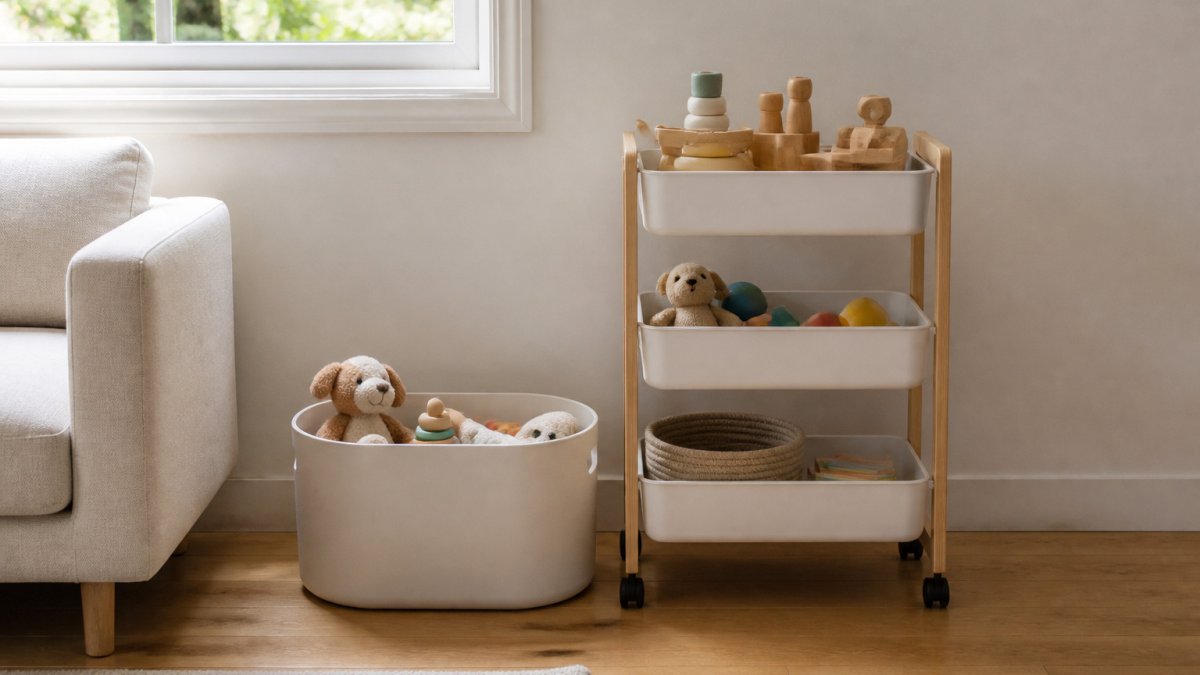
Good options include:
- Low, open bins children can reach and reset themselves
- Hanging organizers on a door or closet wall for small items
- Slim rolling racks that tuck beside a sofa or in a hallway
The Sinkelle DoorNest 5-Tier Hanging Organizer provides five storage pockets for small items and hangs over a door without drilling. For tight spots, the Sinkelle FlowCart Storage Rack offers a slim, rolling design that fits narrow gaps.


Place the most-used toys at child height. Store seasonal or rarely used items higher up or in a closet.
Step 4: Set Up a Kids' Daily Cleanup Routine
A kids' daily cleanup routine keeps the home from slipping back into clutter. The key is short, consistent and visual.
Try a routine like this:
- Morning: make beds and put pajamas away
- After dinner: pick up toys from the main room
- Before bed: return books and shoes to their homes
Use pictures or labels on bins so younger children know where things go. Keep the routine to 10 minutes or less, and cheer when it is done.
Step 5: Use a Family Decluttering Checklist for Maintenance
A one-time cleanout does not stay clean. What keeps a minimalist home with children running is a short, repeatable rhythm: a weekly reset, a monthly check, and a seasonal review. Each layer handles a different kind of clutter and prevents the slow accumulation that forces a big purge every year.
Sinkelle FlowCart Storage Rack →
The Three-Layer Maintenance Rhythm
| Layer | Frequency | Time | What It Handles |
|---|---|---|---|
| Weekly reset | Once a week, same day | 15-20 minutes | Surface clutter, toys, mail, backpacks |
| Monthly check | Once a month | 30-45 minutes | Bins, clothes, papers, broken items |
| Seasonal review | At each season change | 1-2 hours | Wardrobe, toys, activity gear, keepsakes |
Pick a fixed day for the weekly reset, Sunday evening works for many families, and post it where everyone can see it. Consistency matters more than duration.
The Weekly Reset (15-20 Minutes)
Run this as a family, with each person responsible for their own zone.
- Return stray toys to their bins (use a single "lost and found" basket for anything without a home)
- Clear the kitchen counter and entry drop zone
- Sort the week's mail into action, file, and recycle
The Monthly Check (30-45 Minutes)
This is where you catch what the weekly reset misses.
- Open each toy bin and remove broken, missing-piece, or unused items
- Check the kids' clothes for fit and wear; pull too-small items for donation or hand-me-downs
- Review the paper tray: file what matters, recycle the rest
The Seasonal Review (1-2 Hours)
Tie this to daylight saving time or the start of each school semester so it is easy to remember.
- Swap the wardrobe: store out-of-season clothes, bring in the next season
- Rotate toys: pull out stored toys, put away the ones currently out
- Sort activity and sports gear; retire outgrown equipment
Decision Rules That Speed Up Every Sort
A few simple rules remove the hesitation that stalls decluttering.
- The 20-minute rule: if you have not used an item in 20 minutes of looking for it, you probably will not miss it.
- The one-in, one-out rule: every new item that enters requires one to leave.
- The "would I buy it again?" test: if you saw it in a store today, would you pay full price? If not, let it go.
Handling the Hardest Categories
Some clutter resists every checklist. These systems help.
- School papers and artwork: keep one portfolio box per child. Monthly, photograph the rest and recycle. At year's end, keep no more than 10 pieces per child.
- Sports and activity gear: one labeled bin or hook per activity. Outgrown gear goes to a sibling or donation bin immediately, not the garage.
- Sentimental items: one labeled keepsake box per child. When it is full, the child chooses what to remove, teaching the same limit-setting you use for toys.
A Printable Family Decluttering Checklist
Post this where everyone can see it, and check off each item as it is done.
Weekly
- Toys returned to bins
- Counter and entry cleared
- Mail sorted
Monthly
- Toy bins checked
- Clothes checked for fit
- Paper tray reviewed
Seasonal
- Wardrobe swapped
- Toys rotated
- Activity gear sorted
Adapting the System by Age, Custody, and Gift Boundaries
A routine that works for a toddler will frustrate a teenager. Families who sustain minimalism adjust the system to each child's developmental stage, the number of households involved, and the flow of gifts coming in. Treat the guidance below as a starting point, then tune it to your child.
Infants and Toddlers (0-3)
At this stage, you are the decision-maker, so the goal is to keep the inventory small and the play space open.
- Cap the active toy set. Keep 8-12 toys accessible at a time and rotate the rest in a closet every two to four weeks, novelty without buying more.
- Favor open-ended toys. Blocks, stacking cups, board books, and a ball outlast single-purpose electronic toys, which tend to be abandoned quickly.
- Skip the toy box. Low, open bins at floor level let a toddler help drop items in during cleanup, building the habit early.
Preschool and Early Elementary (4-7)
Children this age can sort and choose, but they need short sessions and clear limits.
- Use a number, not a feeling. "Pick five to keep" is easier than "keep your favorites."
- Introduce the one-in, one-out rule for toys and clothes. When a new item arrives, the child chooses one to donate.
- Make a home for artwork. A single portfolio box or a folder on the fridge holds current work; photograph and recycle the rest monthly.
School-Age Children (8-12)
This is when school papers, activity gear, and collections start to pile up.
- Set a paper routine. Empty the backpack every Friday into three trays: action, keep, recycle. Action items get handled that weekend.
- Give sports and activity gear a single zone, one bin or hook per activity, so it does not migrate through the house.
- Let the child own one collection. A defined shelf or box teaches limits without banning interests.
Teens (13-18)
Teens need privacy and control over their space, which means the parent's role shifts from enforcer to coach.
- Negotiate the standard, not the stuff. Agree on what "clean" means for their room (for example, floor clear, laundry in the hamper) and let them manage the rest.
- Provide storage that fits their life. A lidded bin for charging cables, a hook for the backpack, and a drawer for school papers prevent drift into common areas.
- Use a seasonal review, not a weekly purge. Teens often resist frequent sorting; a review at the start of each semester and each summer is more sustainable.
Shared Custody and Blended Families
The goal is to reduce the back-and-forth of belongings, not to duplicate everything.
- Keep a core set at each home. A basic wardrobe, toothbrush, and a few comfort items at each household cut down on packing and forgotten items.
- Agree on a transfer list. A short shared note listing what travels, school laptop, sports bag, medication, prevents duplicate purchases.
- Align on the standard, not the method. Two households do not need identical systems, but agreeing that "toys live in bins, not on the floor" reduces friction for the child.
Gift Boundaries That Actually Hold
Gift-giving is the largest single source of incoming clutter for most families. A few practical moves help:
- Send a short, warm note before holidays and birthdays. Name two or three specific alternatives, museum memberships, a class, books, or consumables like art supplies, rather than a vague "no toys."
- Keep a running wish list. A shared list of what the child actually wants and needs gives relatives a concrete option.
- Use a wish-list registry for birthdays. Many retailers offer a registry or wish-list feature that relatives can shop from, reducing duplicates.
Your Next Step: Set Up a Starter Zone This Weekend
Pick one zone this weekend, the toy corner, entry hall or kitchen counter. Clear it, sort it and give everything a home. Then add your daily cleanup routine and monthly checklist.
Small, steady changes make a minimalist home with children possible. Start with one zone and build from there.
Frequently Asked Questions
How do you keep a minimalist home with kids?
Keep the number of toys and clothes low enough that everything has a home, and reset the space every day with a short cleanup routine. Rotate toys so only a portion is out at once, and review belongings each season. Involve children in choosing what stays so they learn to care for fewer, well-loved items. Consistency matters more than perfection: a five-minute reset each evening prevents most clutter from building up.
How can I declutter toys without upsetting my children?
Involve children in the decision rather than removing toys without warning. Sort toys into keep, donate, and rotate piles, and let your child choose which items go. Set a clear rule, such as keeping a limited number of toys in each category, and explain it before you start. Storing rotated toys out of sight for a few weeks makes it easier to decide later whether they were truly missed.
How often should families declutter toys and clothes?
Many families find it works well to do a quick toy review every month or two and a fuller clothing review each season, when children outgrow sizes and needs change. Use the seasonal change as a natural checkpoint. Keep a donation bag in a closet and add to it between reviews so the process takes minutes rather than an entire weekend.
What are the best storage ideas for a minimalist home with children?
Choose open, low storage that children can reach themselves, such as bins on a shelf or a slim rolling rack for everyday supplies. Limit each category to one container so the limit is visible. The SinkElle FlowCart Storage Rack ($30.99) fits narrow gaps and works for household supplies, and the SinkElle DoorNest 5-Tier Hanging Organizer ($65.99) uses door space for small toys and accessories without drilling.
