


Last Updated: October 23, 2026
Quick Summary
Creative ways to store spices in small kitchens include rotating racks, wall-mounted shelves, cabinet-door organizers, drawer dividers, and tiered shelf units that maximize vertical space without cluttering countertops. Each method suits different kitchen layouts and lifestyles, from renter-friendly freestanding options to permanent wall installations.
- Rotating racks work best for 8-15 regularly used spices and require no installation, making them ideal for renters.
- Wall-mounted racks turn unused vertical space into organized storage but should avoid areas near stoves or sinks to prevent heat and moisture damage.
- Cabinet-door storage is hidden and accessible, holding 10-20 spices while keeping them fresher longer than open shelves.
- Drawer-based systems can hold 30-50 bottles using dividers or small boxes, requiring only clear labeling for visibility.
- Glass jars with tight-sealing lids preserve spice flavor better than cardboard, and spices lose potency after 2-3 years for ground spices or 3-4 years for whole spices.
Table of Contents
- Rotating Racks and Lazy Susans for Easy Access
- Wall-Mounted Spice Racks to Maximize Vertical Space
- Best Spice Organizer for Small Spaces: Inside Cabinet Doors
- Drawer-Based Spice Organization Systems
- DIY Spice Storage Ideas Using Everyday Items
- Spice Rack Ideas to Maximize Space Without Installation
- No-Cost Spice Organization Methods and Labeling
- Keeping Spices Fresh in Limited Storage Conditions
- Comparison: Spice Storage Solutions by Kitchen Type
- Frequently Asked Questions
Rotating Racks and Lazy Susans for Easy Access
A rotating rack stacks bottles in tiers on a central axis; you turn the unit to reach any bottle, so everything stays visible without moving the rack.
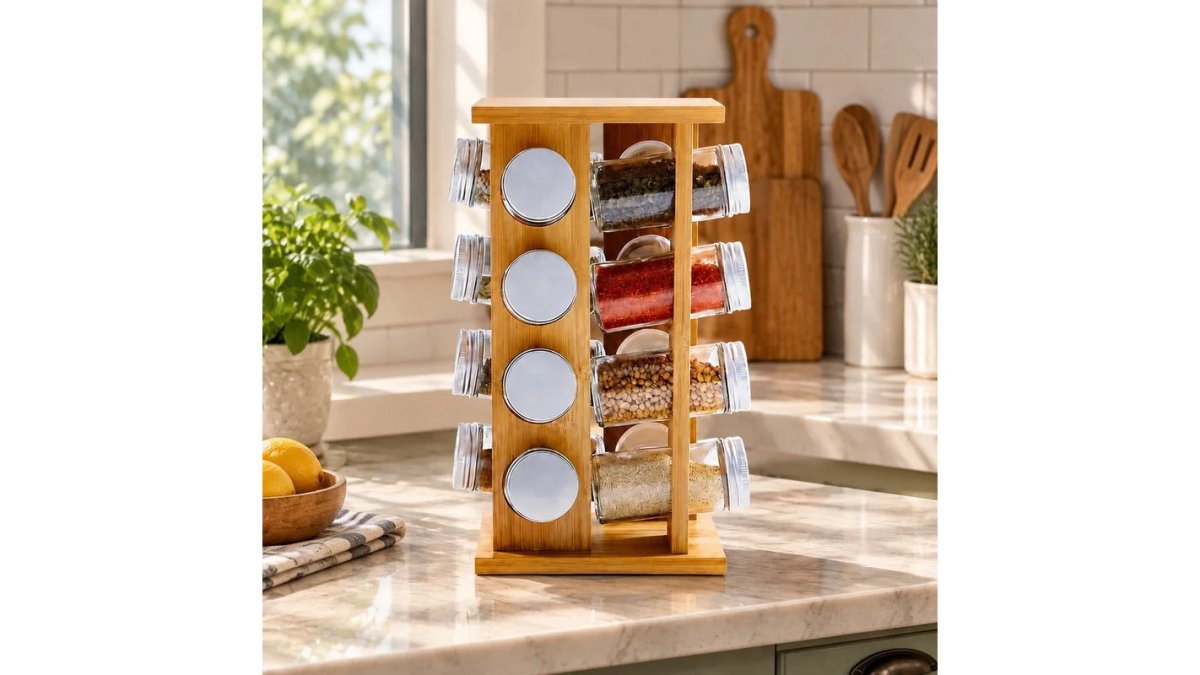
The Sinkelle SpinSpice Bamboo Rack ($29.99) brings minimalist Scandinavian design to spice organization. Its multi-layer rotating structure keeps bottles neatly arranged, and the bamboo adds warmth.

Lazy Susans work on the same principle but are more flexible: pick one sized to your collection, and use it in cabinets, on shelves, or on counters.
For renters avoiding permanent installation, rotating racks and Lazy Susans are ideal: no drilling, adhesive, or tools. Set them down and they're ready, perfect for temporary kitchens or walls you can't modify.
Wall-Mounted Spice Racks to Maximize Vertical Space
Wall-mounted spice racks turn unused vertical space into organized storage.
Styles include narrow single-row shelves, tiered racks, and hanging organizers with pockets or hooks. Each saves counter space by anchoring storage to the wall.
The key advantage is visibility: bottles face outward, so you see labels at a glance, cook faster, and avoid buying duplicates you forgot you owned.
Installation matters for renters: some racks require drilling, which landlords often prohibit, so look for adhesive strips or magnetic mounts.
If you can drill, traditional mounted racks offer durability and weight capacity. Install at eye level and keep most-used spices on the top tier.
Learn about the specific benefits of pull-out spice racks(page:2)
Best Spice Organizer for Small Spaces: Inside Cabinet Doors
Cabinet door storage is hidden, accessible, and steals no shelf or counter space.
It works best on doors with solid backing or shallow shelves.
The Sinkelle SpiceRise 3-Tier Organizer ($58.99) fits inside cabinets and on countertops, giving you flexibility in placement.
Explore small kitchen organization ideas that complement spice storage(page:3)
The main limitation is weight: doors flex when opened and closed, so stick to lightweight jars or a tiered organizer that distributes weight evenly.
Cabinet doors also block light and heat, so spices stored inside stay fresher longer than those on open shelves or sunlit countertops.
Drawer-Based Spice Organization Systems
Drawers are underused spice real estate: one deep drawer can hold 30-50 bottles depending on size and system, keeping spices out of sight but accessible.
Dividers or small containers keep bottles from sliding. Use custom spice inserts, or DIY a grid from small boxes or repurposed containers.
The advantage is simplicity: open, grab, close.
The downside is visibility: you can't see everything at once, so label bottle tops clearly to avoid forgetting what you have or buying duplicates.
Arrange alphabetically for speed when you need something specific, or by category (baking, savory, herbs) if you often use a group together.
In small kitchens, dedicate one drawer to spices and keep it organized from the start: it holds more than a disorganized cabinet shelf and takes up no visible space.
DIY Spice Storage Ideas Using Everyday Items
You don't need specialized organizers: everyday items already in your home work well.
Small cardboard boxes cut to your drawer dimensions make a free grid divider; stand bottles upright in each section.
Tension rods installed horizontally inside a cabinet create shelves without drilling: place rods front, middle, and back, and stack bottles between them.
Learn how to organize a small kitchen with no pantry using creative storage methods(page:4)
Magnetic strips mounted on the inside of a cabinet door hold metal spice tins.
Sinkelle SpinSpice Bamboo Rack →
The appeal of DIY storage is cost and customization. You build exactly what fits your kitchen and spice collection size. The downside is time investment and the fact that DIY systems sometimes look less polished than commercial organizers.
Spice Rack Ideas to Maximize Space Without Installation
Not every spice storage solution requires mounting, drilling, or permanent placement.
Tiered shelf organizers sit on counters, shelves, or inside cabinets. They stack bottles vertically to use less horizontal space.
Expandable shelf risers create two levels of storage on a single shelf. Place one riser on your cabinet shelf, then stack another shelf or spice bottles on top. This doubles your storage capacity in the same footprint.
Narrow, tall organizers fit in tight spaces between appliances or in corner cabinets.
Carousel organizers (similar to rotating racks but with a smaller footprint) spin 360 degrees and fit on narrow shelves or countertops.
The advantage of no-installation storage is flexibility. If your kitchen layout changes, you move the organizer. If you rent, you take it with you when you move.
No-Cost Spice Organization Methods and Labeling
The most economical spice storage approach uses items you already own and costs nothing beyond a labeling system.
Start by consolidating. Check your spice cabinet or drawers and discard expired spices.
Next, transfer spices into uniform containers if you have extras on hand. Empty jars, small boxes, or containers from other products work.
Label everything. Use a permanent marker on masking tape, adhesive labels, or a label maker.
Arrange by frequency of use. Keep daily-use spices (salt, pepper, garlic powder) in the most accessible location.
Group by category. Keep baking spices together, savory spices together, herbs together.
No-cost organization relies on discipline. Without a system, spices migrate back to chaos within weeks. Commit to returning each spice to its designated spot after use, and the system stays functional.
Keeping Spices Fresh in Limited Storage Conditions
How you store spices matters as much as where you store them.
Spices deteriorate when exposed to heat, light, moisture, and air.
Glass jars with tight-sealing lids are superior to cardboard boxes or open containers.
Avoid storing spices above the stove or near the sink, even if space is tight.
Keep spices away from direct sunlight. Sunlight fades color and flavor.
Consider humidity. Kitchens near bathrooms or in humid climates expose spices to moisture.
Browse pantry and food storage organizers designed to maintain spice freshness(page:5)
Rotate stock regularly. Use older spices first (FIFO method: first in, first out).
For small kitchens with limited cool, dark storage, prioritize freshness over quantity. Keep only spices you use regularly, and replace them more frequently. A smaller, fresher spice collection produces better cooking results than a large collection of stale spices.
Comparison: Spice Storage Solutions by Kitchen Type
| Storage Method | Best For | Space Required | Installation | Cost |
|---|---|---|---|---|
| Rotating rack | Countertops, islands, frequent cooking | 12-18 inches diameter | None | $30-60 |
| Wall-mounted shelf | Limited counter space, visible organization | 24-36 inches wide | Drilling or adhesive | $25-75 |
| Cabinet-door organizer | Hidden storage, apartment kitchens | Inside cabinet door | Adhesive or small nails | $15-50 |
| Drawer divider | Minimalist aesthetic, out-of-sight storage | One drawer depth | None | $0-30 |
| Tiered shelf | Shelves, cabinets, counters | 12-16 inches wide | None | $30-75 |
| Magnetic fridge shelf | Apartment kitchens, no-drill options | Refrigerator side | Magnetic mount | $35 |
At SinkElle, we understand that small kitchens demand smart organization solutions. The Sinkelle SpiceRise 3-Tier Organizer combines practical functionality with minimalist Scandinavian design, helping you maximize cabinet and countertop space while keeping spices visible and accessible. Test different approaches to find what works, then commit to a labeling and maintenance system that keeps your spices fresh and your kitchen clutter-free. Find every spice in seconds with the SinkElle SpiceRise 3-Tier Organizer, compact, tiered design for countertops, cabinets, or pantry shelves.

Frequently Asked Questions
What is the best spice organizer for small spaces?
Rotating racks and wall-mounted organizers work best for small kitchens because they use vertical space instead of consuming counter real estate. The Sinkelle SpinSpice Bamboo Rack ($29.99) offers a rotating design that keeps multiple spice bottles accessible without taking up much footprint. For even more capacity, tiered metal organizers like the Sinkelle SpiceRise 3-Tier Organizer ($58.99) fit inside cabinets or on narrow countertops while holding more bottles in layers. Choose based on your available space: countertop rotation for frequent access, wall-mounted for zero counter impact, or inside-cabinet storage if you lack wall space.
How can I store spices without using counter space in small kitchens?
Inside cabinet doors, drawer organizers, and wall-mounted racks eliminate counter clutter entirely. Cabinet-door adhesive strips or tension rods hold bottles vertically, freeing up shelf space. Drawer organizers with dividers keep spices organized and hidden from view. Wall-mounted magnetic or hanging racks work on any kitchen wall or beside your stove. The Sinkelle CabinetFlow Hanging Organizer ($44.99) hangs beneath existing cabinets, creating storage without drilling or wall damage. For renters, magnetic refrigerator-mounted shelves like the Sinkelle Magnetic Refrigerator Storage Shelf ($34.99) attach without tools or permanent installation.
What are some DIY spice storage ideas for small kitchens?
Repurpose mason jars, spice tins, or small glass containers and store them in a shallow drawer with cardboard dividers. Use tension rods inside cabinet doors to hang spice bottles sideways, maximizing vertical space. Create a tiered shelf using stacked books and small shelves inside a cabinet. Label containers with waterproof tape and a permanent marker for quick identification. Store spices in a shallow wooden crate or magazine holder placed on a shelf or countertop corner. These DIY methods cost little to nothing and adapt to any kitchen layout without requiring installation or special tools.
How do I organize a large spice collection in a small kitchen?
Use multiple storage methods across different areas: a rotating rack on the counter for daily spices, drawer organizers for backup bottles, and wall-mounted or cabinet-door storage for less-used seasonings. Group spices by type (baking, cooking, specialty) and label each container clearly so you can find what you need quickly. The Sinkelle SpiceRise 3-Tier Organizer ($58.99) holds many bottles in one compact footprint with its adjustable tiered design. Prioritize frequently used spices in the most accessible spots and rotate seasonal or specialty items to less visible storage. This approach keeps your collection organized while maintaining easy access to everyday seasonings.
What keeps spices fresh when stored in small spaces with limited light and airflow?
Store spices in airtight containers away from direct sunlight, heat sources, and moisture. Small kitchens often mean cabinets near stoves or sinks, so use opaque or tinted glass jars to block light. Ensure containers seal tightly to prevent humidity from degrading flavor and potency. Keep spices away from the stove's heat and steam by storing them in upper cabinets, drawers, or wall racks positioned away from cooking areas. Label containers with purchase or opening dates and rotate older spices to the front. Proper storage extends spice life by 6-12 months, making organized small-space solutions worthwhile for both flavor and cost.
