


Table of Contents
- Why Material Choice Decides How Long Your Kitchen Storage Hardware Lasts
- Solid Wood vs. Engineered Wood in Cabinet Storage
- Stainless Steel vs Plastic Kitchen Hardware: Strength, Rust, and Load Limits
- Hardware-Specific Durability Testing: What Actually Breaks First
- Waterproof Kitchen Storage Solutions for Sink and Under-Cabinet Zones
- Lifecycle Cost Analysis: Budget-Friendly Cabinet Options vs. Premium Materials
- How to Maintain Kitchen Storage Hardware and Repair What Wears Out
- Frequently Asked Questions
Last Updated: September 28, 2026
Why Material Choice Decides How Long Your Kitchen Storage Hardware Lasts
Choosing durable materials for kitchen storage hardware determines whether your cabinets feel solid in year ten or rattly in year two.
Solid Wood vs. Engineered Wood in Cabinet Storage
Solid wood is a single piece of lumber milled from one species; engineered wood bonds fiber or veneer with adhesive into a stable panel. That difference drives how each performs around a sink.
| Material | Moisture Behavior | Fastener Hold | Best For |
|---|---|---|---|
| Solid hardwood | Swells, then recovers | Excellent | Frames, doors, face frames |
| Plywood | Good if edges sealed | Good | Cabinet carcass, shelves |
| MDF | Swells permanently | Fair | Painted doors |
| Particleboard | Swells and crumbles | Poor | Budget box construction |
Hardwood Species and How They Handle Moisture
Hardwood species differ in density and porosity, which changes how they react to a damp kitchen. Maple and oak are common; cherry is stable but dents easily.
- Maple: dense, fine-grained, resists denting, takes paint and stain evenly
- Oak: open pores absorb moisture faster unless sealed, very strong
- Cherry: stable and easy to work, but softer than maple or oak
Stainless Steel vs Plastic Kitchen Hardware: Strength, Rust, and Load Limits
Stainless steel wins on load capacity and corrosion resistance; plastic wins on cost and never rusts. That trade-off decides most hardware choices.
Corrosion Resistance and Load-Bearing Capacity Compared
Corrosion resistance and load capacity pull in opposite directions on price, not performance. A stainless slide rated for the real load will outlast a plastic slide in a wet zone.
Three rules that hold up in practice:
- Match the hardware rating to the real load, not the label on the box
- Choose stainless or coated steel anywhere within splash distance of a sink
- Never mix metals that create galvanic corrosion, such as bare aluminum against stainless in a wet environment
Hardware-Specific Durability Testing: What Actually Breaks First
Drawer slides and hinges fail before cabinet boxes do. The failure sequence tells you where to spend, and the metallurgy tells you which spec predicts that failure.
The typical order of failure in a busy kitchen:
- Drawer slides: rollers flatten, ball bearings wear, tracks bend under overload
- Hinges: screws strip from the cabinet, springs lose tension, soft-close dampers fail
- Handles and pulls: finish wears at the touch point, then the fastener loosens
- Shelf pins: shear or pull out under a heavy load
What the Metallurgy Actually Tells You
Most guides stop at "stainless is better." Grade and plating matter more than the label.
- Zinc-plated steel is the workhorse for hinges and slides. The zinc is sacrificial: it corrodes before the steel underneath. It lasts decades in a dry cabinet, but near a sink the plating breaks down at cut edges and screw holes, where rust starts.
- Stainless steel resists corrosion because chromium forms a passive oxide layer that re-forms when scratched. Common grades are 304 and 316; 316 adds molybdenum for chloride-rich environments, making it marine-grade. For a kitchen, 304 usually suffices; 316 is worth the premium only in a coastal home or a cabinet that sees standing water.
- Die-cast zinc is common in hinge bodies and handle bases. It is stable and takes plating well, but brittle under shock load, a slammed door can crack it where stamped steel would bend.
- Nylon and acetal are the standard engineering plastics for rollers and shelf pins. They never corrode, but creep under sustained load: a plastic shelf pin holding heavy cans slowly deforms, and the deformation does not reverse.
Weight Ratings and Cycle Ratings
Slide spec sheets carry two numbers, and both matter:
- Load rating, the weight the slide carries, often stated per pair. The rating assumes an evenly loaded drawer, so a front-heavy drawer sags below its stated capacity.
- Cycle rating, the open-and-close cycles the slide is tested to survive. A kitchen drawer opened twenty times a day hits roughly 7,300 cycles a year, so the cycle rating predicts whether the slide outlasts the cabinet.
The mistake is buying to the drawer's empty weight. Add the contents: a drawer of canned goods can weigh far more than the drawer itself.
Finish Durability: PVD, Powder Coat, and Electroplating
- Electroplating (chrome, nickel, zinc) deposits a thin metal layer that wears thin at the touch point, which is why a polished chrome pull dulls within a year of daily use.
- Powder coating cures a dry polymer powder under heat into a thick, uniform film. It resists chipping and hides fingerprints better than polished plating, which is why it is common on organizers and utility hardware.
- PVD (physical vapor deposition) deposits a hard ceramic-like film at the molecular level. It is the most scratch- and corrosion-resistant common finish, holding color on brushed brass and matte black pulls where plating wears through.
ASTM International standards for hardware and coating testing publishes the test methods manufacturers use to rate finishes and corrosion resistance, which is worth knowing when a spec sheet cites them.
Sinkelle PanNest Adjustable Pot →
Waterproof Kitchen Storage Solutions for Sink and Under-Cabinet Zones
Waterproof kitchen storage solutions matter most in the two zones that see constant moisture: under the sink and in the cabinet next to it. Here, material choice stops being theoretical.
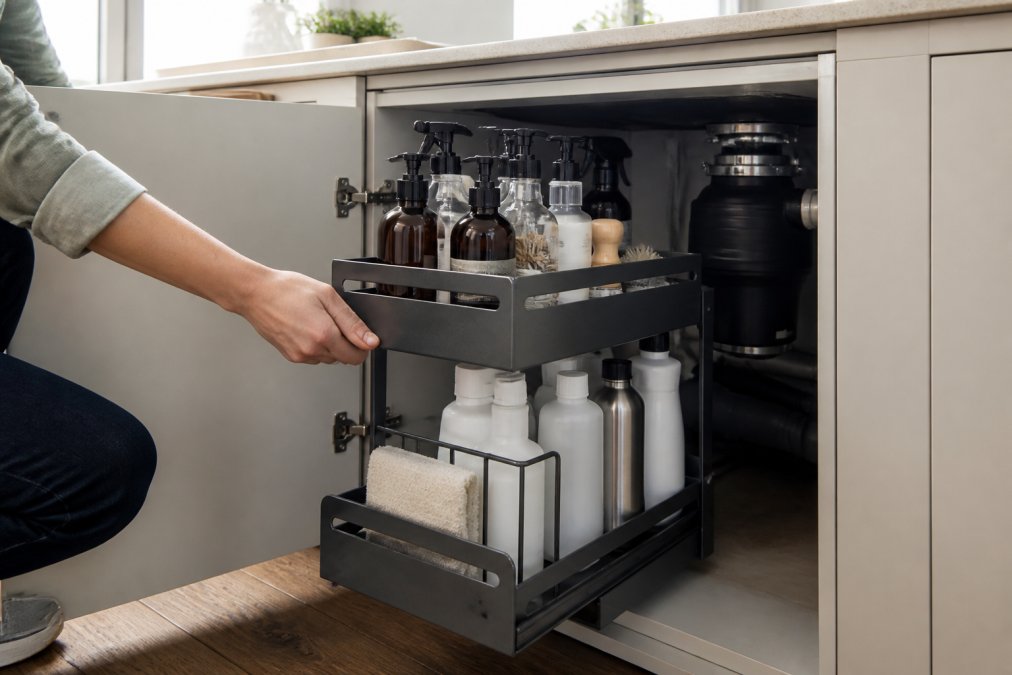
What holds up:
- Metal frames with a powder-coated or stainless finish
- Bamboo and sealed hardwood, which tolerate occasional moisture far better than raw particleboard
- Plastic and coated wire, which never rust but flex under load
Lifecycle Cost Analysis: Budget-Friendly Cabinet Options vs. Premium Materials
Lifecycle cost is purchase price plus maintenance plus replacement, divided across the years you keep the hardware. On that math, cheap hardware rarely stays cheap, the calculation most buying guides skip.
The framework has four inputs:
- Upfront cost per unit (hinge, slide, pull, shelf pin)
- Expected service life in cycles or years under real kitchen load
- Replacement labor, a slide swap is a 15-minute job; a stripped hinge screw in particleboard can mean a door replacement
- Collateral damage, a failed slide that drops a drawer can crack a face frame, and a leaking under-sink cabinet can delaminate a particleboard base
| Option | Upfront Cost | Expected Service Life | Replacement Effort | 20-Year Outlook |
|---|---|---|---|---|
| Budget plastic roller slides | Lowest | Short, often a few years in a daily-use drawer | Frequent, easy swap | Multiple replacements; track wear accumulates |
| Mid-grade ball-bearing slides | Moderate | Long, commonly outlasts the cabinet finish | Rare | Usually one set for the life of the kitchen |
| Premium stainless or heavy-gauge steel | Highest | Longest, often the last slide the cabinet will need | Very rare | Lowest total cost when labor is counted |
| Budget hinges on particleboard | Low | Short, screw holes strip before the hinge wears out | High, because the cabinet is the failure point | Door replacement, not hinge replacement |
| Quality steel hinges on plywood or solid wood | Moderate | Long, the hinge, not the cabinet, is the wear item | Low, and the screw hole survives a re-drive | One set, one install |
How to Maintain Kitchen Storage Hardware and Repair What Wears Out
Maintenance is mostly about removing the two things that kill hardware: grit and moisture. A few minutes a quarter extends the life of every slide and hinge.
A practical routine:
- Wipe slides and hinges with a dry cloth to clear grit
- Tighten handle and pull screws every few months
- Check under-sink cabinets for moisture after heavy use
- Lubricate metal slides with a dry silicone spray, never oil, which attracts dust
- Re-seal any exposed wood edges near the sink
Repairs worth knowing:
- Stripped hinge screw: glue a wooden dowel into the hole, let it cure, then re-drive the screw
- Sagging drawer: tighten the slide mounting screws first, then check for a bent track
- Slamming soft-close door: the damper has failed; replace the hinge, not the door
- Sticking slide: clean the track, then apply dry silicone lubricant
Frequently Asked Questions
What are the most durable materials for kitchen storage hardware?
Stainless steel and carbon steel frames hold up best in wet kitchen zones because they resist corrosion and carry heavy loads without bending. Powder-coated finishes add scratch resistance. For shelves and racks, premium bamboo and hardwood species like maple and oak offer strong tensile strength, while plywood and medium-density fiberboard work for dry cabinet interiors but swell if water reaches the core. Match the material to the moisture level of the spot it sits in.
How do I choose hardware that resists moisture and rust?
Look for stainless steel or coated carbon steel on any rack, slide, or hinge that sits near the sink or dishwasher. Check that hinges and drawer slides carry a corrosion-resistance rating, and avoid uncoated steel in under-sink cabinets where humidity stays high. Sealed wood finishes and powder-coated metal also slow moisture damage. If a listing does not name the metal, treat it as a risk in wet zones.
What should I look for in waterproof kitchen storage materials?
Waterproof kitchen storage solutions should use metal frames, sealed finishes, or non-porous surfaces that will not absorb water or grow mold. Porosity matters more than thickness: a thin sealed metal shelf outperforms a thick particleboard one under a leaky pipe. Check for rust-resistant coatings on joints and feet, since that is where water pools. Reusable, wipe-clean materials hold up better than unfinished wood or bare fiberboard near sinks.
How does material choice affect the longevity of kitchen organization tools?
Material decides which failure mode you get first. Plastic racks crack under UV and heavy pots, particleboard swells after a leak, and uncoated steel rusts. Stainless steel and carbon steel frames resist all three, which is why organizers such as the Sinkelle PanNest Adjustable Pot Organizer use them for cookware loads. Lifecycle cost analysis usually favors metal: it costs more upfront but avoids replacement every year or two.
Durable kitchen storage hardware comes down to matching material to load and moisture, then maintaining it. SinkElle builds storage for the hardest-working zone in the kitchen, with waterproof materials, tool-free installation, and minimalist Scandinavian design that fits a modern sink area. Explore the SinkElle collection and organize your kitchen in minutes.