


Table of Contents
- Why Heavy Cookware Needs a Different Organizer
- Weight Capacity for Kitchen Cabinet Organizers: What to Look For
- Heavy Duty Pull Out Pot Organizer: Slides, Glides, and Load Limits
- How to Store Cast Iron Skillets in Cabinets Without Damage
- Materials That Hold Up: Steel, Bamboo, and Durable Finishes
- SinkElle Organizers Built for Heavy Cookware
- Installation Safety, Accessibility, and Long-Term Wear
- Frequently Asked Questions
Last Updated: September 25, 2026
Why Heavy Cookware Needs a Different Organizer
A standard wire rack will sag under a cast iron skillet. That is why the best kitchen cabinet organizers for heavy cookware are built around load-bearing hardware rather than thin coated wire. This guide from SinkElle breaks down weight capacity, materials, and installation safety.
Weight Capacity for Kitchen Cabinet Organizers: What to Look For
Weight capacity is the most important spec, and the one most listings bury. A pull-out organizer holding cast iron must support the cookware's weight plus the dynamic load of pulling the drawer toward you.
Three numbers matter:
- Static load rating: how much the shelf holds at rest
- Dynamic load rating: how much it holds while sliding (always lower)
- Mounting capacity: how much weight the cabinet floor or shelf can carry
Load-Bearing Hardware and Cabinet Base Reinforcement
Load-bearing hardware carries the weight: the slides, brackets, and fasteners. On a heavy-duty pull out pot organizer, the slides do the work, and the cabinet base resists downward pressure.

Heavy Duty Pull Out Pot Organizer: Slides, Glides, and Load Limits
A heavy duty pull out pot organizer solves the access problem that kills stacked cookware: instead of lifting three pans to reach one, you slide the rack out.
- Roller slides: cheaper, noisier, lower load ratings, and prone to flat-spotting under constant weight
- Ball-bearing slides: smoother travel, higher load ratings, and far better longevity under heavy loads
Ball-Bearing Slides vs. Vertical Dividers
Ball-bearing slides carry weight along the full travel of the drawer. Vertical dividers keep cookware upright and separated but do not move.
How to Store Cast Iron Skillets in Cabinets Without Damage
Storing cast iron comes down to two rules: keep it dry, and stop it knocking against other pans. Cast iron is tough, but its seasoning is not, chipped seasoning means rust.
A practical approach:
- Let the skillet cool completely before storing.
- Wipe it dry. Any trapped moisture under a stacked pan will cause rust spots.
- Place a thin barrier between stacked pieces. A paper towel, a felt pad, or a silicone mat works.
- Store skillets on edge or in a divided rack rather than flat-stacked.
- Keep the heaviest pieces low, where lifting is easier and the load is more stable.
Materials That Hold Up: Steel, Bamboo, and Durable Finishes
Material choice decides how long an organizer survives a heavy load, but the material name alone tells you little. Two carbon steel racks can behave completely differently under a cast iron Dutch oven because the finish, not the base metal, takes the abuse.
| Material | Best For | Weight Handling | Finish That Lasts | Watch Out For |
|---|---|---|---|---|
| Carbon steel | Heavy pots and cast iron | High | Powder coating (electrostatic, cured) | Bare or thin-coated steel rusts at scratches |
| Stainless steel | Wet or humid cabinets | High | Brushed or passivated surface | Higher cost; can show fingerprints and scuffs |
| Bamboo | Light pantry items | Moderate | Food-safe oil or lacquer | Warps and cracks if kept damp |
| Coated wire | Light bakeware | Low | PVC or epoxy dip | Coating chips at weld points; bows under cast iron |
Powder Coating vs. Chrome vs. Bare Steel Under Cast Iron
Cast iron is abrasive: every time you slide a skillet onto a rack, the pan's rough bottom edge drags across the finish. Daily use reveals which finish was built for the job.
- Powder coating is applied as a dry powder and baked into a hard, uniform shell. It resists chipping better than liquid paint and does not flake the way chrome can. On a carbon steel rack, powder coating is the finish that survives cast iron dragging across it. The trade-off: a deep gouge that reaches bare steel becomes a rust point, so touch up any exposed metal.
- Chrome plating looks bright and cleans easily, but it is a thin electroplated layer over steel. Under repeated impact from heavy pans, chrome can chip and peel at edges and weld joints, and once moisture reaches the steel underneath, rust creeps under the plating and lifts more of it. Chrome is fine for light bakeware; it is a poor match for a rack that holds a 12-inch skillet.
- Bare or oiled steel has no protective layer at all. It will rust in a humid cabinet and will stain the shelf beneath it. Some industrial-style racks ship bare and expect you to season or oil them, which is extra maintenance most kitchens do not want.
- Stainless steel does not need a coating because the alloy itself resists corrosion. It is the right pick for under-sink cabinets, damp basements, and anywhere humidity swings. It costs more and scratches show, but it will not rust through.
What Actually Wears Out First
In heavy-cookware setups, the finish usually fails before the structure does: the steel frame is still straight, but the coating has worn through at contact points. Three spots wear first:
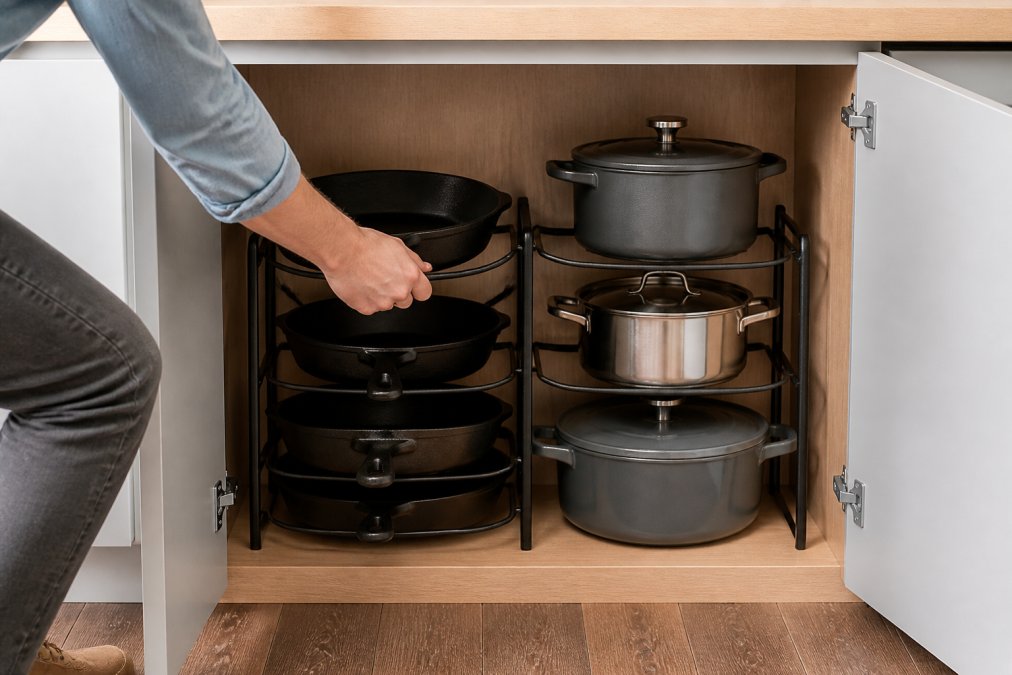
Sinkelle PanNest Adjustable Pot →
- The rail or shelf surface where pans slide on and off
- Weld joints and corners, where coating is thinnest and impact concentrates
- Mounting holes and brackets, where flexing works the finish loose
SinkElle Organizers Built for Heavy Cookware
SinkElle builds minimalist, Scandinavian-inspired organizers designed around real cabinet dimensions and real loads.
Installation Safety, Accessibility, and Long-Term Wear
Installation safety is about weight distribution, not just assembly. A heavy organizer concentrates load at its mounting points, so those points need solid cabinet material beneath them, otherwise the organizer that holds 100 pounds on paper pulls its screws out of a cabinet floor never built for the load.
Reinforcing the Cabinet Base for Heavy Loads
Most cabinet floors are thin particleboard, designed for dishes sitting still, not the concentrated, dynamic load of a pull-out rack full of cast iron. Pulling a loaded drawer adds leverage and vibration, which tears fasteners loose.
Before you load anything, check three things:
- Cabinet base thickness: thin panels need a reinforcing strip. A piece of 3/4-inch plywood cut to the cabinet footprint and screwed across the base spreads the load across a much larger area than the organizer's own mounting holes.
- Screw placement: drive fasteners into the cabinet base or a solid rail, not just a shelf that is only supported at its edges. Short screws into thin panels are the most common failure point.
- Clearance: confirm the organizer slides without hitting the cabinet frame, door hinges, or a face frame lip. A rack that binds will be yanked, and yanking multiplies the load on the fasteners.
Designing for Limited Mobility and Weak Grip
If you have arthritis, a bad back, or limited grip strength, a pull-out organizer changes the equation, but only if it is set up for your body, not just storage capacity.
- Keep the heaviest cookware between knee and shoulder height. Lifting a Dutch oven from a low shelf or down from an overhead cabinet is where strain and injury happen. The pull-out mechanism belongs on the cabinet you use daily, at a height where you can slide rather than lift.
- Full-extension slides matter more here than anywhere else. A rack that only pulls partway out forces you to reach into the back of the cabinet, which means bending and twisting under load. Full extension brings the pan to you.
- Soft-close is an accessibility feature, not a luxury. A loaded drawer that slams shut transmits shock through your hands and wrists. Soft-close absorbs that and keeps the rack from creeping open on its own.
- Large, smooth pulls are easier to grip than small knobs or recessed edges, especially with arthritic hands. Test the pull before you commit.
- Lighter individual pieces beat one heavy stack. If lifting a full rack is the problem, organize so each pan comes out on its own rather than lifting a nested pile.
Long-Term Wear: What to Inspect and When
Long-term wear shows up in three places: the slides, the coating, and the fasteners. Ball-bearing slides outlast roller slides under constant weight, though even good slides collect grit. Scratch-resistant coating keeps carbon steel from corroding where pans rub, and fasteners loosen over time.
- Tighten every mounting screw. Load and vibration work screws loose; a quarter-turn on each is often all it takes.
- Wipe and lubricate the slides with a dry silicone or PTFE lubricant, not oil, which attracts grit.
- Inspect the finish at contact points and touch up any exposed steel before rust spreads.
- Check for shelf sag by sighting along the front edge; a bowed shelf means the load needs to be redistributed or the base reinforced.
Frequently Asked Questions
How do you store heavy pots and pans in deep cabinets?
Deep cabinets swallow heavy cookware unless you create a pull-out layer. A heavy duty pull out pot organizer with ball-bearing slides brings the back of the cabinet to the front, so you are not lifting a 12-pound Dutch oven over stacked pans. Choose a unit with a stated drawer weight limit above your heaviest pot plus a margin, and keep the heaviest items on the bottom tier. SinkElle's PanNest Adjustable Pot Organizer uses carbon and stainless steel to support cast iron without sagging.
Can cabinet organizers support the weight of professional-grade cookware?
It depends on the hardware, not the shelf. A single 12-inch cast iron skillet can weigh 8 pounds, and a Dutch oven can exceed 15 pounds. Look for organizers rated for at least 25 pounds per shelf and built with load-bearing hardware like steel frames and full-extension glides. Wire racks and thin plastic bins bend under that load over time. SinkElle's PanNest Organizer is constructed from carbon steel and stainless steel for reliable support.
How do I prevent cabinet damage from heavy cookware storage?
Weight is the risk, not the cookware itself. A 40-pound stack of cast iron on a single cabinet shelf can bow the base over months. Distribute weight across multiple shelves, use a cabinet base reinforcement panel if your shelf is particleboard, and avoid dragging heavy pots across the surface. Pull-out organizers reduce friction damage because you slide the rack, not the pan. Also check that mounting hardware is anchored into cabinet framing, not just the thin back panel.
Are pull-out organizers better than vertical dividers for heavy pans?
For heavy cookware, pull-out organizers win. Vertical dividers work for baking sheets and light lids, but lifting a 15-pound Dutch oven out of a deep divided slot strains your wrists and risks dropping it. A heavy duty pull out pot organizer with full-extension glides lets you pull the entire load forward, then lift straight up. Dividers still help for lids and splatter guards. Many kitchens use both: dividers for flat items, pull-outs for the weight.