


Table of Contents
- Why Over the Sink Storage Transforms Your Kitchen
- Reclaim Counter Space with Over-the-Sink Organization
- Using Vertical Space More Effectively
- Over-the-Sink Dish Drying Racks: How They Work
- What to Store Above the Kitchen Sink
- Over-the-Sink vs. Countertop Dish Rack: Which Fits Your Kitchen
- Durability, Drainage, and Maintenance Trade-Offs
- Conclusion
- Frequently Asked Questions
Last Updated: October 20, 2026
Why Over the Sink Storage Transforms Your Kitchen
Over the sink storage is one of the most effective ways to reclaim kitchen real estate without renovations or expense. The vertical space directly above your sink is an area most kitchens leave completely empty.
The transformation is immediate. Instead of dishes stacked on the counter, sponges scattered around the basin, and cleaning supplies cluttering your workspace, everything has a designated home. Your sink area becomes a functional workstation rather than a catch-all for clutter.
At SinkElle, we've designed our over-sink storage solutions for exactly this: helping modern homeowners maximize their sink area without sacrificing the minimalist aesthetic they want.
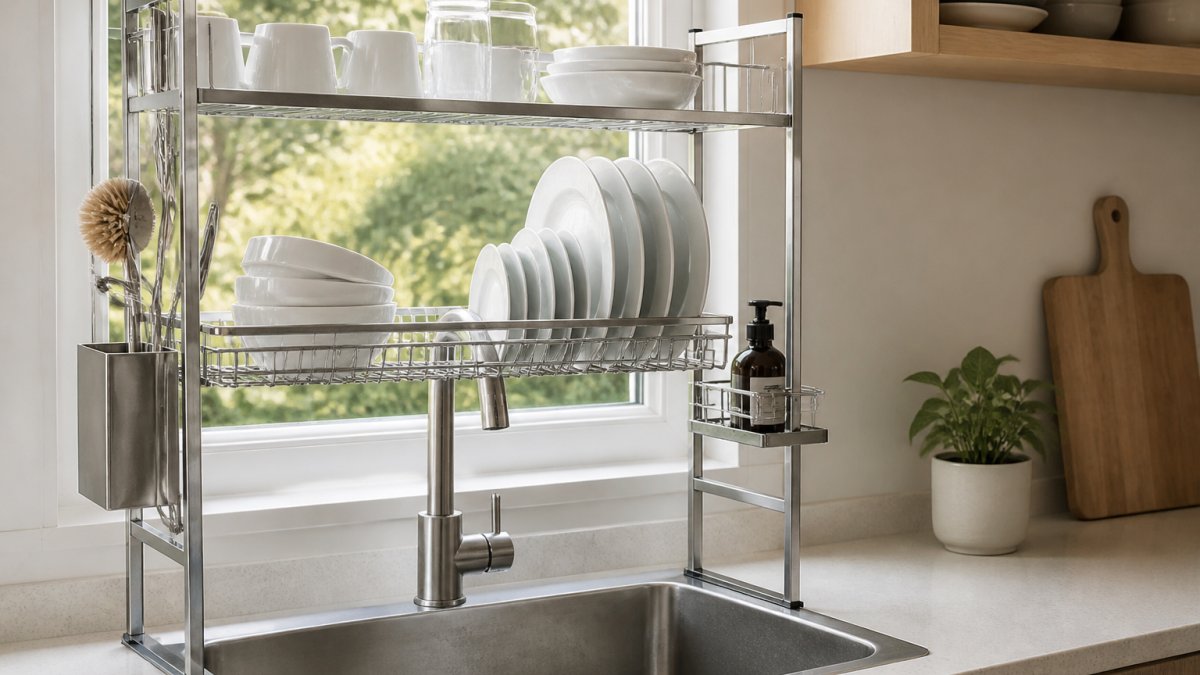
Reclaim Counter Space with Over-the-Sink Organization
Counter space is the currency of a functional kitchen, especially in urban apartments. Over-the-sink organization reclaims it by moving storage and drying functions vertical.
A dish drying rack, cleaning supplies, sponges, and soap dispensers often consume 1-2 square feet of prime counter real estate that could live above the sink.
Moving these items up opens your countertop for food prep or a cleaner visual landscape, making the kitchen feel larger and more inviting.
The Sinkelle ExtendDry Retractable Sink Rack at $24.99 is designed exactly for this purpose, it extends across your sink and holds dishes, produce, or small items, freeing up counter space while water drains directly into the basin. No puddles. No wet countertop. Just organized space.

Using Vertical Space More Effectively
Most kitchen organization advice focuses on cabinets and drawers, but vertical space above your sink is visible, accessible, and directly connected to where you work. Fit comes down to a handful of measurable dimensions.
Start with your sink bowl configuration. A single-bowl sink gives you one wide, unobstructed span, which suits a full-width retractable rack.
Check your faucet style and height. A high-arc gooseneck faucet can conflict with a rack that spans the sink, and pull-down sprayer heads need room for the hose to extend and retract.
Account for window placement. Tension rods and suction systems won't work against glass, so choose a freestanding bridge rack that rests on the sink rims.
Measure cabinet clearance. Upper cabinets above the sink limit how tall a rack can be.
Match the system to the layout, not the other way around. A retractable rack that spans the sink is the most flexible choice for single-bowl sinks with standard faucets. A rim-mounted bridge rack suits double-bowl sinks and window-above-sink layouts.
The real advantage of getting this right is workflow: when your dish drying rack, sponges, and cleaning supplies sit right at your sink, you skip hundreds of small trips across the kitchen each week.
For kitchens with limited counter depth, especially where the sink sits close to the stove, vertical storage becomes essential. Over-the-sink solutions let you build up without blocking your view, provided the dimensions match your sink.
Over-the-Sink Dish Drying Racks: How They Work
An over-the-sink dish drying rack sits directly over your sink basin, creating a dedicated surface for air-drying dishes. Water drains through the rack back into the sink instead of pooling under dishes or spreading across the counter.
Most designs use an open mesh or slatted surface that lets water pass through. Some are fixed; others retract for full sink access. The best promote ventilation around dishes, helping them dry faster and more completely.
The Sinkelle ExtendDry Retractable Sink Rack uses stainless steel construction with an adjustable design that fits different sink widths. Water flows through the open design directly into the basin, and you can remove or reposition the rack when you need full sink access.
Air-drying is gentler on dishes than heat-drying and uses zero energy, making an over-the-sink rack a practical, convenient choice for anyone concerned about sustainability.
What to Store Above the Kitchen Sink
The space above your sink works best for items you use frequently and that benefit from drainage or ventilation.
Cleaning supplies and tools are the primary candidates. Sponges, scrubbers, dish brushes, and cleaning cloths should be stored where water can drain away between uses, a closed cabinet traps moisture and promotes bacterial growth, while the open air above the sink solves this naturally.
Dishes and produce during preparation work well on an over-the-sink rack. After washing plates or rinsing vegetables, set them directly on the rack to drain, no dish towel or drying mat needed.
Sinkelle FlexiDrain Sink Caddy →
Small kitchen utensils that need to stay accessible, measuring spoons, small whisks, tongs, can live in a compact holder above the sink. The Sinkelle DryStand Utensil Holder at $31.99 provides multiple compartments for forks, spoons, chopsticks, and other tableware while allowing water to drain through.
Soap dispensers and hand soap fit naturally in the sink area. They're used right there, and the open air keeps them dry between uses.
Items that should NOT go above the sink: anything that deteriorates with moisture exposure, electronics, or items you rarely use. Keep paper products, packaged goods, and infrequently used tools elsewhere.
Over-the-Sink vs. Countertop Dish Rack: Which Fits Your Kitchen
Both over-the-sink racks and traditional countertop dish racks air-dry dishes, but they solve different space problems.
A countertop dish rack occupies counter space and can look cluttered, but it's portable, needs no installation, and works with any sink configuration, straightforward and effective where counter space is generous.
An over-the-sink rack uses vertical space instead, freeing your counter entirely and integrating into your workflow right at the sink. The trade-off: it requires clearance above the sink and may not work with a low ceiling or a high-extending faucet.
| Feature | Over-the-Sink Rack | Countertop Dish Rack |
|---|---|---|
| Counter space used | None | 1-2 square feet |
| Installation | Minimal or none | Just set it down |
| Accessibility | Very high | High |
| Sink compatibility | Requires clearance | Works with any sink |
| Visibility | Integrated into workspace | Visible clutter |
| Workflow efficiency | Excellent | Good |
| Best for | Small kitchens, clutter-free aesthetic | Generous counter space |
The Sinkelle DryFlow Dish Rack at $61.99 represents a middle ground, it's a premium countertop solution with stainless steel construction and an auto-draining system that prevents water from sitting under your dishes. If your kitchen has the counter space, this delivers the aesthetic and functionality of a high-end organization system.
For apartments or kitchens where counter space is genuinely scarce, an over-the-sink rack almost always wins. The space savings alone justify the investment.
Durability, Drainage, and Maintenance Trade-Offs
Not all over-the-sink storage is built the same. Material, drainage design, load capacity, and build quality determine how long your system lasts and whether it's safe to load with wet plates or a heavy cast-iron pan.
Material matters for longevity and load safety. Stainless steel resists rust, holds its shape under weight, and reliably handles heavy cookware without flexing. Coated metal is lighter and cheaper, but chips expose steel that then rusts. Plastic warps, cracks, and grows mold in seams.
Load capacity and stability are the safety story. Over-sink racks fail by bending or tipping. Bending is a material and gauge problem, so check the listed weight capacity and favor thicker stainless steel over thin wire.
Drainage design determines whether your system actually works. Solid surfaces or poor drainage trap water underneath dishes, defeating the purpose. The Sinkelle FlowRack Pro Caddy at $39.99 addresses this with a built-in spout that drains water directly into the basin, no standing water, no soggy sponges.

Installation method affects stability and maintenance. Suction-cup systems are tool-free and ideal for renters, but they're the least stable for heavy loads and lose grip as the cups age. Adjustable racks that span your sink need locking or tension features so they don't slide.
Hygiene is the trade-off nobody mentions. An open rack dries faster than a closed cabinet, but it also collects dust, grease splatter, and food residue.
Moisture resistance is non-negotiable. Every product should be explicitly designed for water exposure, not just tolerant of it. Premium materials and thoughtful drainage cost more upfront but save you from replacing a warped, moldy, or rusted system in a year.
Conclusion
Over-the-sink storage transforms your kitchen by solving two problems at once: it eliminates counter clutter and creates a more efficient workflow around the sink. Whether you have a tiny apartment kitchen or simply want a more organized space, vertical storage above the sink is one of the highest-impact changes you can make.
The key is choosing a system that fits your sink, faucet clearance, and daily routine. SinkElle's collection, from the compact FlexiDrain Sink Caddy at $24.99 to the premium DryFlow Dish Rack at $61.99, features tool-free installation, waterproof materials, and a minimalist Scandinavian aesthetic that turns organization into design. Get started with a SinkElle over-the-sink storage solution and experience how much cleaner and more functional your kitchen becomes.

Frequently Asked Questions
What are the main benefits of over-the-sink storage?
Over the sink storage reclaims valuable counter space by moving dishes, drying racks, and cleaning supplies vertically above your sink. It keeps your countertops clear and organized, improves workflow during dishwashing, and helps prevent water from pooling around your sink area. Products like the Sinkelle ExtendDry Retractable Sink Rack ($24.99) use adjustable designs that fit different sink sizes, while the FlowRack Pro Caddy ($39.99) includes drainage features that prevent soggy sponges and bacterial growth.
Does over-the-sink storage actually save counter space?
Yes, significantly. By using the vertical space directly above your sink instead of placing dish racks on your countertop, you free up 1-2 square feet of work surface. This matters especially in apartments or small kitchens where every inch counts. The Sinkelle FlexiDrain Sink Caddy ($24.99) stores sponges and cleaning supplies in a compact footprint, while retractable racks can be removed when not in use, giving you full sink access when needed.
Can over-the-sink storage fit in a small kitchen with tight plumbing?
It depends on your sink layout and faucet clearance. Over-the-sink racks work best on sinks with open space above them and adequate faucet height. If your under-sink area has a garbage disposal or unusual plumbing angles, countertop caddies like the FlowRack Pro Caddy (which sits beside your sink with a spout over the basin) may work better. Always measure your faucet clearance and sink dimensions before purchasing to ensure compatibility.
How do you keep an over-the-sink rack clean and prevent mold?
Choose products with open drainage designs and ventilation that prevent water from sitting around items. Stainless steel and waterproof silicone materials resist moisture buildup better than plastic. Wipe your rack dry after use, empty any water collection trays regularly, and ensure air can circulate around stored items. The Sinkelle DryFlow Splash Mat ($19.99) and AquaShield Faucet Guard ($17.99) use sloped designs and premium silicone to channel water directly into the sink, reducing the conditions where mold grows.